
Hangman Quiz
How the Scales are Structured
Who Usually Takes This Test?
See How You Compare
Below is a preview of how scores are typically distributed across each scale.
Example Questions From the Test
- GAME
- LATE
- WAVE
- CAPE
- The attempt counts as an incorrect guess
- The word setter must reveal one additional letter
- The hidden word is changed while retaining the same blanks
- The player loses all previously revealed letters
- LEMUR
- TIGER
- HERON
- ZEBRA
Hangman Quiz - Description and methodology of the test
People who want to play more thoughtfully can use this assessment to check their grasp of ordinary Hangman play, from choosing useful letters to interpreting partial word patterns. The hangman quiz is suited to casual players, hosts, and learners who want a clear snapshot of practical game knowledge. Its result can make later practice more focused. It works as an online hangman test for reviewing strengths before tackling unfamiliar situations.
What This Assessment Measures
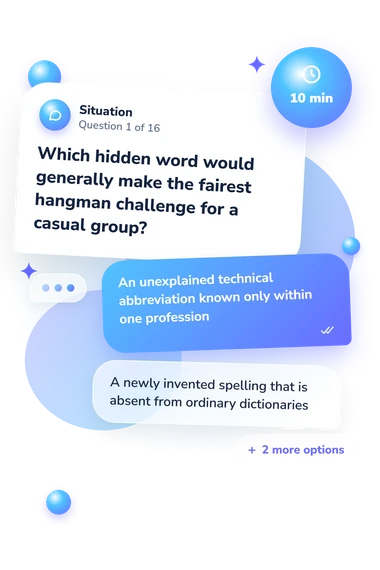
This assessment measures practical Hangman knowledge, not vocabulary breadth or general intelligence. Its situations cover fair word selection, incorrect guesses, repeated letters, visible spaces, whole-word attempts, and revealing an answer before mistakes run out.
The focus makes this test useful for targeted practice during a hangman game.
These are the practical dimensions reflected in the result:
- Rule handling shows how you understand misses, repeated guesses, spaces, and whole-word attempts.
- Letter strategy indicates how you judge vowels and common consonants before choosing a guess.
- Pattern solving reflects how you use visible positions and category clues to eliminate impossible words.
The displayed Hangman Knowledge scale runs from 0-16: Foundations (0-6) indicates basic recognition, Developing Solver (7-12) reflects usable tactics, and Strong Solver (13-16) indicates reliable command of rules, letter strategy, and pattern inference.
Methodology and Evidence Base
Each item presents a short scenario or rule question with four answer choices. Some ask for a direct consequence, such as what follows from an incorrect letter or whole-word attempt; others require eliminating options from a visible pattern. The format tests both recognition and application.
The score summarizes performance across the questionnaire and is presented as one bounded total rather than separate trait scores. The result is one total with catalogue-defined descriptive bands, not a demonstrated comparison with a reference population; it summarizes responses across rules, letter strategy, and pattern-solving items, while the bands guide practice.
Its evidence base is conceptual, not evidence that this online questionnaire reproduces a published instrument. Reams (2009) examines optimal play through letter choices and information gained from guesses, while Barbay and Subercaseaux (2020) address computational aspects of adversarial Hangman. These works support the relevance of strategy and pattern decisions; the present test remains a separate knowledge check.
Familiarity and attention at completion can affect performance, so the result is best read as a snapshot of Hangman knowledge rather than a prediction of live-game performance. Use this hangman rules quiz to identify which standard rules or solving tactics deserve further practice.
- Reams, Charles. "Playing Perfect Hangman." ICGA Journal 32, no. 3 (2009): 149-153. 10.3233/ICG-2009-32304.
- Barbay, Jérémy, and Bernardo Subercaseaux. "The Computational Complexity of Evil Hangman." In 10th International Conference on Fun with Algorithms (FUN 2021), Leibniz International Proceedings in Informatics (LIPIcs), vol. 157, article 23, pp. 23:1-23:12. Schloss Dagstuhl-Leibniz-Zentrum für Informatik, 2020. 10.4230/LIPIcs.FUN.2021.23.