
Hobbit Character Quiz
How the Scales are Structured
Who Usually Takes This Test?
See How You Compare
Below is a preview of how scores are typically distributed across each scale.
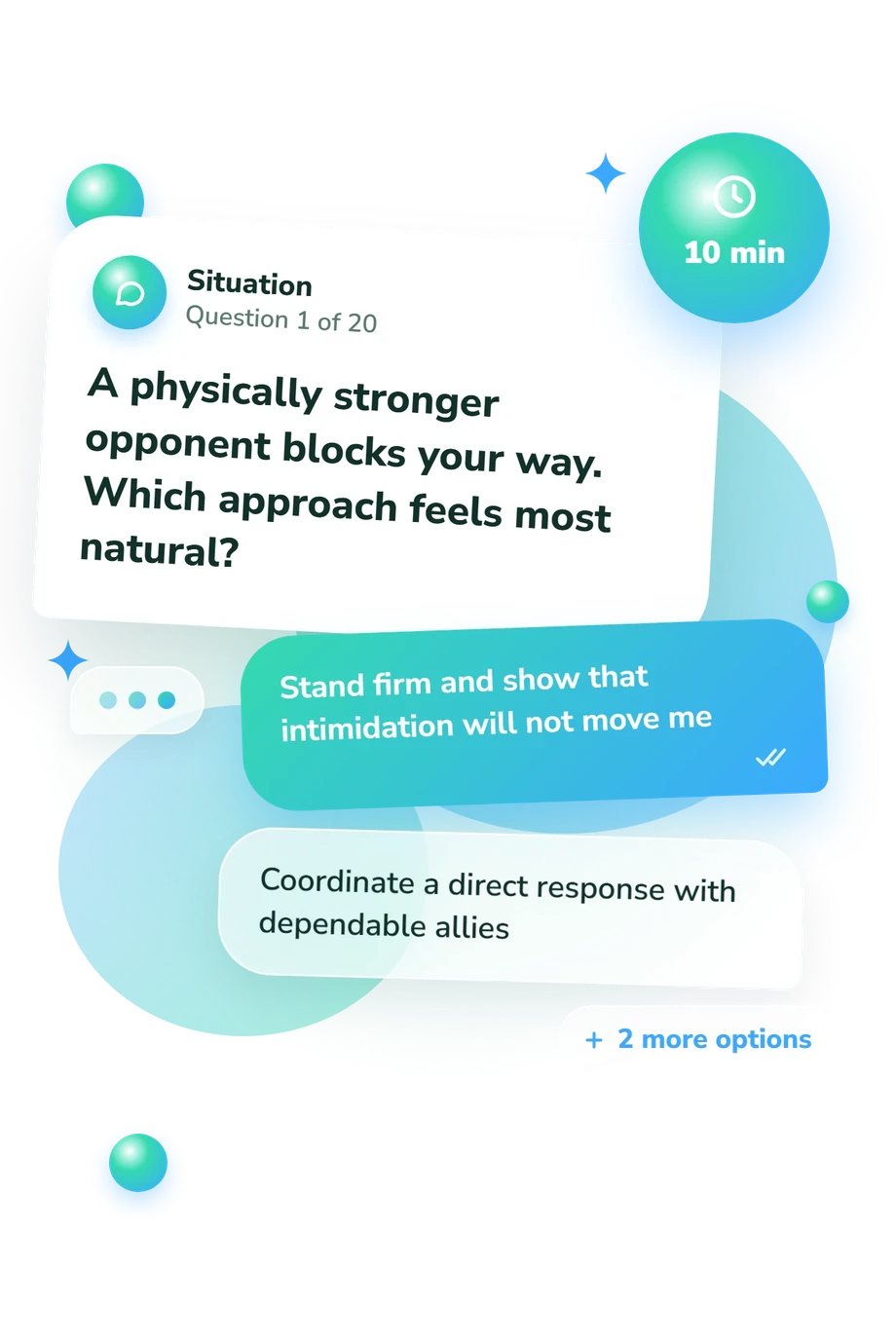
Example Questions From the Test
- Stand firm and show that intimidation will not move me
- Coordinate a direct response with dependable allies
- Look for a bargain that gives both sides something useful
- Use wordplay, observation, and improvisation to outthink them
- A new journey with an entirely different challenge
- A respected role that lets me influence important decisions
- Time to record and share everything I discovered
- A peaceful home, a thriving garden, and a meal with loved ones
- A lively gathering that helps life feel familiar again
- A useful project that restores an everyday rhythm
- A new challenge that turns the change into forward motion
- Quiet reflection and the company of a few people who understand
Hobbit Character Quiz - Description and methodology of the test
Readers who enjoy Tolkien’s characters can use this assessment to reflect on how they approach uncertainty, friendship, responsibility, and adventure. The hobbit character quiz suits anyone who wants a playful comparison grounded in recognizable choices rather than plot knowledge alone. As a Tolkien character quiz, it offers a literary self-reflection exercise for people curious about which character qualities feel familiar, without requiring detailed recall of the stories.
What This Assessment Explores
Situations involving pressure, travel, friendship, mistakes, leadership, mercy, and care reveal the patterns being compared. The Hobbit personality test turns them into five character affinities rather than one fixed type. The five result dimensions are:
- Bilbo Baggins (0-12) measures curious independence and ingenuity: Home-Centered (0-4), Curious Storyteller (5-8), or Unexpected Adventurer (9-12).
- Frodo Baggins (0-12) measures reflective courage and responsibility: Different Road (0-4), Quiet Resolve (5-8), or Steadfast Bearer (9-12).
- Meriadoc “Merry” Brandybuck (0-12) measures sociability and initiative: Flexible Participant (0-4), Clever Organizer (5-8), or Bold Strategist (9-12).
- Peregrin “Pippin” Took (0-12) measures spontaneous curiosity and growth: Measured Explorer (0-4), Bright-Hearted Companion (5-8), or Spirited Took (9-12).
- Samwise Gamgee (0-12) measures practical loyalty and care: Independent Supporter (0-4), Dependable Companion (5-8), or Faithful Gardener (9-12).
The highest score shows your strongest affinity; scores within one point suggest a blend.
Methodology and Evidence Base
Each item presents a brief situation with four response options. The scenarios address pressure, unfamiliar places, friendship, mistakes, authority, moral choice, group planning, and care. Choosing the most natural response compares preferences rather than factual knowledge or literary recall.
The scoring screen presents five separate affinity totals. The highest total identifies the strongest resonance, while totals within one point indicate a blend. Bands label each range; they do not create one overall type, and options are not right or wrong. As a Hobbit character test, it works best when answers reflect ordinary tendencies rather than an idealized self-image.
Olson (2018) offers a relevant lens on Frodo’s burden, external support, and persistence. Kullmann and Siepmann’s discussion of point of view helps explain the profiles’ different ways of seeing and acting, while Tolkien’s novels provide literary context. The questionnaire is conceptually consistent with these sources, not an adaptation of either academic discussion.
No population norms, reliability estimates, or clinical cutoffs are stated. Self-report results may shift with mood, circumstances, and self-perception, so the profile is best used as a focused reflection prompt rather than formal psychological measurement.
- Olson, Carl P. “A Cloud of Witnesses: External Mediation in Frodo’s Journey to Rivendell and Beyond.” Mythlore: A Journal of J.R.R. Tolkien, C.S. Lewis, Charles Williams, and Mythopoeic Literature, vol. 37, no. 1 (133), 2018, pp. 119-132.
- Kullmann, Thomas, and Dirk Siepmann. “Points of View.” In Tolkien as a Literary Artist, pp. 89-127. Palgrave Macmillan, 2021. 10.1007/978-3-030-69299-5_4.
- Tolkien, J. R. R. The Hobbit. George Allen & Unwin, 1937.
- Tolkien, J. R. R. The Lord of the Rings. George Allen & Unwin, 1954-1955.
Updated: