
Identifying Verbs Quiz
How the Scales are Structured
Who Usually Takes This Test?
See How You Compare
Below is a preview of how scores are typically distributed across each scale.
Example Questions From the Test
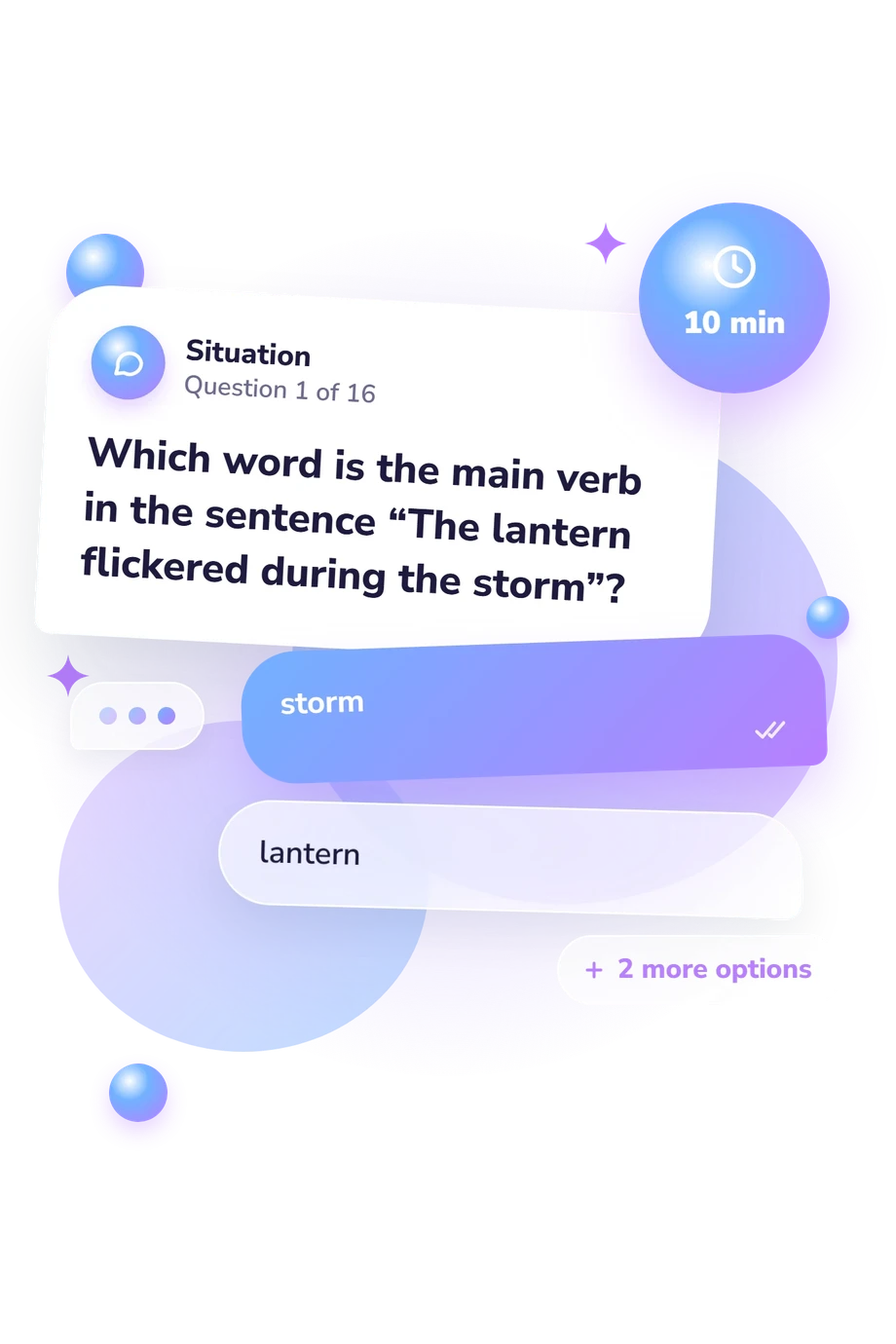
- storm
- lantern
- during
- flickered
- she arrive
- shall lunch
- arrive after
- will arrive
- The fabric feels soft.
- The dog smelled the parcel carefully.
- Nora felt the fabric with her fingertips.
- Leo tasted the sauce before dinner.
Identifying Verbs Quiz - Description and methodology of the test
Students, teachers, and independent learners who want to sharpen sentence analysis can use this identifying verbs quiz to check a specific grammar skill rather than a broad measure of English ability. It is useful as a subject verb identification quiz when you are unsure how to locate a verb, follow a complete verb phrase, or distinguish a verb from a nearby noun or modifier. It provides a focused starting point for subject-verb identification and grammar review.
What This Assessment Explores
The assessment examines verb function in sentence structure. Items identify main, helping, and linking verbs and recognize complete verb phrases, while also distinguishing verbs from subjects, modifiers, and verb-like nouns. Context matters because one spelling can be a noun in one sentence and a verb in another.
Because it also provides verb identification practice, the result emphasizes these areas:
- Main verbs show whether you can locate the clause's central verb.
- Complete verb phrases show whether you recognize the full phrase, including helping verbs.
- Verb types show how you separate action, linking, and helping uses.
- Sentence roles show whether you distinguish verbs from subjects and modifiers.
The result is Identifying Verbs Knowledge, scored from 0-16: Foundation Building (0-6) requires review; Developing Accuracy (7-12) reflects growing control; Strong Identification (13-16) reflects consistent recognition across contexts. The score describes quiz performance, not overall language ability.
Methodology and Scientific Basis
Each item uses a four-option selected-response format and asks you to select the word, phrase, or pair that identifies the requested feature in a sentence or sentence set. The prompts cover tense, contractions, complete verb phrases, subject-verb relationships, and changes in grammatical function.
Results are interpreted through the displayed performance band, giving a snapshot of accuracy on the constructions. It can guide review of auxiliary combinations, tense forms, complete verb phrases, and subject-verb relationships without extending the result to overall language ability.
Its framework is conceptually consistent with Huddleston, Pullum, and Reynolds (2022), alongside the broader descriptive account in Huddleston and Pullum (2002). These references support distinctions involving clauses, verb phrases, auxiliaries, and grammatical functions; the quiz uses grammatical distinctions also described in these books.
Interpretation should treat this grammar skills assessment as a focused record of performance on the quiz items. Performance may vary with attention, prior instruction, familiarity with sentence patterns, and care when reading options. Use the result to choose review topics, then test those skills in writing and sentence analysis.
- Huddleston, Rodney, Geoffrey K. Pullum, and Brett Reynolds. A Student’s Introduction to English Grammar. 2nd ed. Cambridge University Press, 2022. 10.1017/9781009085748.
- Huddleston, Rodney, and Geoffrey K. Pullum. The Cambridge Grammar of the English Language. Cambridge University Press, 2002. 10.1017/9781316423530.
Updated: