
Indian Road Safety Quiz
How the Scales are Structured
Who Usually Takes This Test?
See How You Compare
Below is a preview of how scores are typically distributed across each scale.
Example Questions From the Test
- Accelerate so you enter before red appears
- Continue at the same speed because amber gives priority
- Stop before the line if you can do so safely
- Sound the horn and proceed through the junction
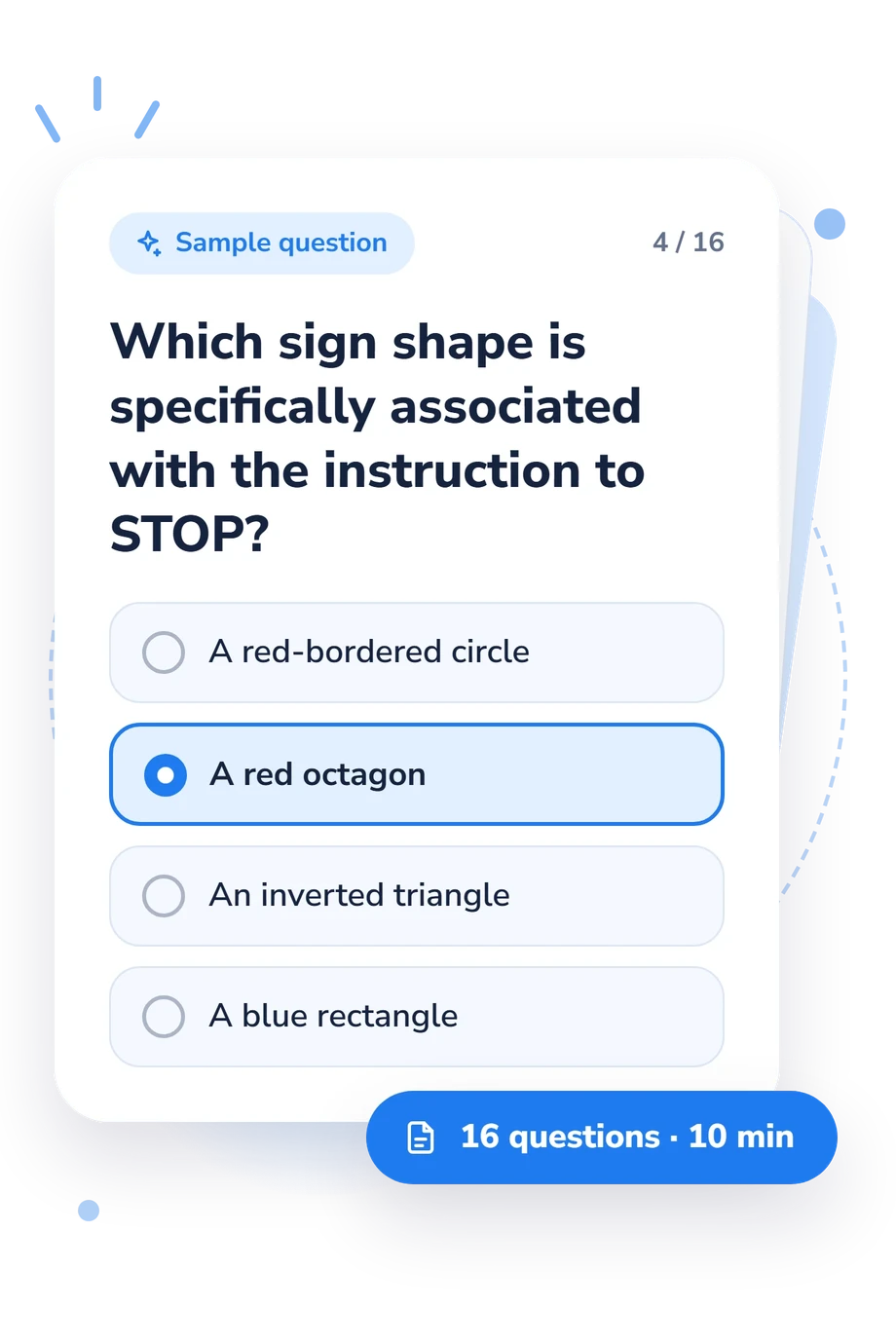
- A red-bordered circle
- A red octagon
- An inverted triangle
- A blue rectangle
- Only the driver needs a belt on urban roads
- Occupants should use the seat belts provided for their seats
- Rear passengers need belts only on expressways
- Belts are unnecessary when the vehicle has airbags
Indian Road Safety Quiz - Description and methodology of the test
Drivers, learners, and anyone revising everyday traffic rules can use this assessment to check practical knowledge before it is needed on the road. The Indian Road Safety Quiz Questions and Answers focus on signs, priorities, emergency responses, and safer choices in common Indian traffic situations. As a road safety quiz for India, it helps identify rules worth revisiting rather than measuring driving ability itself.
What This Assessment Explores
The questions examine practical recognition of Indian traffic rules in situations that demand a clear next action. They cover learner identification, signs and markings, overtaking and lane position, seat belts, emergency vehicles, mobile-phone use, pedestrians, roundabouts, poor visibility, railway crossings, and loss of tyre grip. Its practical Indian traffic-rule scenarios make the assessment useful for drivers, learners, and anyone refreshing safety habits.
The result contains one educational scale, Indian Road Safety Knowledge (0-16), which counts correct answers rather than estimating driving skill. Its displayed bands are:
- Foundations to build (0-6) indicates that signs, priority rules, and hazard responses need structured review.
- Developing knowledge (7-12) shows that many essentials are recognised, while some gaps remain.
- Strong knowledge (13-16) reflects a solid grasp of the principles covered by the questionnaire.
Methodology and Evidence Base
Each item presents a short road scene or rule-based problem with four answer choices. The respondent selects the option that best matches lawful, safer conduct, and the total counts correct answers. This is a scenario-based knowledge assessment, not a measure of reaction time, vehicle control, or behaviour under pressure.
Its content is conceptually consistent with the Motor Vehicles (Driving) Regulations, 2017, which provide the regulatory reference for signs, road position, signals, safety equipment, and responses around vulnerable road users. It also connects with the knowledge-and-practice focus examined by Jothula and Sreeharshika (2021) and D’Costa and colleagues (2020). The questionnaire is conceptually consistent with these studies but is not an adaptation of either one, and their findings do not validate its score.
The road safety questions and answers in this assessment can show which topics deserve review, but a strong result does not prove that every rule will be applied in traffic. The score is an unvalidated educational score and is not an official licence result. Rules and conditions change, so follow current signs and transport-authority guidance; written questions cannot capture hazards.
- Ministry of Road Transport and Highways, Government of India. Motor Vehicles (Driving) Regulations, 2017. Gazette of India, Extraordinary, Part II, Section 3, Sub-section (i), No. 525, 23 June 2017, G.S.R. 634(E).
- Jothula, Kishore Yadav, and D. Sreeharshika. "Knowledge, attitude, and practice toward road safety regulations among college students in Telangana state." Journal of Education and Health Promotion, 10, 25 (2021). 10.4103/jehp.jehp_442_20.
- D'Costa, Reema Shalet, Relina Joeline Fernandes, Remain Phawa, and Rishai Bareh. "A study on knowledge and self-reported practices towards road safety regulations among university students in selected college in Mangaluru." Manipal Journal of Nursing and Health Sciences, 6(1) (2020).
Updated: