
Indeed Quiz Results
How the Scales are Structured
Who Usually Takes This Test?
See How You Compare
Below is a preview of how scores are typically distributed across each scale.
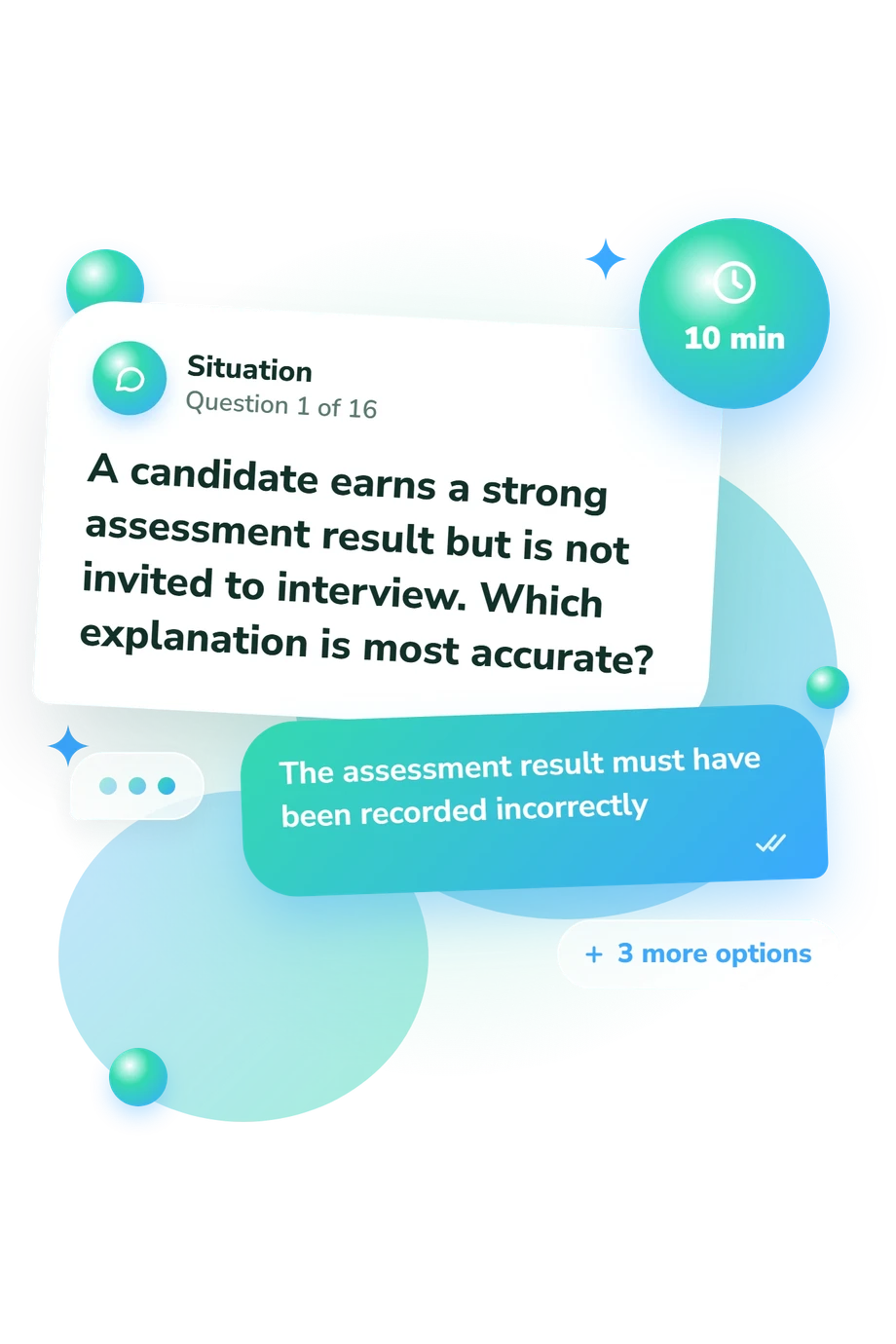
Example Questions From the Test
- The assessment result must have been recorded incorrectly
- Strong results are considered only after an interview
- Assessment results have no role in screening decisions
- Hiring decisions can also depend on experience, application fit, availability, and employer criteria
- One additional piece of evidence about the particular skill sampled by the assessment
- Confirmation that the lower scorer falsified the resume
- A complete substitute for interviews and work samples
- Proof that the higher scorer will perform better in every part of the job
- A percentile counts unanswered questions, while percentage correct counts only attempted questions
- A percentile compares performance with a reference group, while percentage correct reflects the share of scored items answered correctly
- A percentile is always employer-assigned, while percentage correct is always platform-assigned
- A percentile measures work experience, while percentage correct measures education
Indeed Quiz Results - Description and methodology of the test
Job seekers who want to judge hiring-assessment information in context can use Indeed Quiz Results as a focused knowledge check. It is intended for people reviewing an employment application, comparing evidence across a hiring process, or deciding what a result does and does not establish. The questions emphasize practical interpretation of Indeed assessment results rather than personal employability or a prediction of hiring success.
What This Assessment Explores
At its core, the questionnaire tests whether a respondent can treat an assessment as one piece of role-relevant evidence rather than a verdict. The items cover percentile rank versus percentage-correct scores, reliability, the limits of a strong result, and the importance of matching sampled skills to actual job duties. They also address deadlines, retakes, accessibility, technical interruptions, suspicious links, and result visibility.
The displayed Knowledge scale summarizes one overall result:
- A score of 0-16 falls into Foundations to build (0-6), Developing knowledge (7-12), or Strong knowledge (13-16), indicating respectively a need to review basic concepts, growing understanding with possible gaps, or strong interpretation of assessment evidence and its limits.
This is a knowledge summary, not a personality profile or forecast. For readers comparing indeed quiz scores, ask whether the result reflects sound reasoning about relevance, process, and evidence.
Methodology and Scientific Basis
Each item presents a practical scenario with four answer options. The score combines performance across the 16 items into one unofficial knowledge summary; it does not produce trait scores or a hiring prediction. Topics include evidence, procedures, measurement terms, access, and security.
SIOP Principles (Tippins et al., 2018) provides the closest framework for reading these topics: selection evidence should be job-related, appropriately interpreted, and considered with other information. Schmidt and Hunter (1998) likewise supports treating assessment performance as one source of evidence rather than a guarantee. This questionnaire is conceptually consistent with those works, not an adaptation of either instrument.
The AERA, APA, and NCME standards explain why reliability, validity, fairness, and accessibility require evidence rather than assumption. Noble, Foster, and Craig (2021) is relevant to questions about transparency, access, and procedural fairness in automated screening. When interpreting employment assessment scores, treat this result as an educational snapshot. Because this questionnaire is not standardized or validated as a hiring measure, responses can vary with familiarity, attention, and current circumstances; employer and platform instructions take priority.
- Tippins, N. T., Sackett, P. R., Oswald, F. L., et al. (2018). Principles for the Validation and Use of Personnel Selection Procedures. Industrial and Organizational Psychology, 11(S1), 1-97. 10.1017/iop.2018.195
- Schmidt, F. L., and Hunter, J. E. (1998). The Validity and Utility of Selection Methods in Personnel Psychology: Practical and Theoretical Implications of 85 Years of Research Findings. Psychological Bulletin, 124(2), 262-274. 10.1037/0033-2909.124.2.262
- American Educational Research Association, American Psychological Association, and National Council on Measurement in Education. (2014). Standards for Educational and Psychological Testing. American Educational Research Association.
- Noble, S. M., Foster, L. L., and Craig, S. B. (2021). The Procedural and Interpersonal Justice of Automated Application and Resume Screening. International Journal of Selection and Assessment, 29, 139-153. 10.1111/ijsa.12320
Updated: