
Observation and Inference Quiz
How the Scales are Structured
Who Usually Takes This Test?
See How You Compare
Below is a preview of how scores are typically distributed across each scale.
Example Questions From the Test
- An animal may have opened or disturbed the container
- The trash container is open
- Several pieces of trash are on the ground
- The prints are visible in the mud
- A prediction about what will happen in the future
- An explanation proposed before any evidence is collected
- Information noticed or measured through the senses or tools
- A general rule that applies to every similar situation
- The fabric feels rough
- The liquid looks cloudy
- The container holds 250 milliliters of liquid
- The metal probably contains iron
Observation and Inference Quiz - Description and methodology of the test
People who want to sharpen their handling of evidence can use the Observation and Inference Quiz to decide whether they need more practice with a basic reasoning distinction. It suits learners, educators, and adults who want a focused learning check. As an observation-and-inference quiz, it can help them choose between reviewing direct evidence and explanations or practising more nuanced cases.
What This Assessment Explores
At its core, the assessment tests whether respondents can separate direct evidence from the explanation built around it. Situations ask respondents to identify what was seen or measured, distinguish it from a conclusion, and judge whether an inference fits.
That distinction makes the test useful for checking observation and inference skills in classroom situations.
The question themes form components that contribute to the single knowledge result:
- Direct evidence is separated from explanations by identifying what was seen or measured.
- Warranted inferences are evaluated by whether conclusions fit the available observations.
- Revision is recognized when new evidence should change an earlier judgment.
These components contribute to the Observation and Inference Knowledge scale, scored from 0-16. Foundational (0-6) reflects partial recognition; Developing (7-12) reflects accurate distinctions with gaps in nuanced cases; Strong (13-16) reflects consistent identification, evaluation, and revision.
Methodology and Scientific Basis
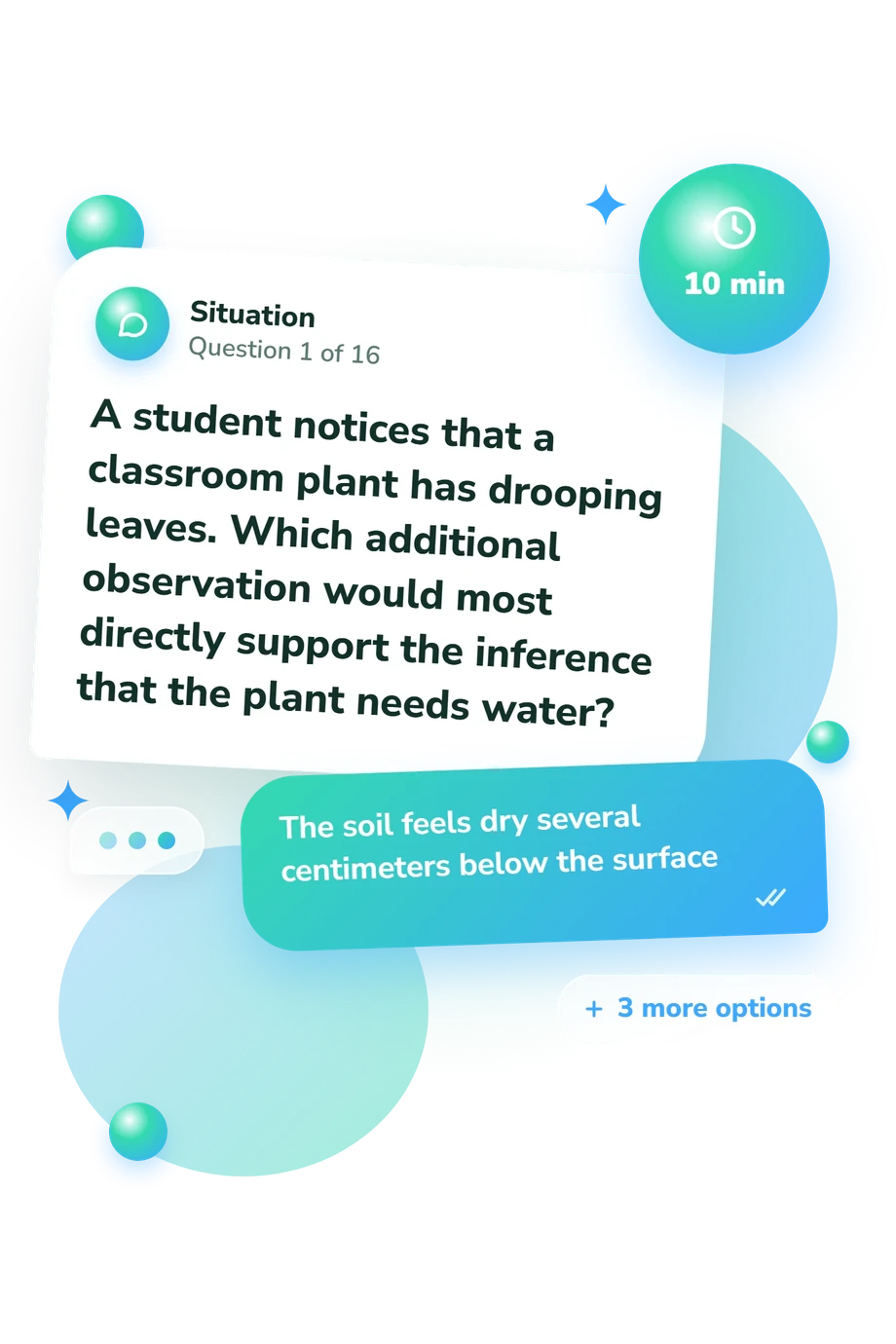
Each item presents a situation, measurement, or definition with four answer choices. The respondent selects the option that best matches the evidence: a direct observation, a justified inference, or an appropriate response to new information. This makes the observation and inference test a multiple-choice exercise.
Performance is reported through the displayed knowledge result. It describes application of the distinction in these situations, not reasoning ability across every context.
Cansiz and Cansiz (2018) provide the closest supporting study, examining how observation and inference skills can be taught. Suzuki (2015) treats the distinction as part of science learning, while Eberbach and Crowley (2017) show that observing involves attention, not merely seeing. The questionnaire is conceptually consistent with these works, not an adaptation of them.
The cited studies support the framework but do not establish standardization for this online version, so the displayed bands are catalogue-defined ranges rather than population norms. Attention, prior instruction, and interpretation of wording can affect performance, making the result a snapshot of the skills tested.
- Cansiz, Nurcan, and Mustafa Cansiz. “Enhancing Preservice Teachers’ Observation and Inference Skills.” Inonu University Journal of the Faculty of Education, vol. 19, no. 3, 2018, pp. 362-373. 10.17679/inuefd.335762
- Suzuki, Hiroaki. “Instructional Approach of the ‘Nature of Science’ in American Science Textbooks: Focusing on the ‘Distinction between Observation and Inference’.” Journal of Research in Science Education, vol. 56, no. 2, 2015, pp. 173-181. 10.11639/sjst.14049
- Eberbach, Catherine, and Kevin Crowley. “From Seeing to Observing: How Parents and Children Learn to See Science in a Botanical Garden.” The Journal of the Learning Sciences, vol. 26, no. 4, 2017, pp. 608-642. 10.1080/10508406.2017.1308867
Updated: