
Which NHL Player Are You Quiz
How the Scales are Structured
Who Usually Takes This Test?
See How You Compare
Below is a preview of how scores are typically distributed across each scale.
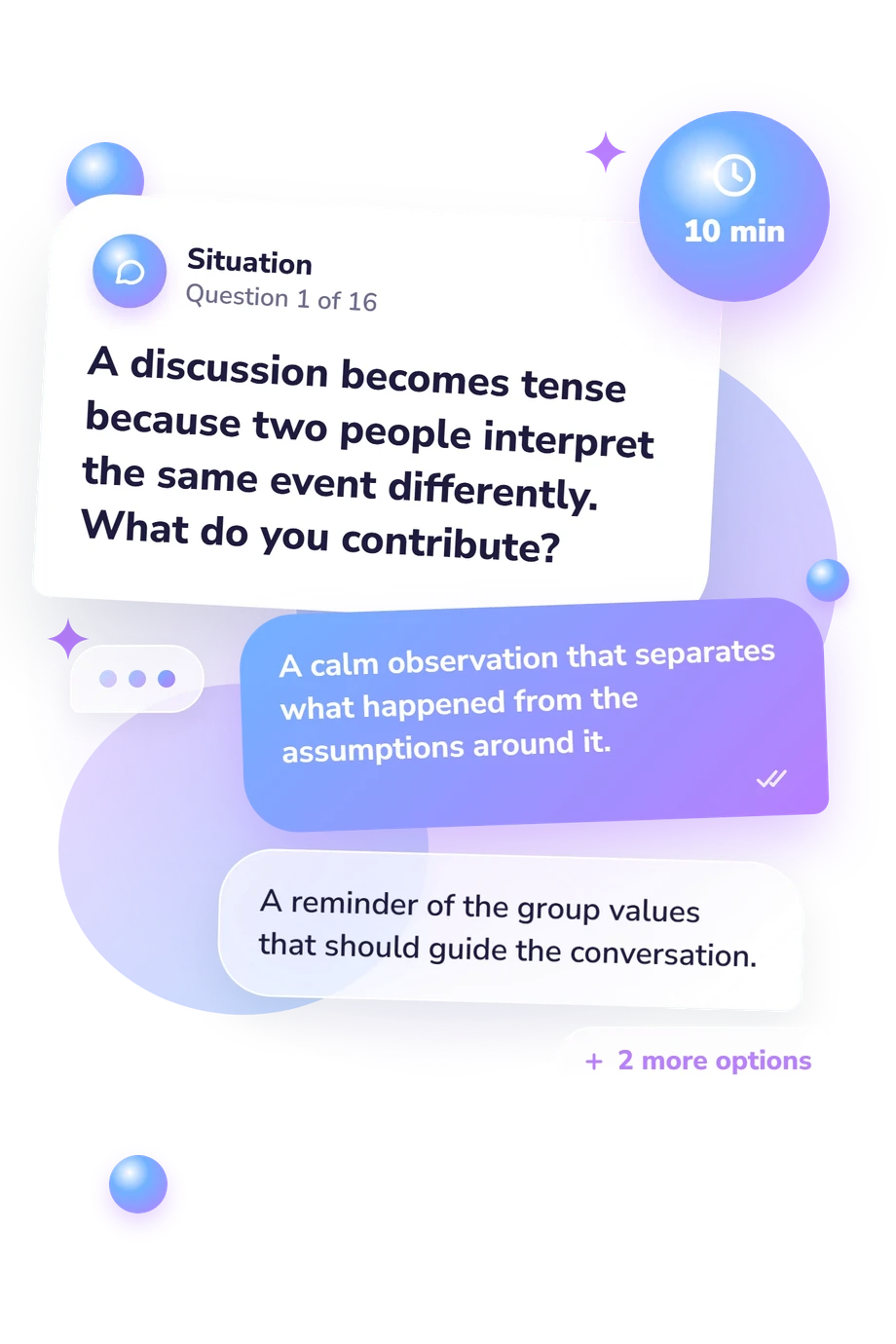
Example Questions From the Test
- A calm observation that separates what happened from the assumptions around it.
- A reminder of the group values that should guide the conversation.
- A direct opinion so the discussion has a clear position to address.
- A reframing that helps both people see the issue from a new angle.
- One with clear traditions and a group standard to uphold.
- One that prizes efficient ideas and thoughtful refinement.
- One that offers structure but leaves room for occasional experiments.
- One where distinctive ideas and confident personal expression are rewarded.
- Understand the system, experiment carefully, and make each movement more efficient.
- Repeat the basic technique until it becomes completely dependable.
- Attempt it at full pace and learn by responding to immediate feedback.
- Personalize the technique early so it feels engaging and original.
Which NHL Player Are You Quiz - Description and methodology of the test
Readers curious about how they handle pressure, decisions, practice, leadership, and teamwork can use NHL Quiz Which Player Are You to organize those instincts. By asking what hockey player you are in varied situations, the quiz invites comparison of choices rather than knowledge of the sport. Its result offers a light framework for noticing how you respond when momentum, standards, or group needs compete.
What the Questionnaire Measures
The questionnaire maps situational preferences onto four public player-inspired profiles. Questions place the respondent in social, performance, and team situations. The resulting hockey personality quiz profile shows familiar tendencies rather than a complete likeness or judgment of ability.
These dimensions show the displayed results:
- Auston Matthews Affinity (0-12) measures expressive confidence: Understated Approach (0-4), Selective Flair (5-8), and Matthews-Style Match (9-12) move from low-key focus to bold originality.
- Cale Makar Affinity (0-12) measures composure and adjustment: Higher-Impact Style (0-4), Composed Adapter (5-8), and Makar-Style Match (9-12) move from force to fluid problem-solving.
- Connor McDavid Affinity (0-12) measures momentum: Different Tempo (0-4), Speed-Minded Overlap (5-8), and McDavid-Style Match (9-12) move from other priorities to intense initiative.
- Sidney Crosby Affinity (0-12) measures team-first consistency: Independent Route (0-4), Reliable Teammate (5-8), and Crosby-Style Match (9-12) move from individual expression to shared achievement.
Methodology and Scientific Basis
Each item is situational self-report: four choices present instincts, and respondents select an option that feels applicable. Scenarios cover tension, creative work, learning, pressure, decisions, practice, recognition, and coordination rather than hockey knowledge.
Answers produce four separate affinity scores, allowing the profiles to be viewed together. Displayed ranges do not document an item-weighting or point-per-answer rule, so the bands should be read as the reporting format rather than reverse-engineered into a formula.
The interpretive frame is conceptually consistent with research by Kim and colleagues linking personality characteristics to informal roles in interdependent sport teams. Work by Bucci and colleagues on ice-hockey leadership, alongside research by Loughead, Hardy, and Eys on athlete leadership, offers a frame. These themes contextualize initiative, composure, cooperation, and shared standards; the quiz is an original online self-reflection questionnaire, not a validation study or source instrument.
Results are organized through the displayed affinity bands, which give descriptive style ranges rather than clinical thresholds for this NHL player quiz. Mood, self-presentation, and imagined situations can influence answers, making the outcome suited to structured reflection on a public-player-inspired style.
- Kim, J., Gardant, D., Bosselut, G., & Eys, M. (2018). Athlete personality characteristics and informal role occupancy in interdependent sport teams. Psychology of Sport and Exercise, 39, 193-203. 10.1016/j.psychsport.2018.07.011
- Bucci, J., Bloom, G. A., Loughead, T. M., & Caron, J. G. (2012). Ice Hockey Coaches’ Perceptions of Athlete Leadership. Journal of Applied Sport Psychology, 24(3), 243-259. 10.1080/10413200.2011.636416
- Loughead, T. M., Hardy, J., & Eys, M. A. (2006). The nature of athlete leadership. Journal of Sport Behavior, 29(2), 142-158.
Updated: