
Music Appreciation Listening Quiz
How the Scales are Structured
Who Usually Takes This Test?
See How You Compare
Below is a preview of how scores are typically distributed across each scale.
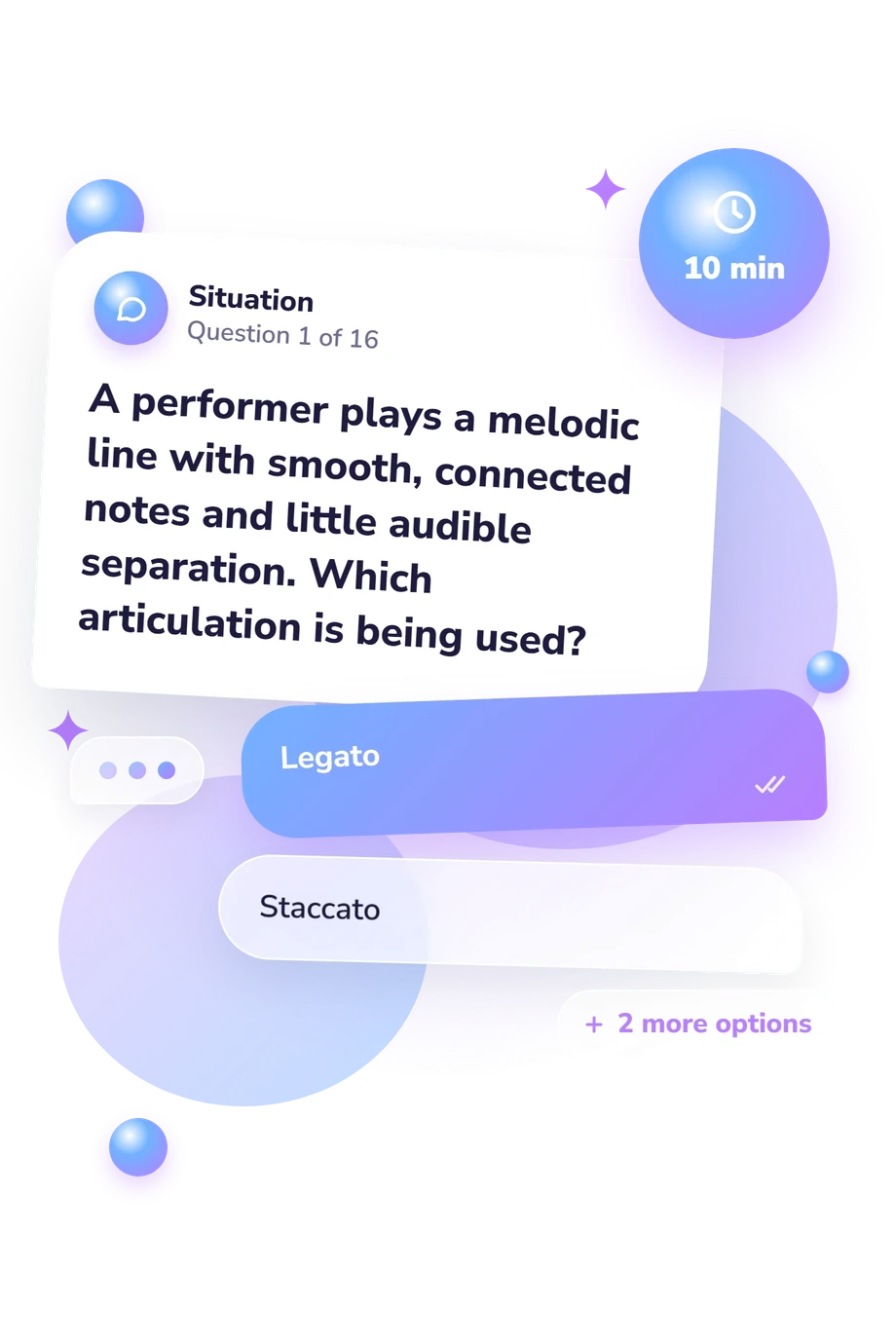
Example Questions From the Test
- Legato
- Staccato
- Marcato
- Tenuto
- Monophonic
- Heterophonic
- Polyphonic
- Homophonic
- A sequence
- A drone
- An ostinato
- A cadence
Music Appreciation Listening Quiz - Description and methodology of the test
Listeners who want a clearer grasp of musical vocabulary can use this assessment to connect classroom terms with what they hear. The music appreciation listening quiz answers reveal which foundational concepts a respondent recognizes in listening situations. It is suited to students, hobbyists, and curious listeners seeking a structured check of musical knowledge. As a listening quiz music appreciation learners can use, it examines terminology and attentive listening concepts.
What This Assessment Explores
The questions ask whether a listener can connect audible events with standard terms, not merely recall isolated definitions. The music appreciation listening quiz answers reveal which foundational concepts a respondent recognizes in listening situations.
The main thematic groups are:
- Musical elements show whether you can identify melody, timbre, dynamics, tempo, and meter from descriptions of sound.
- Texture and technique show whether you can distinguish how lines combine and how performers produce or organize sounds.
- Form, rhythm, and harmony show whether you recognize recurring structures, syncopation, ostinatos, cadences, and related cues.
The single reported scale, Music Appreciation Listening Knowledge (0-16), appears as Foundations to build (0-6), Developing listener (7-12), or Accomplished listener (13-16). A higher result indicates stronger command of the concepts represented in the items. Use this music appreciation listening test to decide whether to revisit terminology, listen for structural cues, or move toward more advanced theory study.
Methodology and Scientific Basis
Each item presents a brief musical situation or definition with four answer choices. The respondent chooses one option rather than composing an explanation. The four-choice format makes this music listening quiz a recognition exercise: the respondent selects the term that best matches an articulation, texture, form, rhythmic pattern, harmonic movement, or expressive change. The questionnaire presents one knowledge result, and its meaning stays focused on the concepts represented by the items rather than every musical ability.
Conceptually, this questionnaire is consistent with Omar et al. (2010), who examined how music knowledge can be organized into distinguishable conceptual domains. Its vocabulary also aligns with College Board (2026) instructional expectations for foundational theory. Law and Zentner (2012) provide related context for separating musical perception abilities, but this questionnaire is not an adaptation of their instrument.
This version has no reported norms, reliability estimates, or validation results. Prior study, attention, guessing, and terminology familiarity can affect performance; the result is a focused snapshot of concept knowledge, not a measure of musicianship, enjoyment, or instrumental skill.
- Omar, Rohani, Julia C. Hailstone, Jane E. Warren, Sebastian J. Crutch, and Jason D. Warren. “The Cognitive Organization of Music Knowledge: A Clinical Analysis.” Brain 133, no. 4 (2010): 1200-1213. 10.1093/brain/awp345
- College Board. AP Music Theory Course and Exam Description, Effective Fall 2026. New York, NY: College Board, 2026.
- Law, Lily N. C., and Marcel Zentner. “Assessing Musical Abilities Objectively: Construction and Validation of the Profile of Music Perception Skills.” PLOS ONE 7, no. 12 (2012): e52508. 10.1371/journal.pone.0052508
Updated: