
New Zealand Pub Quiz
How the Scales are Structured
Who Usually Takes This Test?
See How You Compare
Below is a preview of how scores are typically distributed across each scale.
Example Questions From the Test
- Takahē
- Kiwi
- Kākāpō
- Weka
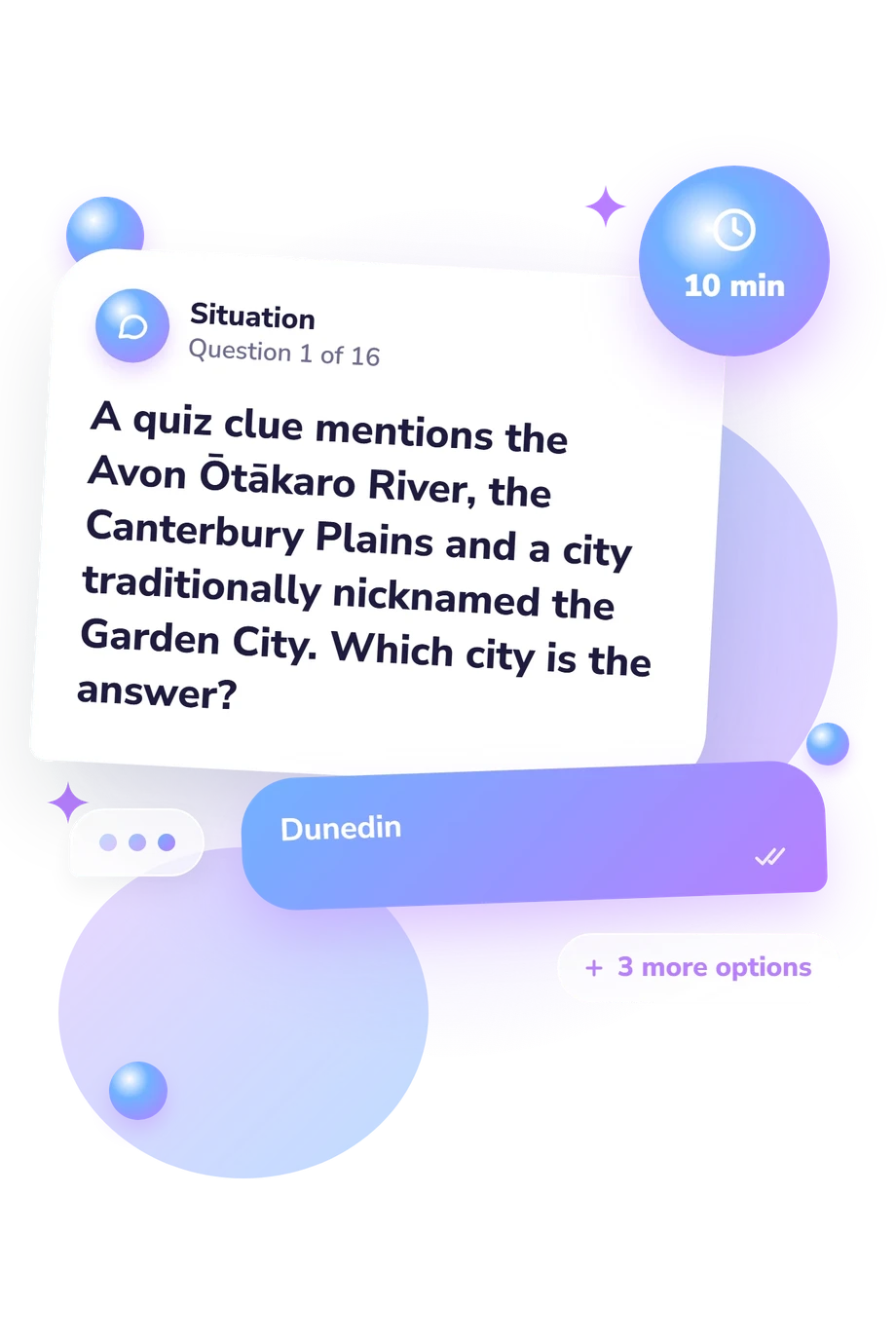
- Dunedin
- Auckland
- Christchurch
- Wellington
- Auckland and Tauranga
- Wellington and Picton
- Nelson and New Plymouth
- Napier and Gisborne
New Zealand Pub Quiz - Description and methodology of the test
People who enjoy pub quiz questions in NZ or casual learning can use this quiz for a focused check of their general familiarity with the country. The New Zealand pub quiz questions offer a self-contained challenge, while the overall result indicates performance across the quiz. It suits curious visitors, social players, and anyone wanting a light way to revisit what they know.
What This Assessment Explores
This New Zealand knowledge test measures factual recall for general audiences, not personality, opinion, or academic ability. Questions span places, history, culture, wildlife, geology, transport, sport, food, and national symbols. Clues sometimes give context before asking for a city, event, object, or term, engaging recognition and recall.
The questions fall into these topic groups:
- Geography links cities, rivers, ports, and landscapes.
- History covers milestones, treaties, exploration, and development.
- Culture examines Māori traditions such as Matariki and hāngī.
- Nature covers native birds and extinct fauna.
- National symbols include the flag and currency.
- Sport identifies the national rugby nickname.
- Achievements include Hillary and Norgay’s ascent.
New Zealand Knowledge reports Foundation to build (0-6), Developing pub form (7-12), or Strong Kiwi knowledge (13-16). These bands describe overall quiz performance; the questions support self-directed review.
Methodology and Evidence Base
Each item uses a multiple-choice format with four answer options. Some ask directly about a fact, while others present a short clue involving a place, bird, ferry route, or national symbol. The answer choices make these New Zealand trivia questions accessible while still requiring distinction between related alternatives.
This factual method reports the result through the supplied scale and its stated performance bands; they describe performance on the quiz, not population norms or intelligence. Factual reference works by Hayward and colleagues, McLintock’s historical work, and Te Ara’s discussions of national identity supply background for the places, civic change, Māori traditions, and national identity represented here. They support question content rather than measurement validity. The questionnaire is an online, non-standardized knowledge quiz, not an adaptation of a published psychometric instrument.
As a self-administered quiz, the result can be influenced by guessing, uneven familiarity, current attention, schooling, travel, and prior exposure to trivia, so it is best read as a snapshot of recalled information and a prompt for further reading rather than a broad judgment of knowledge beyond these subjects.
- Hayward, Janine, Richard Shaw, Lara Greaves, and Claire Timperley. Historical Dictionary of New Zealand. 4th ed. Lanham, MD: Rowman & Littlefield, 2024. 10.5771/9781538184691
- McLintock, Alexander Hare, ed. An Encyclopaedia of New Zealand. 3 vols. Wellington: Government Printer, 1966.
- Phillips, Jock. "The Online Encyclopedia of New Zealand: Te Ara." New Zealand Journal of History 37, no. 1 (2003): 80-89.
Updated: