
Motivation and Emotion Quiz
How the Scales are Structured
Who Usually Takes This Test?
See How You Compare
Below is a preview of how scores are typically distributed across each scale.
Example Questions From the Test
- Learning guitar to qualify for a cash prize
- Learning guitar because practicing and improving feel satisfying
- Practicing guitar to avoid a parent's criticism
- Performing guitar mainly to gain social media followers
- Achievement, status, and security
- Arousal, incentive, and balance
- Approval, certainty, and obedience
- Autonomy, competence, and relatedness
- Physiological adaptation
- Behavioral conditioning
- Cognitive appraisal
- Sensory habituation
Motivation and Emotion Quiz - Description and methodology of the test
Students revising psychology, curious adults, and independent learners can use this motivation and emotion quiz to locate topics that deserve attention before further reading. By giving the learner a concise check of progress, this psychology quiz on motivation and emotion helps organize a study plan around theories that feel less familiar.
What This Assessment Explores
The questionnaire tests conceptual understanding, not personal symptom severity. It covers motivation, emotion, learning, and regulation, making it suitable for students, independent learners, and readers reviewing introductory psychology.
The question themes fall into four areas:
- Physiological and cognitive accounts explain how arousal, appraisal, and interpretation shape emotional experience.
- Social expression and regulation show how display rules, reappraisal, and suppression affect emotional responses.
- Learning and incentives clarify how reinforcement, intrinsic interest, external cues, and overjustification influence behavior.
- Needs, goals, and arousal show how autonomy, competence, relatedness, mastery, approach, homeostasis, and activation guide behavior.
For study planning, the motivation and emotion test helps identify concepts answered correctly and distinctions needing review. Motivation and Emotion Knowledge: 0-16 reflects the number of correct answers. Results are Foundations to Build (0-6), Developing Knowledge (7-12), or Strong Knowledge (13-16), representing educational knowledge rather than clinical functioning.
Methodology and Evidence Base
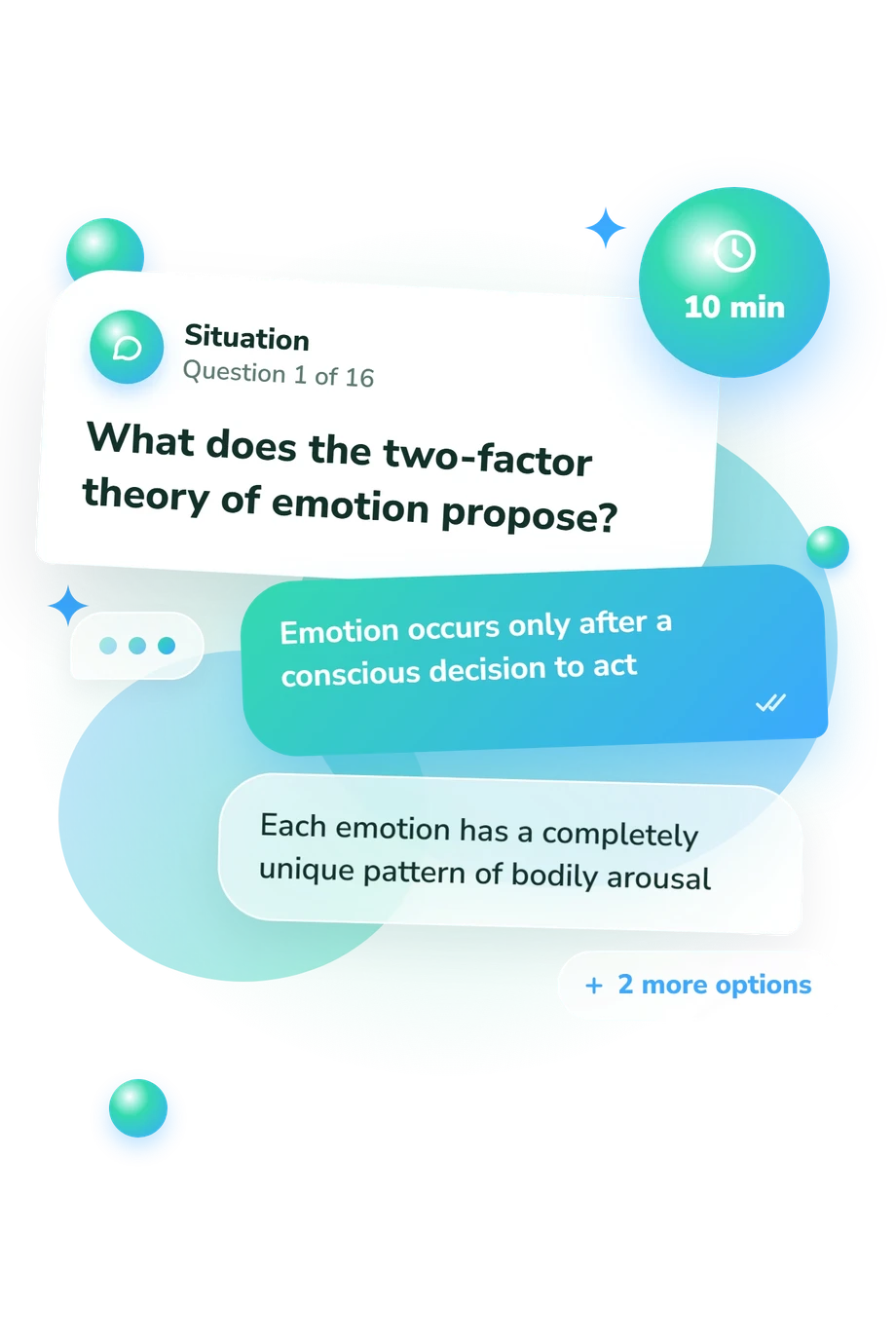
Each item presents a short scenario or conceptual question with four answer choices. The respondent selects the best explanation or application, and the displayed score simply counts correct responses. This format tests recognition and discrimination among related theories rather than personal intensity, frequency, or symptoms.
The questions are conceptually consistent with Reeve's 2024 treatment of motivation and emotion, which covers major ideas about motives, needs, incentives, learning, arousal, and emotion. Schachter and Singer support the link between physiological arousal and cognitive interpretation; Ryan and Deci support autonomy, competence, relatedness, and autonomous motivation; Gross supports the contrast between cognitive reappraisal and expressive suppression. These sources provide conceptual coverage for the questions rather than authorship of the questionnaire, which is not an adaptation of any one instrument.
Interpretation should remain modest. The motivation and emotion assessment reports how many answers are correct. Guessing, attention, prior coursework, wording familiarity, and difficulty distinguishing related terms can affect performance, so the bands are best used to guide review of related concepts.
- Reeve, Johnmarshall. Understanding Motivation and Emotion. 8th ed. Hoboken, NJ: Wiley, 2024.
- Schachter, Stanley, and Jerome E. Singer. "Cognitive, Social, and Physiological Determinants of Emotional State." Psychological Review 69, no. 5 (1962): 379-399. 10.1037/h0046234.
- Ryan, Richard M., and Edward L. Deci. Self-Determination Theory: Basic Psychological Needs in Motivation, Development, and Wellness. New York: Guilford Press, 2017.
- Gross, James J. "Emotion Regulation: Current Status and Future Prospects." Psychological Inquiry 26, no. 1 (2015): 1-26. 10.1080/1047840X.2014.940781.
Updated: