
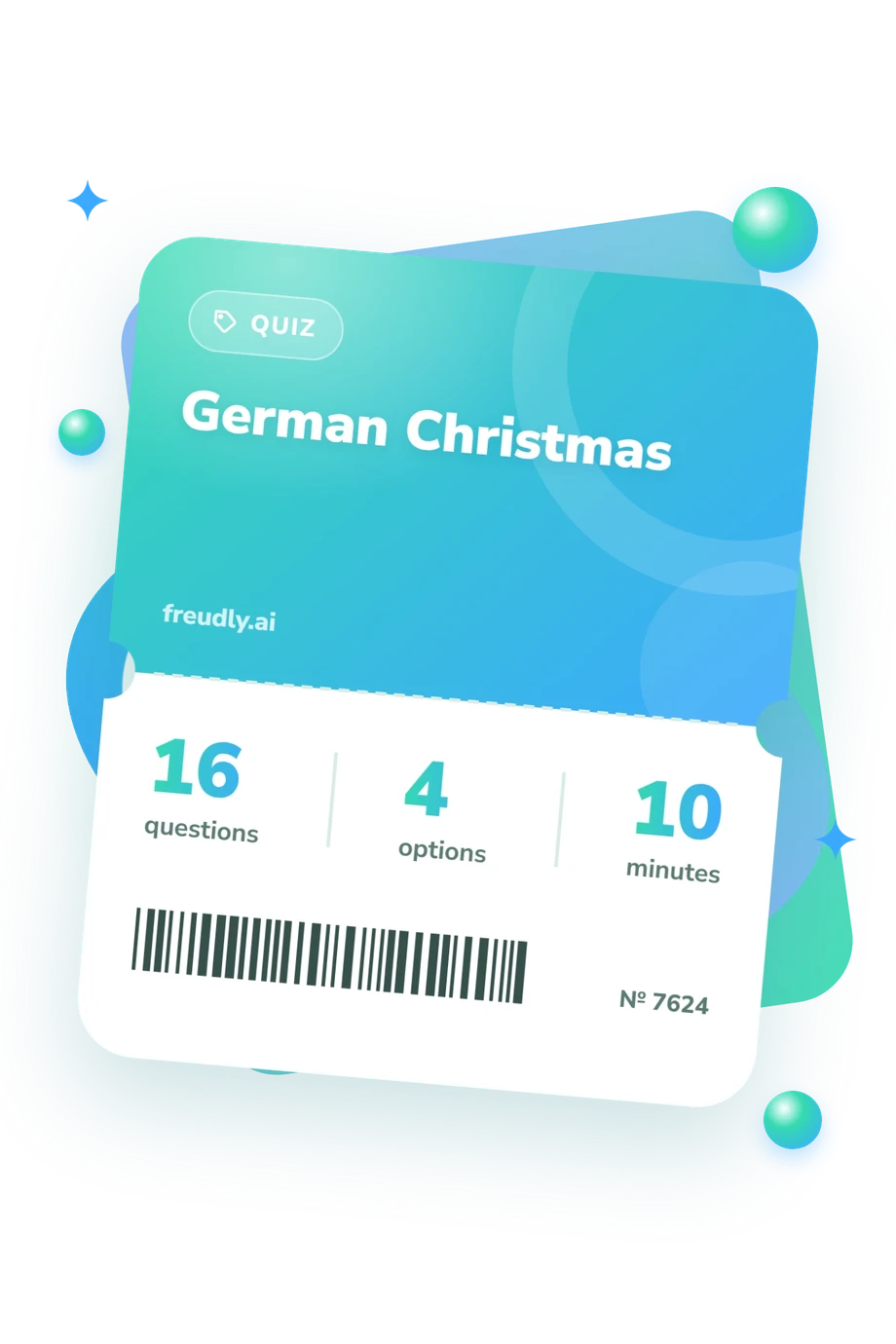
German Christmas Quiz
How the Scales are Structured
Who Usually Takes This Test?
See How You Compare
Below is a preview of how scores are typically distributed across each scale.
Example Questions From the Test
- Guten Rutsch!
- Frohe Ostern!
- Herzlichen Glückwunsch!
- Frohe Weihnachten!
- Adventssonntag
- Heiligabend
- Nikolaustag
- Dreikönigstag
- Small wrapped presents
- Decorative candleholders
- Printed holiday cards
- Small cookies or biscuits
German Christmas Quiz - Description and methodology of the test
For learners who want to connect German study with seasonal culture, the German Christmas Quiz offers a focused way to check practical recognition rather than abstract grammar. It is suited to culture-curious visitors and language learners who want a clear snapshot of familiar holiday terms, customs, and food references. German holiday vocabulary test results can suggest which topics deserve further review without claiming to represent overall fluency.
What This Assessment Measures
Recognition is the central skill. The items connect German words with seasonal situations, showing whether a learner can interpret meaning in context rather than recall isolated translations. As a German Christmas vocabulary quiz, it focuses on practical holiday language and customs, with examples involving greetings, Advent, gift-giving, food, music, and markets.
The main result dimensions are:
- Holiday vocabulary shows whether you can identify greetings, objects, occasions, and celebration terms.
- Seasonal customs reveal whether you recognize Advent, St Nicholas Day, Christmas Eve, and gift-giving practices.
- Food and festivities indicate whether you understand references to biscuits, gingerbread, mulled wine, carols, and markets.
The score is reported on German Christmas Knowledge: 0-16, with one point for each correct answer. Festive Foundations covers 0-6; Growing Holiday Vocabulary covers 7-12; Weihnachtsprofi covers 13-16. These bands describe performance on this quiz’s content, not complete German ability.
Methodology and Evidence Base
Each item uses a short question or mini-situation followed by four answer choices. The respondent selects the best match, and the scoring is direct: a correct answer adds one point, while the final total reflects the number of items answered correctly. The format tests recognition and interpretation, not free production of German.
Content selection is conceptually consistent with the German Christmas knowledge quiz described by the Goethe-Institut, while AQA’s German vocabulary specification helps anchor ordinary language use. Perry (2010) supplies cultural-historical context, and Spennemann and Parker (2025) support the inclusion of Christmas-market traditions. These sources explain the subject matter; they do not establish that this online questionnaire is a standardized adaptation of their instruments.
For self-directed review, this German Christmas culture quiz can be useful, but interpretation should stay close to the content tested. The bands are descriptive rather than population norms, so performance can be influenced by prior study, exposure to German-speaking traditions, guessing, and momentary attention. It does not measure pronunciation, listening, spontaneous speaking, or cultural knowledge beyond the topics represented here.
- Goethe-Institut. Christmas in Germany: Teachers' Notes. Goethe-Institut United Kingdom, 2012.
- Assessment and Qualifications Alliance. GCSE German 8668 Specification: Subject Content-Vocabulary. AQA, 2016.
- Spennemann, Dirk H. R., and Murray Parker. "Collecting Christmas Commerce: Material Culture Related to German Christmas Markets Held in German Museum Collections." Muzeologia a Kulturne Dedicstvo 13, no. 4 (2025): 23-50. 10.46284/mkd.2025.13.4.2.
- Perry, Joe. Christmas in Germany: A Cultural History. University of North Carolina Press, 2010. 10.5149/9780807899410_perry.
Updated: