
PFT Interpretation Quiz
How the Scales are Structured
Who Usually Takes This Test?
See How You Compare
Below is a preview of how scores are typically distributed across each scale.
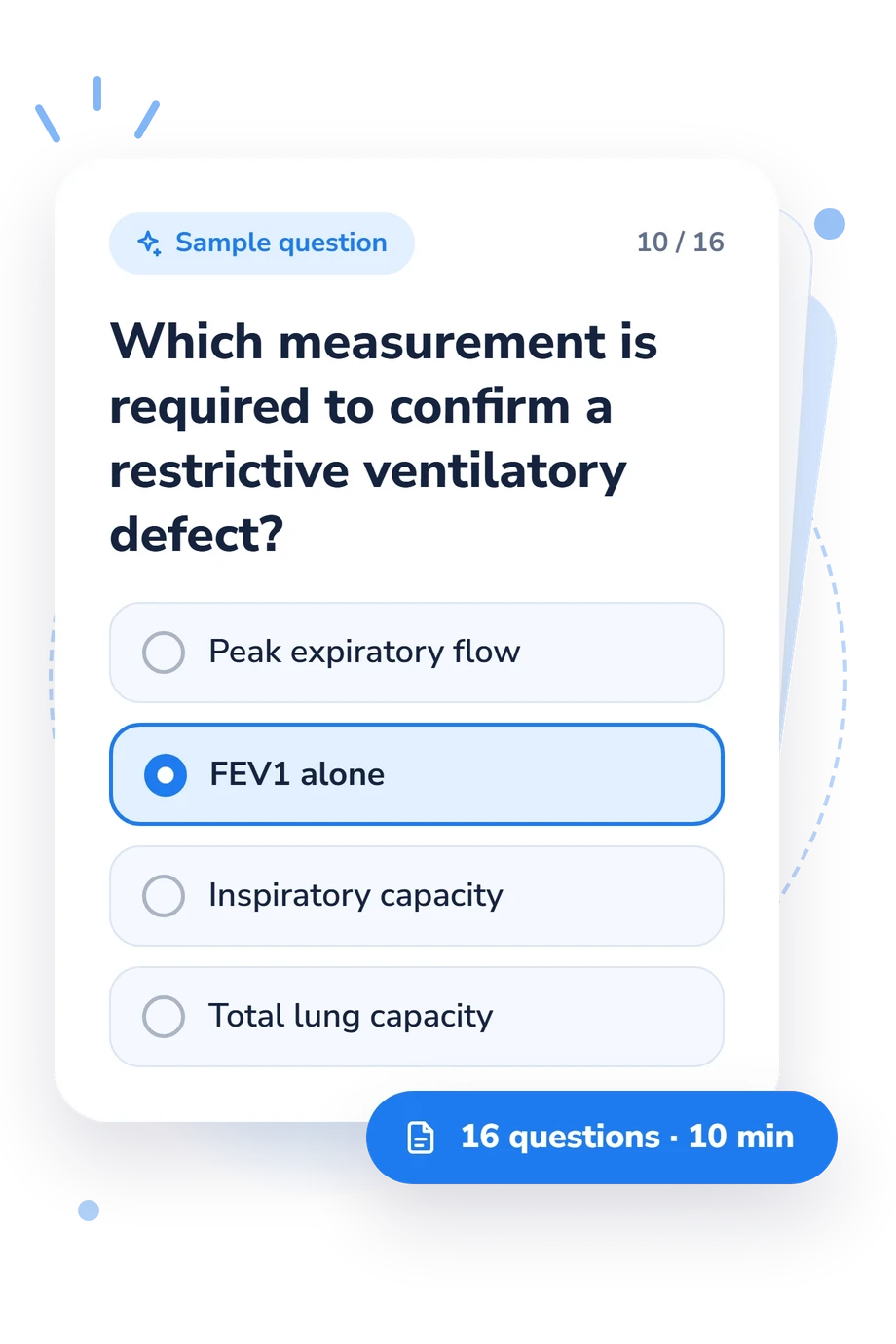
Example Questions From the Test
- Total volume exhaled during the first second
- Strength of the respiratory muscles during forced exhalation
- Transfer of gas from the alveoli into pulmonary capillary blood
- Resistance in the large airways during inspiration only
- Typical small-airway obstruction only
- Fixed upper-airway obstruction
- Isolated restriction with no airway involvement
- Normal variation caused solely by older age
- An increased residual volume by itself
- A reduced FVC with a preserved FEV1/FVC ratio
- An FEV1/FVC ratio below the appropriate lower limit of normal
- A reduced DLCO with otherwise normal spirometry
PFT Interpretation Quiz - Description and methodology of the test
Designed for learners who want to connect pulmonary measurements with defensible patterns, the PFT Interpretation Quiz offers a focused way to check foundational interpretation knowledge. It suits students, trainees, clinicians refreshing core concepts, and anyone studying how spirometry, lung volumes, flow-volume loops, and gas-transfer findings fit together. Used as a PFT interpretation test, it can highlight topics that deserve closer review.
What This Assessment Measures
These questions examine how individual measurements combine into a ventilatory pattern, rather than asking for disease labels alone. The result reflects recognition of definitions, technical quality, and the need to integrate complementary tests.
The main dimensions are:
- Spirometry shows how FEV1, FVC, and their ratio describe expiratory airflow and support pattern recognition.
- Flow-volume loops show how contour changes can suggest upper-airway obstruction.
- Lung volumes clarify whether a low FVC represents confirmed restriction and help separate intrapulmonary from extrapulmonary explanations.
- DLCO shows how gas transfer adds context when obstruction or restriction is present.
Its spirometry interpretation questions test lower-limit-of-normal reasoning, bronchodilator response, and comparison with prior studies. The displayed scale is PFT Interpretation Knowledge (0-16), with Foundation Building 0-6, Developing Interpreter 7-12, and Strong Core Knowledge 13-16. Together, these dimensions show how the score summarizes foundational interpretation knowledge.
Methodology and Evidence Base
Each item presents a direct question or brief testing scenario with four answer choices. The respondent selects the best answer without calculating from raw test data. One point is awarded for each correct response, producing a total that maps to the displayed educational bands; no additional weighting or diagnostic threshold is stated. The score is not presented as a validated clinical assessment.
The content covers principles addressed by the ERS/ATS interpretive strategies standard, the ATS/ERS spirometry standard, and the single-breath carbon-monoxide transfer standard. It considers acceptability and repeatability, appropriate reference limits, obstruction or restriction, and the use of lung volumes, DLCO, flow-volume morphology, and bronchodilator findings to refine the pattern. The questions are conceptually consistent with these standards; the cited standards do not validate this online scoring system.
For someone practising pulmonary function test interpretation, the score is a snapshot of conceptual knowledge. Real interpretation draws on test quality, reference equations, history, symptoms, and context; honest answers and prior exposure to PFT terminology can also affect performance.
- Stanojevic S, Kaminsky DA, Miller MR, Thompson B, Aliverti A, Barjaktarevic I, Cooper BG, Culver B, Derom E, Hall GL, Hallstrand TS, Leuppi JD, MacIntyre N, McCormack M, Rosenfeld M, Swenson ER. ERS/ATS technical standard on interpretive strategies for routine lung function tests. European Respiratory Journal. 2022;60(1):2101499. 10.1183/13993003.01499-2021
- Graham BL, Steenbruggen I, Miller MR, Barjaktarevic IZ, Cooper BG, Hall GL, Hallstrand TS, Kaminsky DA, McCarthy K, McCormack MC, Oropez CE, Rosenfeld M, Stanojevic S, Swanney MP, Thompson BR. Standardization of Spirometry 2019 Update. An Official American Thoracic Society and European Respiratory Society Technical Statement. American Journal of Respiratory and Critical Care Medicine. 2019;200(8):e70-e88. 10.1164/rccm.201908-1590ST
- Graham BL, Brusasco V, Burgos F, Cooper BG, Jensen R, Kendrick A, MacIntyre NR, Thompson BR, Wanger J. 2017 ERS/ATS standards for single-breath carbon monoxide uptake in the lung. European Respiratory Journal. 2017;49(1):1600016. 10.1183/13993003.00016-2016
Updated: