
Past Simple or Past Continuous Quiz
How the Scales are Structured
Who Usually Takes This Test?
See How You Compare
Below is a preview of how scores are typically distributed across each scale.
Example Questions From the Test
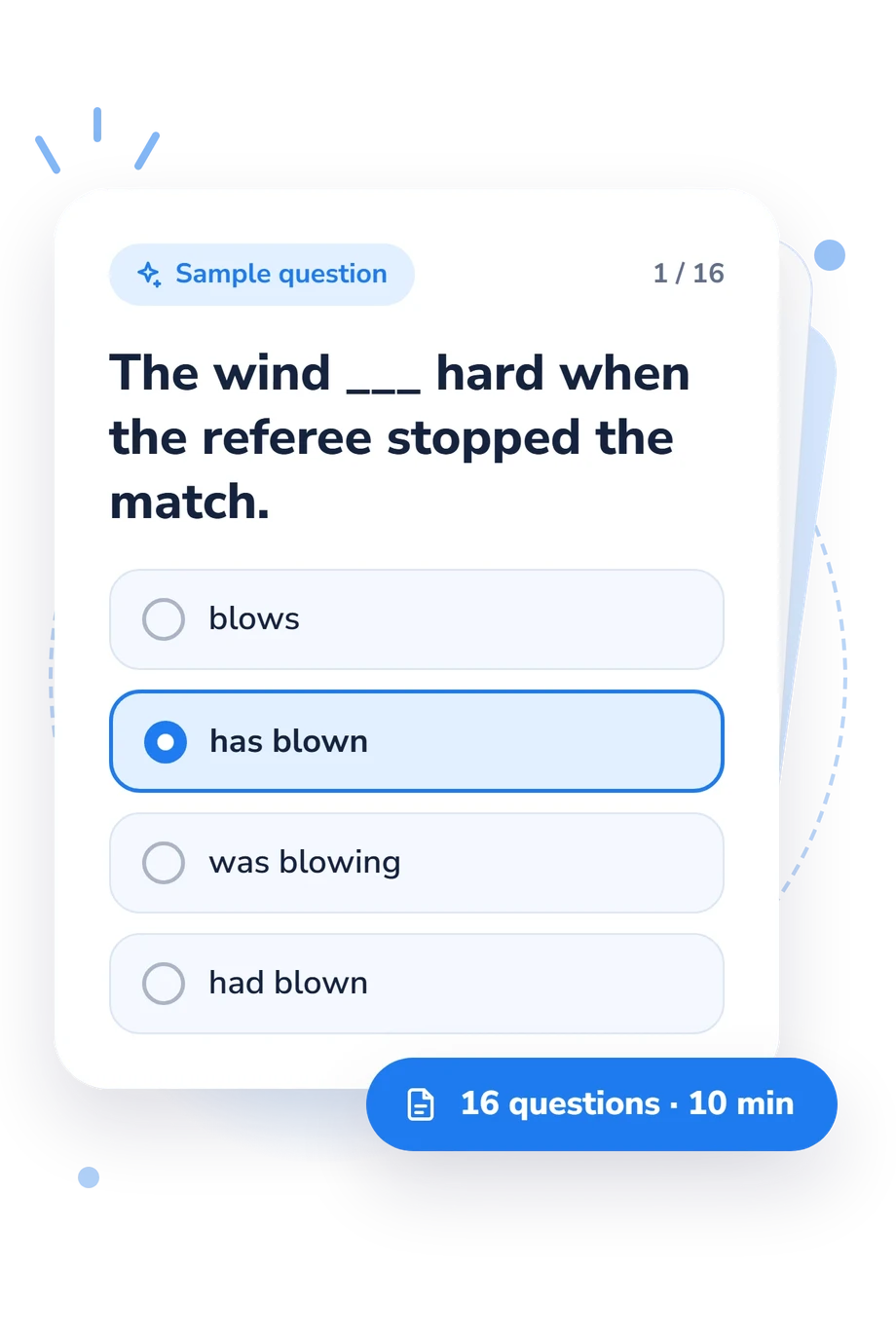
- blows
- has blown
- was blowing
- had blown
- did not have
- was not having
- does not have
- has not had
- were visiting
- have visited
- visited
- had been visiting
Past Simple or Past Continuous Quiz - Description and methodology of the test
Independent learners, classroom students, and teachers may find this past tense quiz useful when they want a quick way to locate gaps in their handling of past-time contexts. Taking this past simple or past continuous quiz produces an overall indication of tense knowledge across the situations represented by the questions. The result can help turn a broad grammar concern into a more specific study plan.
What This Assessment Measures
The questions contrast completed past events with actions unfolding at a particular time. Context also matters when events are sequenced, interrupted, repeated, or used to describe a past state. This makes the assessment useful for learners who know the basic rules but hesitate when choosing a tense in ordinary sentences. This past simple and past continuous test can turn that uncertainty into focused practice.
The result brings together three practical tense decisions:
- Completed events and sequences are recognized when actions are presented as finished or ordered.
- Ongoing and interrupted actions are selected when an activity forms the background to another event.
- Past habits and states are judged by whether the sentence describes repetition or a condition.
The displayed scale is Past Simple or Past Continuous Knowledge (0-16), with Foundations to review (0-6), Developing control (7-12), and Strong knowledge (13-16).
Methodology and Evidence Base
This context-based assessment uses multiple-choice grammar items: each sentence has a missing verb form and four answer choices. The alternatives require attention to time markers, conjunctions, event order, and meaning. Because it contrasts the simple past with the past continuous, each correct choice expresses a completed event, ongoing background action, repeated habit, or past state.
The questionnaire reports one overall score rather than separate subscales. Higher results indicate more consistent choices in the represented contexts, while lower results show where review may help. The total therefore reflects performance across completed events, sequences, habits, states, and ongoing or interrupted actions.
Martin Parrott's teaching framework supports the distinction between completed and ongoing past situations. Rodney Huddleston and Geoffrey K. Pullum explain the tense-and-aspect system behind these choices. The questionnaire is conceptually consistent with both sources, but it is not presented as an adaptation of either instrument.
Because responses depend on selected options, attention, grammar terminology, and interpretation of context can affect performance. A single result also cannot show how reliably the learner uses these forms in spontaneous speaking or writing.
- Parrott, Martin. Grammar for English Language Teachers. 2nd ed. Cambridge University Press, 2010. 10.1017/9781009406536
- Huddleston, Rodney, and Geoffrey K. Pullum. The Cambridge Grammar of the English Language. Cambridge University Press, 2002. 10.1017/9781316423530
Updated: