
Oliver Quiz
How the Scales are Structured
Who Usually Takes This Test?
See How You Compare
Below is a preview of how scores are typically distributed across each scale.
Example Questions From the Test
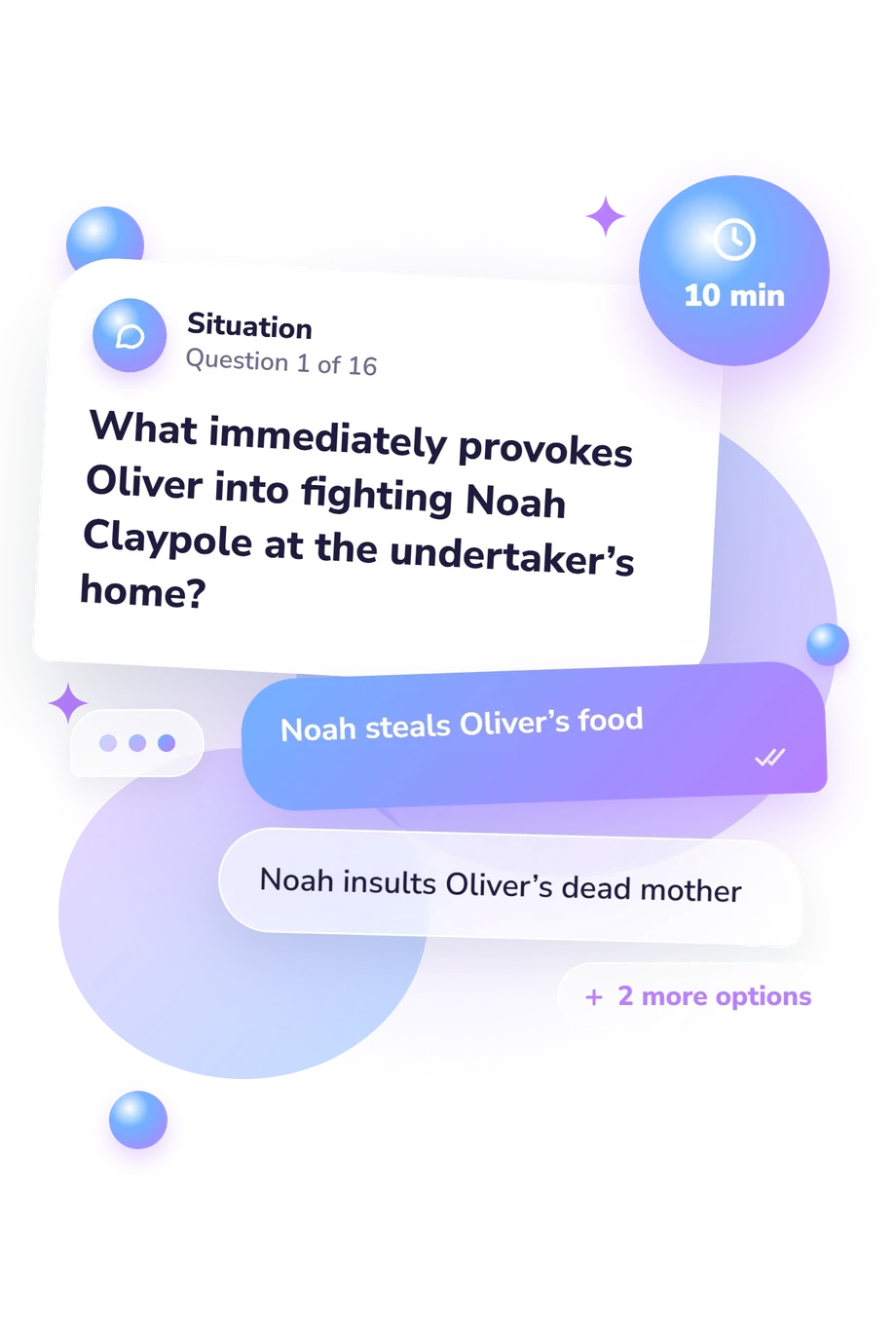
- Noah steals Oliver’s food
- Noah insults Oliver’s dead mother
- Noah tries to send Oliver back to the workhouse
- Noah falsely accuses Oliver of theft
- Monks
- Harry Maylie
- Charley Bates
- Toby Crackit
- Pickpocketing
- Forgery
- Burglary through upper windows
- Selling stolen horses
Oliver Quiz - Description and methodology of the test
For readers who want to check how closely they remember Dickens’s novel, the Oliver Quiz turns familiar scenes into a focused knowledge check. It suits students, book-club participants, and readers returning to the story after a rereading. This questionnaire rewards attentive reading rather than literary theory, while its overall result indicates your level of knowledge of Oliver Twist and whether revisiting the novel may help.
What This Assessment Explores
This quiz on Oliver Twist measures factual recall rather than literary interpretation. Its questions cover character identity, relationships, motives, major events, workhouse life, criminal networks, family history, and setting.
The question themes are:
- Character identity and roles ask whether you can distinguish Oliver, Nancy, Fagin, Sikes, and key adults.
- Relationships and motives test whether you remember family connections, alliances, betrayals, and reasons for action.
- Plot and social setting cover recognition of turning points, workhouse conditions, discoveries, and consequences.
Together, correct answers across these themes produce Oliver Twist Knowledge (0-16), an overall measure of knowledge of the novel. Opening Chapters (0-6) signals partial recognition; Developing Reader (7-12) reflects command of the central story; Workhouse Scholar (13-16) indicates strong recall of its characters, motives, relationships, and major events.
Methodology and Scientific Basis
Each item presents a fixed set of answer choices and asks for the detail that best matches the novel. The score is a raw count of correct responses, so it records demonstrated recall on this questionnaire rather than general reading ability. Nearby characters and events among alternatives make discrimination important.
The tested facts come from Dickens (1838), whose novel supplies the characters, events, relationships, and outcomes tested. Smith and colleagues (2008) and Richardson (2012) provide historical context for the workhouse episode, the workhouse, and London poverty; they do not supply the questionnaire’s scoring or items. The online questionnaire is separately written and is not validated or adapted from those publications.
Its observable output is a raw 0-16 result with descriptive bands and no population comparison. Performance on the Oliver Twist questions can be affected by guessing, prior study, familiarity with film or classroom versions, and the wording of individual items. The overall score is therefore best read as a focused reading check: it reflects remembered content on these items, but cannot capture literary appreciation or the full meaning of the novel.
- Dickens, Charles. Oliver Twist; or, The Parish Boy's Progress. Richard Bentley, 1838.
- Smith, L., S. J. Thornton, Jonathan Reinarz, and A. N. Williams. "Please, Sir, I Want Some More." BMJ, vol. 337, 2008, article a2722. 10.1136/bmj.a2722.
- Richardson, Ruth. Dickens and the Workhouse: Oliver Twist and the London Poor. Oxford University Press, 2012.
Updated: