
Noteworthy Fragrance Quiz
How the Scales are Structured
Who Usually Takes This Test?
See How You Compare
Below is a preview of how scores are typically distributed across each scale.
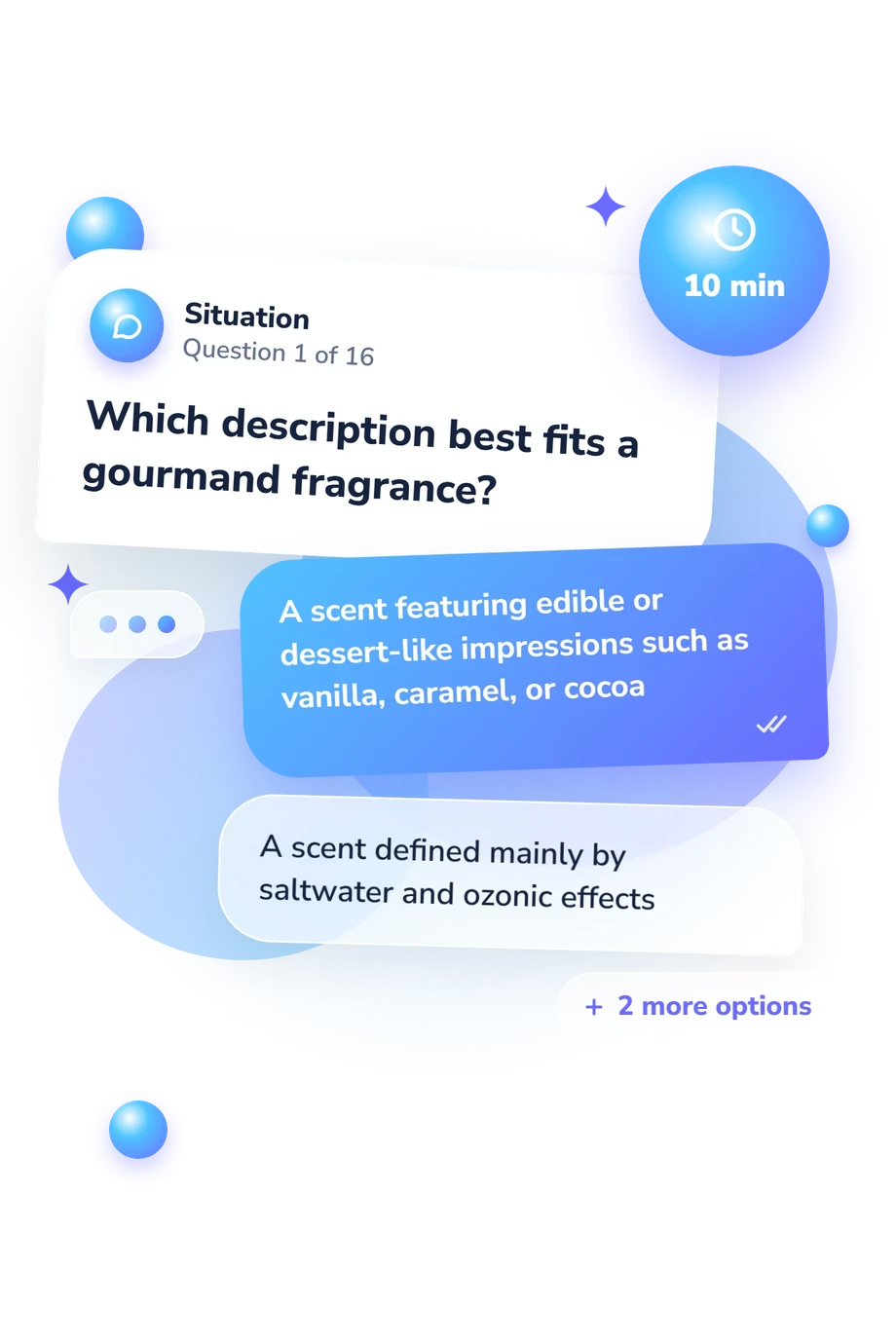
Example Questions From the Test
- Base note
- Heart note
- Top note
- Fixative note
- Steam distillation
- Enfleurage
- Tincturing
- Fractionation
- Aquatic
- Gourmand
- Chypre
- Fougère
Noteworthy Fragrance Quiz - Description and methodology of the test
For readers who want a structured introduction to perfume language, this noteworthy quiz turns common fragrance knowledge into a focused self-check. This fragrance knowledge quiz helps curious wearers, students, reviewers, and aspiring enthusiasts see which parts of perfume terminology feel secure. The result points toward useful next steps, whether that means revisiting fragrance families, practicing evaluation, or building confidence when discussing perfumes.
What This Assessment Explores
Unlike a preference survey, the questionnaire checks whether a visitor can recognize and apply ideas used to describe, compare, test, and preserve fragrances. Its items connect scent vocabulary with families, materials, evaporation, performance, skin effects, layering, and storage. The result reflects fragrance knowledge rather than personal taste.
Three practical areas organize the noteworthy fragrance quiz:
- Families and accords show whether hallmark combinations are linked with categories such as gourmand, chypre, fougère, and amber.
- Materials and development indicate whether ingredients are understood by role, stage, and association.
- Performance, testing, and storage show whether practical choices are made about projection, layering, application, light, and temperature.
These themes feed the Noteworthy Fragrance Knowledge scale (0-16), displayed as Fragrance Foundations (0-6), Developing Nose (7-12), or Noteworthy Knowledge (13-16). The bands indicate increasing command of the tested concepts.
Methodology and Evidence Base
Conceptually, this noteworthy scents quiz uses a four-choice format to test practical perfumery knowledge rather than preference. The result should be interpreted through the displayed 0-16 bands rather than an invented scoring formula. The questionnaire is an online self-reflection tool rather than a standardized measure.
Calkin and Jellinek provide relevant foundations for materials, families, development, and evaluation, matching the concepts covered by the items. Sezille and colleagues' odor-description study and Delon-Martin and colleagues' research on perfumer expertise offer context about describing smells and developing experience; neither validates this questionnaire or its scoring. No published validation or population norms are established for this questionnaire.
The displayed result is best used to identify areas for further study. Prior study, language familiarity, and test context can affect performance, while a knowledge score cannot capture every part of smelling skill, including fine sensory discrimination or creative composition. Use it to choose review priorities and organize further practice.
- Sezille, Caroline, Arnaud Fournel, Catherine Rouby, Fanny Rinck, and Moustafa Bensafi. “Hedonic Appreciation and Verbal Description of Pleasant and Unpleasant Odors in Untrained, Trainee Cooks, Flavorists, and Perfumers.” Frontiers in Psychology 5 (2014): Article 12. 10.3389/fpsyg.2014.00012
- Delon-Martin, Chantal, Jane Plailly, Pierre Fonlupt, Alexandra Veyrac, and Jean-Pierre Royet. “Perfumers’ Expertise Induces Structural Reorganization in Olfactory Brain Regions.” NeuroImage 68 (2013): 55-62. 10.1016/j.neuroimage.2012.11.044
- Calkin, Robert R., and Joseph Stephan Jellinek. Perfumery: Practice and Principles. New York: John Wiley & Sons, 1994.
Updated: