
Political Trivia Quiz
How the Scales are Structured
Who Usually Takes This Test?
See How You Compare
Below is a preview of how scores are typically distributed across each scale.
Example Questions From the Test
- It holds every election in two rounds
- It divides executive power between two presidents
- It uses two different constitutions at once
- It has two legislative chambers
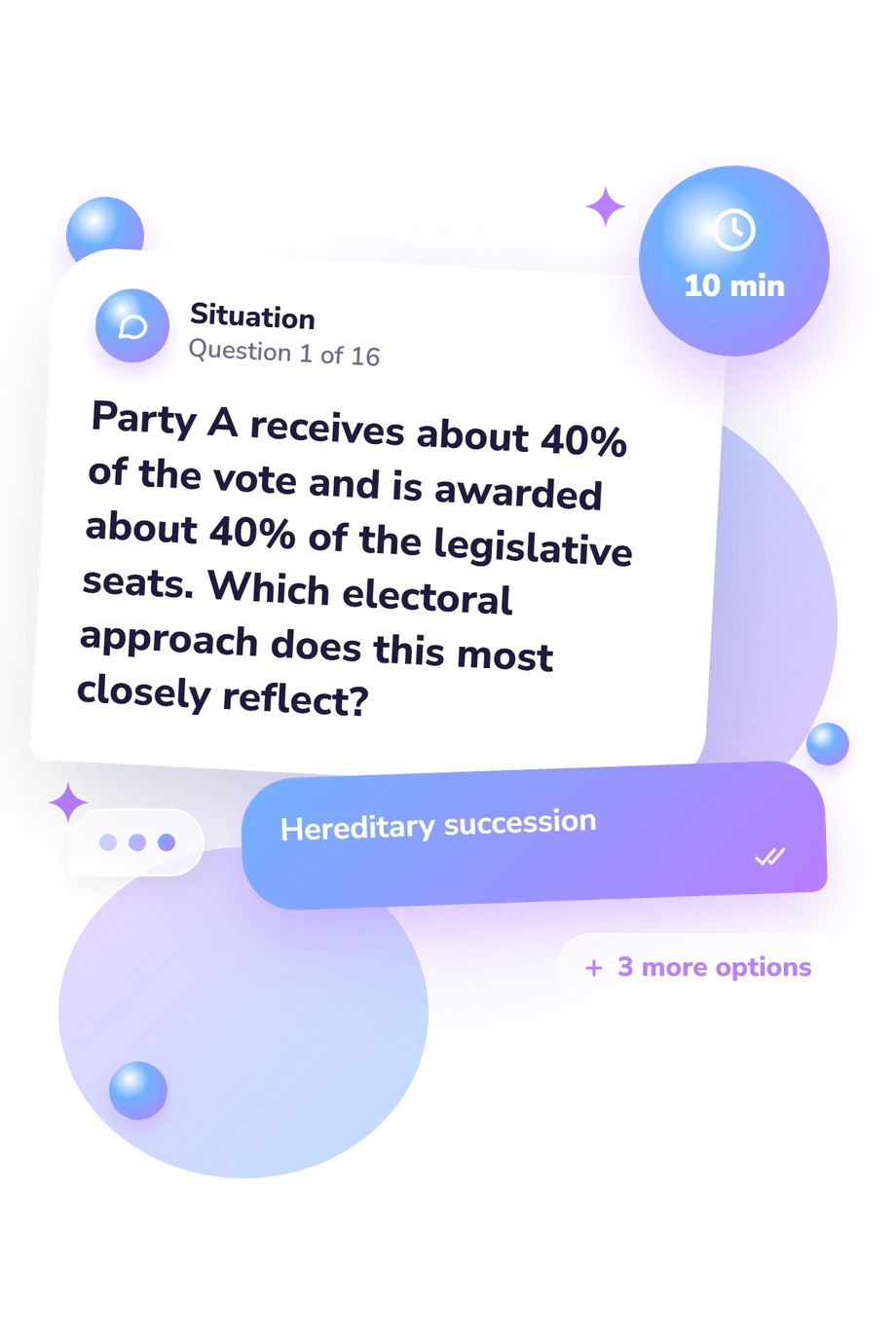
- 600%
- 40%
- 60%
- 67%
- Gerrymandering
- Franchising
- Coalition building
- Filibustering
Political Trivia Quiz - Description and methodology of the test
Readers who want a quick way to check their grasp of civic institutions can use this political trivia quiz as a focused knowledge exercise. It works as a political knowledge test for learners, voters, and anyone reviewing the vocabulary of democratic government. The result offers a starting point for deciding which areas deserve more study, while the questions keep the activity practical rather than purely memorization-based.
What This Assessment Measures
It measures foundational political knowledge: whether a respondent can identify how institutions operate and distinguish civic terms, rather than reveal party preference or ideology. The questions present concepts in practical contexts. Civic scenarios and choices make politics quiz questions and answers distinguish related concepts.
The result is Political Trivia Knowledge: 0-16. Its three bands are Foundation Building (0-6), Developing Knowledge (7-12), and Strong Knowledge (13-16), indicating broader and more consistent command of the concepts tested.
The question themes include:
- Electoral systems and participation test turnout, ballots, plurality, proportional representation, and referendums.
- Legislatures and executive relations cover chambers, vetoes, coalitions, and no-confidence votes.
- Constitutional principles and legal oversight cover amendments, rule of law, and judicial review.
- Territorial organization distinguishes federal power-sharing from unitary central authority.
Together, these dimensions show how well a respondent applies the civic concepts tested.
Methodology and Evidence Base
Each item presents a definition, numerical example, or institutional scenario with four answer choices. The respondent selects the concept that best fits, making this a compact set of politics trivia questions about distinctions rather than personal attitudes.
The questionnaire presents one overall Political Trivia Knowledge result. It indicates performance within this item set, while the bands are descriptive guideposts rather than universal thresholds for political competence.
Delli Carpini and Keeter (1993) provide a conceptual reference point: this questionnaire treats political knowledge as civic factual understanding. Their 1996 book explains why that knowledge matters for civic life, while Mondak (1999) shows why this quiz’s item wording, topic coverage, guessing, and prior exposure can affect its result. The online questionnaire is conceptually consistent with those works, not an adaptation or standardized reproduction of their instruments.
Interpretation is limited by topic coverage, wording, prior exposure, guessing, and attention. A strong result indicates performance on these questions; a lower band identifies concepts worth reviewing, but neither result is a complete measure of political understanding.
- Delli Carpini, Michael X., and Scott Keeter. "Measuring Political Knowledge: Putting First Things First." American Journal of Political Science 37, no. 4 (1993): 1179-1206. 10.2307/2111549
- Delli Carpini, Michael X., and Scott Keeter. What Americans Know about Politics and Why It Matters. New Haven, CT: Yale University Press, 1996.
- Mondak, Jeffery J. "Reconsidering the Measurement of Political Knowledge." Political Analysis 8, no. 1 (1999): 57-82. 10.1093/oxfordjournals.pan.a029805
Updated: