
Hard Riddles Quiz
How the Scales are Structured
Who Usually Takes This Test?
See How You Compare
Below is a preview of how scores are typically distributed across each scale.
Example Questions From the Test
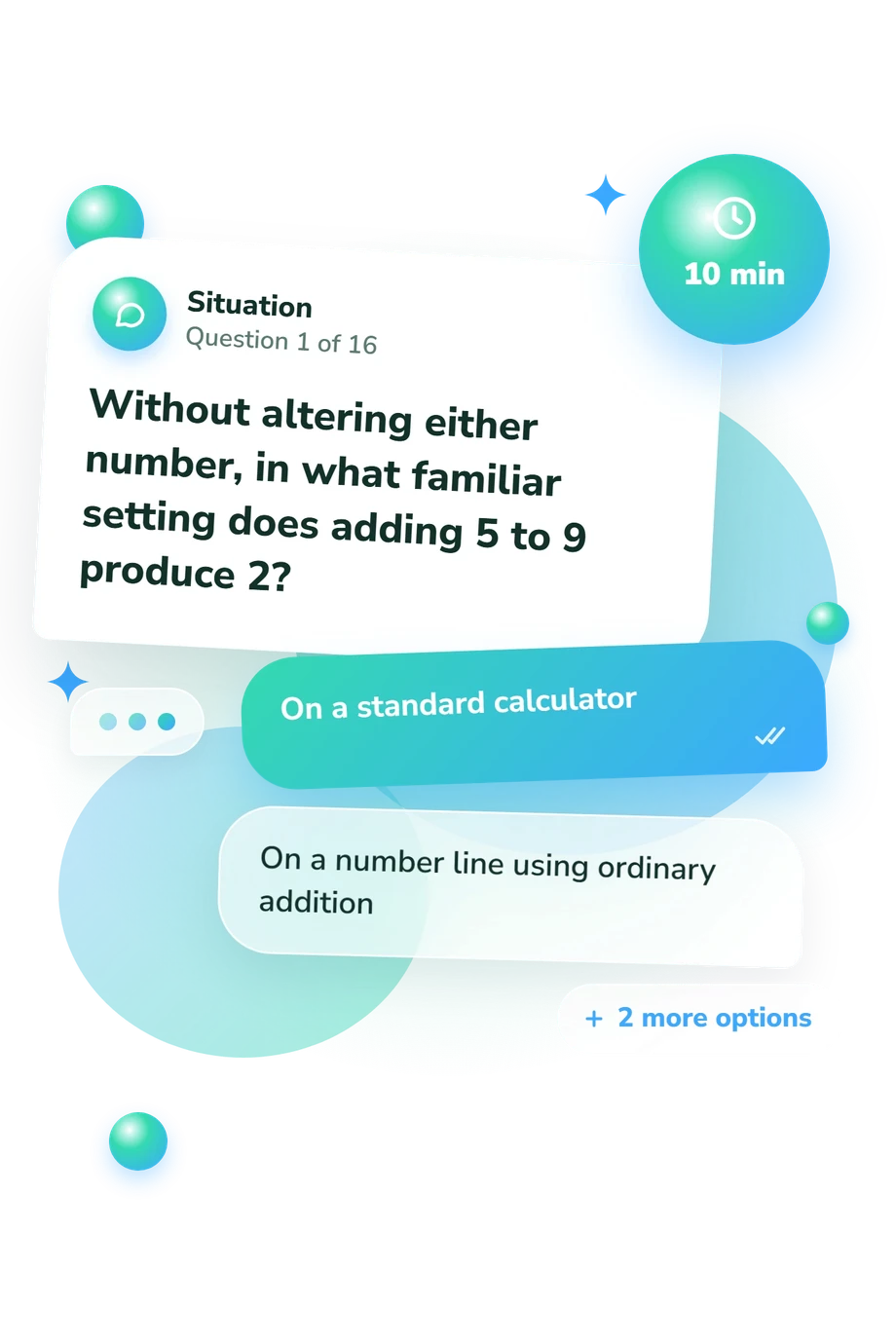
- On a standard calculator
- On a number line using ordinary addition
- In a base-ten multiplication table
- On a 12-hour clock
- Brown
- Black
- White
- Its color cannot be determined
- 312211
- 211221
- 311221
- 1113213211
Hard Riddles Quiz - Description and methodology of the test
Curious solvers who enjoy testing flexible reasoning can use the Hard Riddles Quiz to see how they approach unfamiliar problems rather than relying on routine recall. Some clues may seem impossible at first, making this riddle challenge useful for readers who like checking whether a surprising clue, sequence, or constraint changes the obvious answer. The result offers a broad snapshot of performance across these formats rather than isolating practice areas.
What This Assessment Explores
These items present problem-solving challenges across language, logic, sequencing, and constrained planning. They suit anyone who wants a compact riddle-solving challenge in which familiar situations are presented in less familiar ways. In the logic-and-wordplay questions, noticing assumptions, translating wording into structure, and comparing routes can lead to the answer.
The displayed Hard Riddles Knowledge scale runs from 0-16 and records the total number of riddles solved correctly. The result bands are Puzzle Starter 0-6, Developing Solver 7-12, and Riddle Mastery 13-16. Together, they interpret overall performance across these formats rather than separate abilities.
The main challenge types are:
- Logic and deduction require eliminating alternatives and reaching necessary conclusions.
- Wordplay and interpretation involve handling double meanings and hidden assumptions.
- Sequences and patterns ask you to infer rules from ordered information.
- Planning problems require tracking constraints and consequences.
Methodology and Evidence Base
Each item uses multiple choice with one best answer among several alternatives. Solving depends on the stated conditions rather than specialist knowledge, although careful reading and familiar conventions can help. The score is a direct count of correct responses.
Solving these hard riddle questions requires deduction, restructuring, pattern detection, and deliberate checking of intuitive answers. Webb, Little, and Cropper (2016) examined insight across task types; MacGregor and Cunningham (2008) showed that rebus-style problems can require a change in representation; and Frederick (2005) described the tension between immediate responses and deliberate checking. These studies provide related background, while the questionnaire is conceptually consistent with them, not an adaptation or standardized reproduction.
Taken as an online puzzle set, this assessment is a snapshot of performance on constructed problems. A strong result suggests flexible reasoning across the included formats, while a missed item may reflect wording, pressure, an overlooked assumption, or an unfamiliar trick. Its bands describe performance on these questions and do not establish general intelligence or stable ability. Attentive answers make the result more useful for self-reflection.
- Webb, Margaret E., Daniel R. Little, and Simon J. Cropper. "Insight Is Not in the Problem: Investigating Insight in Problem Solving across Task Types." Frontiers in Psychology 7 (2016): 1424. 10.3389/fpsyg.2016.01424
- MacGregor, James N., and J. Barton Cunningham. "Rebus Puzzles as Insight Problems." Behavior Research Methods 40, no. 1 (2008): 263-268. 10.3758/brm.40.1.263
- Frederick, Shane. "Cognitive Reflection and Decision Making." Journal of Economic Perspectives 19, no. 4 (2005): 25-42. 10.1257/089533005775196732
Updated: