
General Knowledge Quiz in Malayalam
How the Scales are Structured
Who Usually Takes This Test?
See How You Compare
Below is a preview of how scores are typically distributed across each scale.
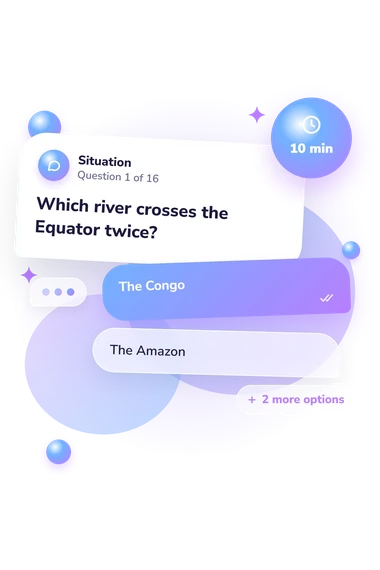
Example Questions From the Test
- The Congo
- The Amazon
- The Niger
- The Nile
- Charles Dickens
- George Bernard Shaw
- John Milton
- William Shakespeare
- Thrissur
- Kochi
- Kozhikode
- Thiruvananthapuram
General Knowledge Quiz in Malayalam - Description and methodology of the test
People seeking a subject-spanning check of factual understanding can use this questionnaire to see how they perform across familiar areas. The General Knowledge Quiz in Malayalam suits learners and curious adults who want an overall indication of recall and simple reasoning, with a result expressed through three broad performance bands. This Malayalam general knowledge test may help them decide whether to revisit foundational topics.
What This Assessment Measures
Rather than focusing on one subject, the questionnaire samples knowledge used in study and daily reasoning. Items cover geography, history, civics, biology, weather, astronomy, arithmetic, vocabulary, and culture through facts and familiar situations. Because it presents Malayalam quiz questions, Malayalam readers can engage with this broad content in an accessible format rather than a specialist or personality assessment.
The result shows recall and application of basic principles across these topics. It is one overall score, and the content areas sampled are:
- Science and environmental reasoning shows how well principles apply to familiar situations.
- History, geography, language, civics, and culture indicate recall of places, institutions, events, vocabulary, and traditions.
- The General Knowledge Knowledge scale ranges from 0-16, with Foundations to Build (0-6), Developing Knowledge (7-12), and Strong Command (13-16).
Higher scores suggest stronger performance; mistakes guide revision.
Methodology and Evidence Base
Each item offers four answer choices, and the respondent selects the best answer. Scoring is direct: one point is awarded for each correct response, so the total reflects sampled performance rather than a weighted profile. The four-option format means general knowledge questions in Malayalam may still be affected by prior education and attention.
The approach is conceptually consistent with Cupani et al.'s 2016 knowledge item bank, which treats knowledge across academic domains as measurable content, but this questionnaire is not an adaptation of that work. Its emphasis also aligns with BEFKI GC-K and Horn and Cattell's distinction between acquired knowledge and fluid reasoning. These connections describe the construct, not the online questionnaire's psychometric properties.
No population norms, reliability estimates, or clinical cutoffs are supplied. The bands therefore provide descriptive feedback about performance on this questionnaire, not a standardized comparison or diagnosis. Current recall, guessing, and familiarity with the Malayalam wording can also influence performance; one sitting cannot represent everything a person knows or how knowledge changes with learning.
- Cupani, Marcos, Fernanda Belén Ghio, María Florencia Leal, Gimena Mariel Giraudo, Tatiana Castro Zamparella, Gisella Piumatti, Antonella Belén Casalotti, Juan Claudio Ramírez, María Andrés Arranz, Analía Norma Farías, Natalia Padilla, and Leandro Barrionuevo. (2016). Development of an Item Bank to Measure Knowledge in University Students. Revista de Psicología, 25(2), 1-18. 10.5354/0719-0581.2016.44808
- Schipolowski, Stefan, Oliver Wilhelm, Ulrich Schroeders, Anastassiya Kovaleva, Christoph J. Kemper, and Beatrice Rammstedt. (2013). BEFKI GC-K: A Short Scale for the Measurement of Crystallized Intelligence. Methods, Data, Analyses, 7(2), 153-181. 10.12758/mda.2013.010
- Horn, John L., and Raymond B. Cattell. (1966). Refinement and Test of the Theory of Fluid and Crystallized General Intelligences. Journal of Educational Psychology, 57(5), 253-270. 10.1037/h0023816