
History of Computer Quiz
How the Scales are Structured
Who Usually Takes This Test?
See How You Compare
Below is a preview of how scores are typically distributed across each scale.
Example Questions From the Test
- Vint Cerf
- Bill Gates
- Tim Berners-Lee
- Steve Wozniak
- Integrated circuits
- Microprocessors
- Vacuum tubes
- Electromechanical relays only
- Herman Hollerith
- Charles Babbage
- George Boole
- Samuel Morse
History of Computer Quiz - Description and methodology of the test
Readers who want to connect machines, inventors, and turning points can use the History of Computer Quiz to engage with history of computer quiz questions and answers in a guided knowledge check. For students, curious learners, and anyone revisiting the subject, this quiz about the history of computers offers a focused way to identify secure knowledge. It also helps decide which historical periods to revisit.
What This Assessment Explores
The assessment moves from mechanical designs and vacuum-tube machines to stored-program computing, transistors, integrated circuits, personal computers, networks, and the Web. Questions identify people, technologies, milestones, and distinctions, including the difference between the internet and the World Wide Web.
Viewed as a computer history test, it measures recognition and conceptual understanding: how well you connect inventions with contributors, uses, and historical significance. It suits learners seeking a focused review rather than a measure of personality or technical performance.
The result appears in three bands on the Computer History Knowledge scale, which runs from 0 to 16:
- Foundations to Build (0-6) means you recognize some events or terms but need more timeline review.
- Developing Knowledge (7-12) shows many important milestones, with room to connect people, machines, and eras.
- Strong Historical Knowledge (13-16) indicates a well-developed grasp of major inventions, contributors, and transitions.
Methodology and Evidence Base
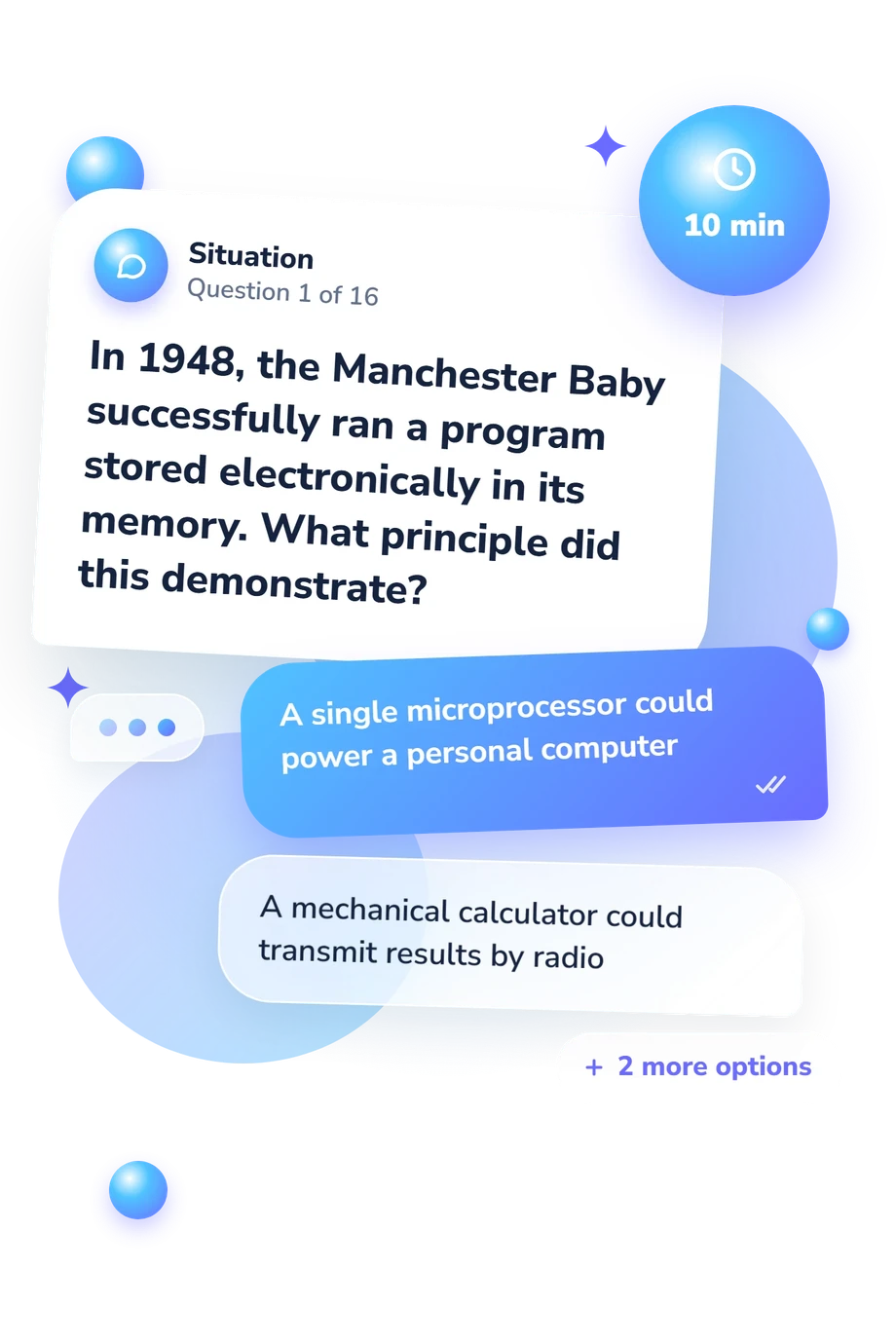
Each item presents a historical prompt with four answer choices. Some ask about a person or machine; others describe a technical situation and identify the principle. This format checks contextual recognition and recall.
Because selected questions cover facts and concepts, this is a structured quiz on the history of computing, not a personality inventory. Correct responses produce one summary result across the milestones; no psychological traits are calculated.
Campbell-Kelly et al. (2023) offer broad coverage of machines, people, and transitions that is conceptually consistent with the quiz. Ceruzzi (2003) adds context on modern computing; the questionnaire is not adapted from either book.
Specific episodes correspond with Engelbart and English (1968) on the 1968 demonstration and Berners-Lee et al. (1992) on the Web’s development. These sources support historical content but do not establish standardized norms or reliability for this online quiz.
Performance can vary with prior study, wording, and concentration. Read the result as a snapshot of the topics tested, not a complete measure of computing knowledge; these questions cannot cover every era or level of expertise.
- Campbell-Kelly, Martin, William F. Aspray, Jeffrey R. Yost, Honghong Tinn, and Gerardo Con Díaz. Computer: A History of the Information Machine. 4th ed. Routledge, 2023. DOI 10.4324/9781003263272.
- Ceruzzi, Paul E. A History of Modern Computing. 2nd ed. MIT Press, 2003.
- Engelbart, Douglas C., and William K. English. "A Research Center for Augmenting Human Intellect." Proceedings of the AFIPS Fall Joint Computer Conference 33 (1968): 395-410. DOI 10.1145/1476589.1476645.
- Berners-Lee, Tim, Robert Cailliau, Jean-François Groff, and Bernd Pollermann. "World-Wide Web: The Information Universe." Electronic Networking: Research, Applications and Policy 2, no. 1 (1992): 52-58. DOI 10.1108/eb047254.
Updated: