
Logo Quiz TV
How the Scales are Structured
Who Usually Takes This Test?
See How You Compare
Below is a preview of how scores are typically distributed across each scale.
Example Questions From the Test
- NBC
- ABC
- CBS
- PBS
- Fox Sports
- CBS Sports
- ESPN
- NBC Sports
- Discovery Channel
- Animal Planet
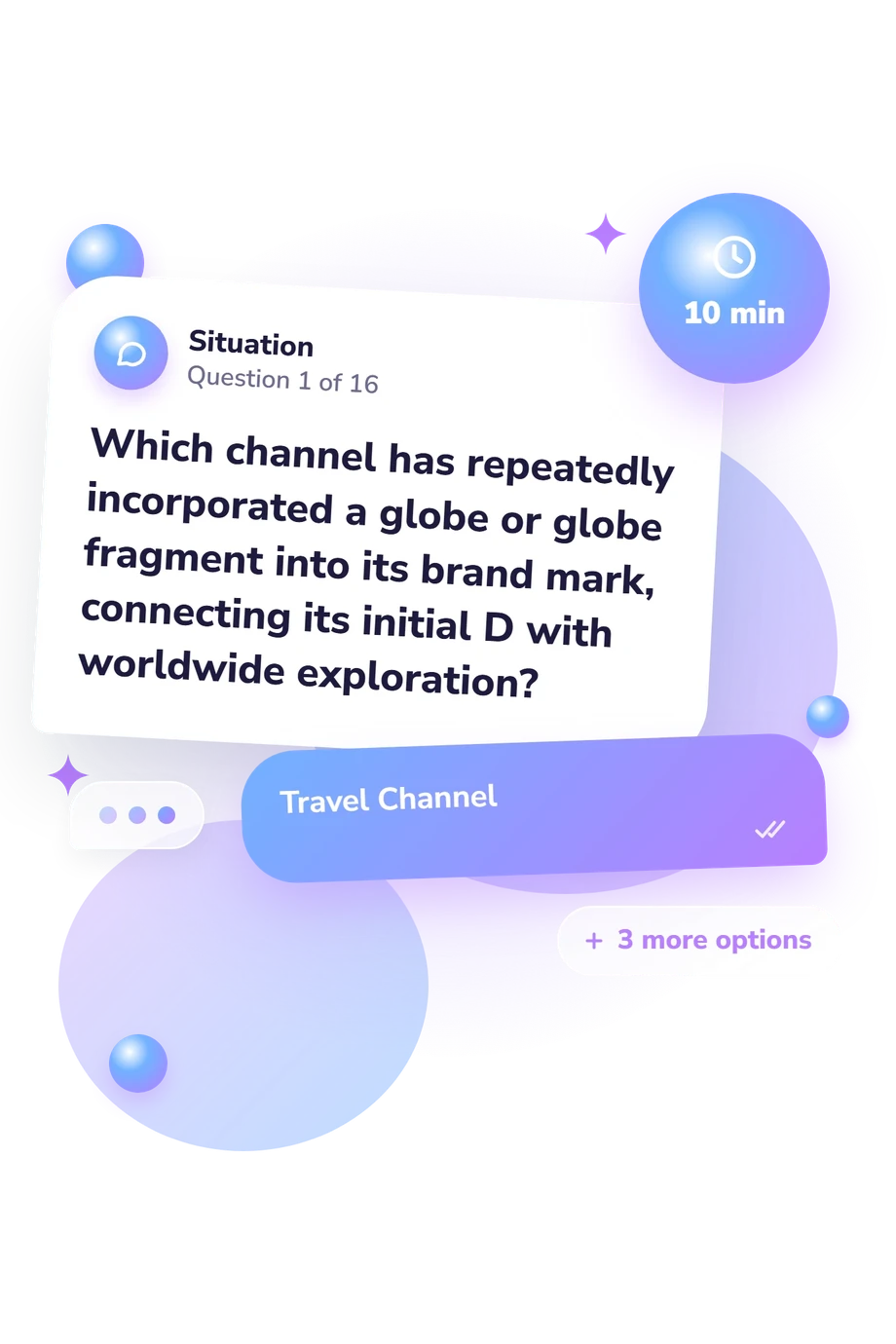
- Travel Channel
- National Geographic
Logo Quiz TV - Description and methodology of the test
People curious about media design may use Logo Quiz TV when deciding whether a short branding challenge suits their interests. It suits viewers, media fans, and anyone considering this American television logo quiz as a light way to explore familiarity with channel identities. The overall result supports self-reflection about broad recognition across the included brands, rather than identifying which individual channels someone knows best.
What This Assessment Explores
The assessment examines recognition of American television branding for visitors interested in identifying familiar channel identities. Across the TV channels included in this logo quiz, the items ask visitors to identify brands from a globe, eye, peacock, geometric emblem, color pattern, or wordmark rather than from program knowledge.
The displayed scale is American TV Logo Knowledge, ranging from 0-16. Its bands are Logo Learner (0-6), Channel Spotter (7-12), and Logo Expert (13-16), showing increasing accuracy with brand features that may change over time.
The questions fall into four thematic groups:
- Broadcast networks show whether eye, peacock, and compact letter marks are easy to distinguish.
- News and sports brands indicate recognition of bold wordmarks and directional lettering.
- Factual and lifestyle channels show whether framed, circular, or geometric identities are recognizable.
- Children's and public-media brands show how color and playful lettering contribute to recognition.
Methodology and Evidence Base
Each item describes a logo or design clue and offers four channel names as answer choices. Selecting the best match measures recognition of those visual features and the ability to distinguish similar brand elements. Recognition in this TV logo quiz depends on prior exposure to U.S. television and on whether someone remembers a current or older version of a mark.
Patalappa and Chandramouli (2021) examine logo recognition after visual makeovers, which is conceptually relevant to identifying the altered or familiar marks in this quiz. This questionnaire is conceptually consistent with that recognition demand, but it is not an adaptation of their instrument. Valkenburg and Buijzen (2005) link television exposure with brand awareness, while Ghosh, Sreejesh, and Dwivedi (2022) distinguish memory effects for pictorial and textual brand elements.
The score summarizes performance on this question set, and the displayed bands are descriptive interpretations of the 0-16 result. Exposure, cultural background, redesigns, and momentary uncertainty can affect recognition, so the result is a snapshot of channel-logo familiarity and a prompt for self-reflection.
- Kiran Kumar Jakkur Patalappa and Supriya Maganahalli Chandramouli. "Robust recognition of logo under makeover in the context of content piracy." Global Transitions Proceedings, 2(2), 421-428 (2021). 10.1016/j.gltp.2021.08.050
- Patti M. Valkenburg and Moniek Buijzen. "Identifying determinants of young children's brand awareness: Television, parents, and peers." Journal of Applied Developmental Psychology, 26(4), 456-468 (2005). 10.1016/j.appdev.2005.04.004
- Tathagata Ghosh, Sreejesh S., and Yogesh Dwivedi. "Brand logos versus brand names: A comparison of the memory effects of textual and pictorial brand elements placed in computer games." Journal of Business Research, 147, 222-235 (2022). 10.1016/j.jbusres.2022.04.017
Updated: