
Mario and Luigi Quiz
How the Scales are Structured
Who Usually Takes This Test?
See How You Compare
Below is a preview of how scores are typically distributed across each scale.
Example Questions From the Test
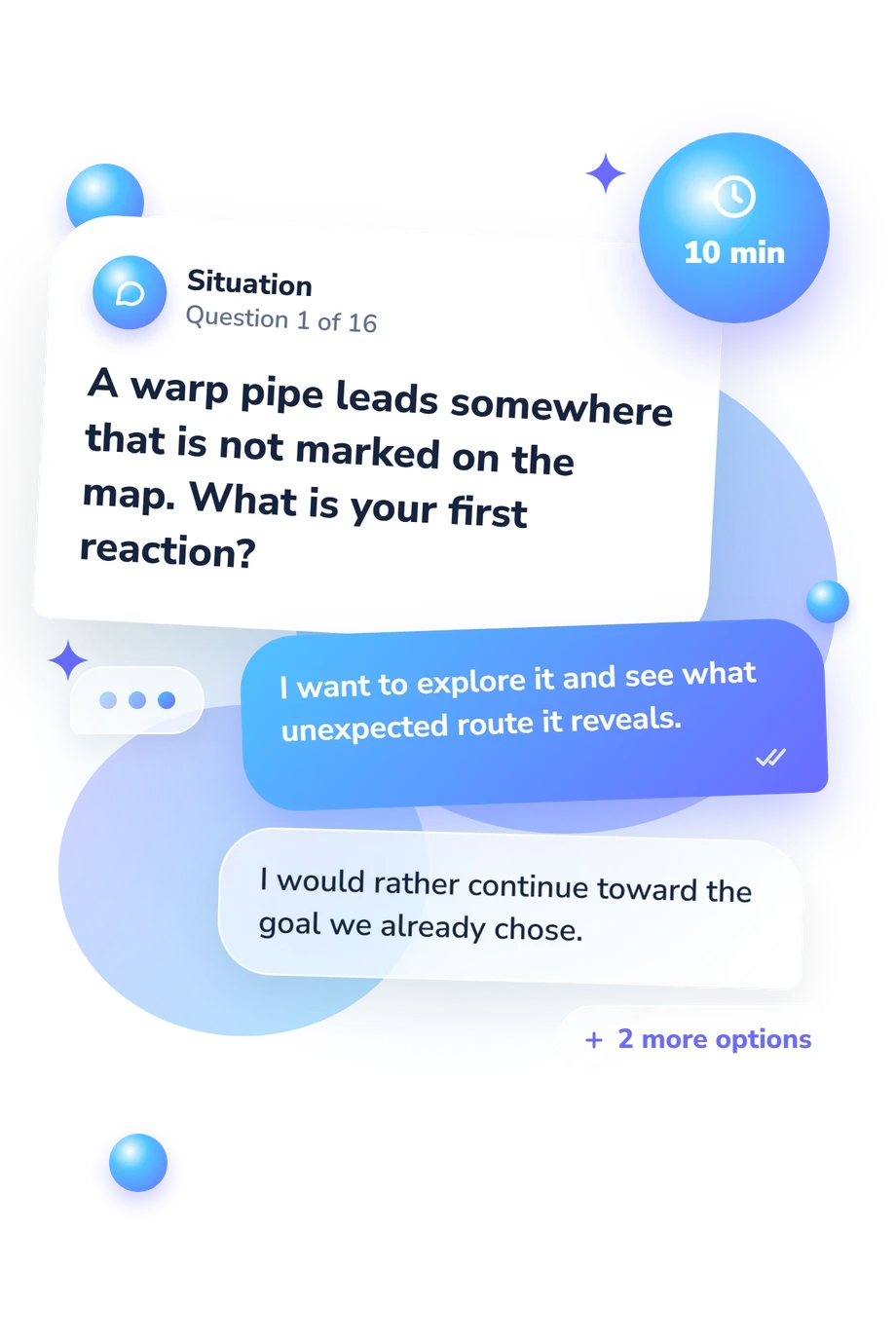
- I want to explore it and see what unexpected route it reveals.
- I would rather continue toward the goal we already chose.
- I check whether the group has time for a short detour.
- I investigate for clues before deciding whether to enter.
- Take charge of one activity and make it excellent without entering the larger debate.
- Hear both priorities and propose a plan that gives each group a meaningful part.
- Ask everyone to vote quickly so preparations can resume.
- Help representatives from both groups develop the compromise themselves.
- Demonstrate a new plan immediately and invite everyone to follow.
- Lighten the mood and see what spontaneous opportunity appears.
- Restate the shared goal, identify current needs, and coordinate new roles.
- Check in with a few people, then suggest a direction based on their input.
Mario and Luigi Quiz - Description and methodology of the test
Readers who enjoy playful character comparisons may find the Mario and Luigi Quiz useful for viewing several qualities side by side. Rather than declaring one winner, this character affinity profile brings initiative, caution, diplomacy, and curiosity into the same picture. It suits anyone who enjoys fictional worlds and wants to consider how distinct character-inspired strengths can coexist in their own responses.
What This Assessment Explores
Scenarios examine how a person acts, prepares, connects, and adapts. Rather than a single identity, the profile shows several affinities. These character-inspired traits are grouped as follows:
- Luigi Affinity (0-12) reflects cautious preparation, sensitivity, and courage despite uncertainty; Different Route (0-4), Thoughtful Courage (5-8), and Quietly Brave (9-12) mark lower, middle, and stronger alignment.
- Mario Affinity (0-12) reflects initiative, energetic competition, direct action, and recovery after setbacks; Measured Pathfinder (0-4), Situational Starter (5-8), and Bold Adventurer (9-12) mark lower, middle, and stronger alignment.
- Princess Peach Affinity (0-12) reflects diplomacy, composed leadership, community awareness, and uniting differing priorities; Independent Contributor (0-4), Collaborative Host (5-8), and Gracious Leader (9-12) show lower, middle, and stronger coordination.
- Yoshi Affinity (0-12) reflects playfulness, curiosity, adaptability, and cheerful support; Steady Specialist (0-4), Flexible Companion (5-8), and Playful Explorer (9-12) show structured, balanced, or exploratory engagement.
Methodology and Evidence Base
Each item presents a short Mushroom Kingdom situation with four reactions. Choices address preparation, initiative, coordination, experimentation, and support, so the task asks what feels natural rather than testing game knowledge. Its preference-based self-report format records these choices without judging performance.
Results present four displayed affinity ranges, creating a comparative profile rather than a single winner. Exact point assignment and external norms are not specified, so the bands function as descriptive labels rather than validated cutoffs.
Research by Cynthia Hoffner and Martha Buchanan on wishful identification, work by Jonathan Cohen on media-character identification, and Eden and colleagues' discussion of personality traits in character perception offer broad conceptual context, not evidence validating this questionnaire, its four displayed scales, or its scoring.
Responses can shift with mood, imagined context, and self-awareness, so the profile is best read as a reflection prompt rather than a diagnosis.
- Hoffner, Cynthia, and Martha Buchanan. (2005). Young Adults' Wishful Identification With Television Characters: The Role of Perceived Similarity and Character Attributes. Media Psychology, 7(4), 325-351. 10.1207/S1532785XMEP0704_2
- Eden, Allison, Mary Beth Oliver, Ron Tamborini, Anthony Limperos, and Julia Woolley. (2015). Perceptions of Moral Violations and Personality Traits Among Heroes and Villains. Mass Communication and Society, 18(2), 186-208. 10.1080/15205436.2014.923462
- Cohen, Jonathan. (2001). Defining Identification: A Theoretical Look at the Identification of Audiences With Media Characters. Mass Communication and Society, 4(3), 245-264. 10.1207/S15327825MCS0403_01
Updated: