
Fast Food Slogans Quiz
How the Scales are Structured
Who Usually Takes This Test?
See How You Compare
Below is a preview of how scores are typically distributed across each scale.
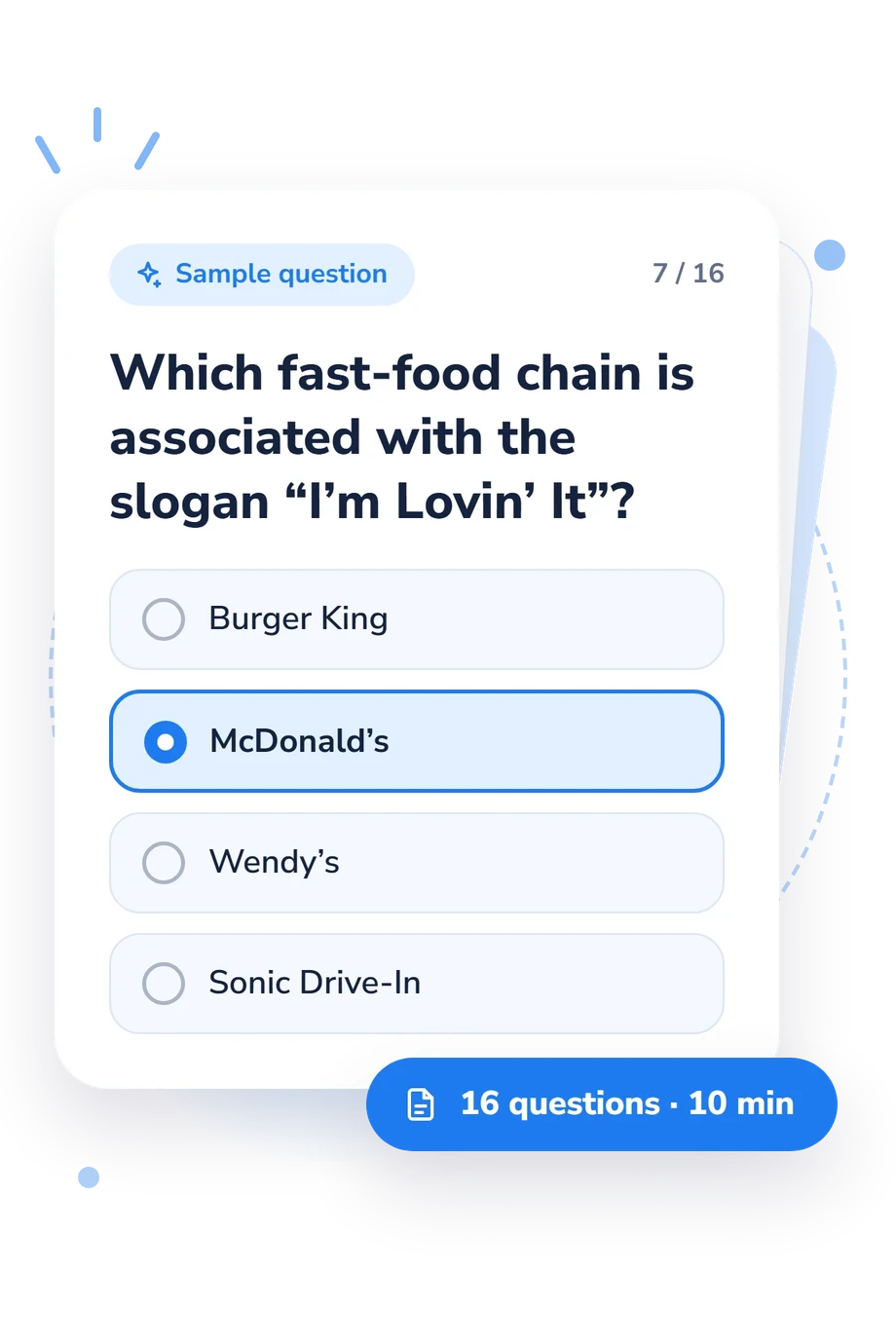
Example Questions From the Test
- Wendy’s
- Jack in the Box
- McDonald’s
- Burger King
- McDonald’s
- Burger King
- Wendy’s
- Hardee’s
- Sonic Drive-In
- Culver’s
- Dairy Queen
- A&W Restaurants
Fast Food Slogans Quiz - Description and methodology of the test
For anyone who enjoys advertising trivia, the fast food slogans quiz offers a focused way to test recognition of memorable brand language. As a quiz about restaurant slogans, it suits readers curious about how campaigns stay in memory, whether they grew up with these commercials or simply notice marketing phrases. The result summarizes recognition across the slogans covered and places overall performance within a knowledge band.
What This Assessment Explores
Rather than measuring opinions or personality, this fast food slogan test examines recognition of lines linked with major United States fast-food chains. Each clue asks the reader to connect a slogan, jingle, campaign idea, or advertising scene with the correct brand. The questions group into these recognition tasks:
- Brand attribution shows whether a familiar phrase leads you to the right chain.
- Historical familiarity indicates whether older campaigns remain recognizable.
- Wording precision reveals whether competing taglines stay distinct in memory.
- Context recognition shows whether a short scenario still points to the correct brand.
The displayed scale, Fast Food Slogans Knowledge (0-16), summarizes recognition of widely used or historical United States advertising lines. Campaign Starter (0-6) means a few famous lines are familiar; Developing Recall (7-12) indicates broader but incomplete recognition; Slogan Savvy (13-16) reflects strong knowledge across brands and advertising eras.
Methodology and Evidence Base
The format is a multiple-choice recognition task: all 16 items present a slogan or short advertising clue with four brand options. The respondent chooses the association that seems correct, so the exercise tests recognition and discrimination rather than opinion. As a fast food advertising quiz, it rewards familiarity with wording, campaign history, and brand context.
The final total is assigned to a displayed band describing performance within this item set, not a population norm. Exposure to United States media, generation, location, attention, and guessing can influence the outcome. Recognition also does not necessarily mean a person remembers a campaign independently of repeated advertising.
Dobzhanska-Knight and Voitko (2017) provide contextual work on linguistic and persuasive techniques in fast-food slogans, showing how wording can attract attention and support brand association. This questionnaire is conceptually consistent with that work, not an adaptation of it. Reece, Van den Bergh, and Li (1994) provide related work on slogan memory, including which advertising lines people remember. Neither source establishes standardization or validity for this particular quiz.
- Nataliia Dobzhanska-Knight and Khrystyna Voitko. "Linguistic Manipulative Techniques in Advertising Slogans of Fast Food Restaurants." East European Journal of Psycholinguistics, 4(2), 14-23, 2017. 10.29038/eejpl.2017.4.2.dob
- Bonnie B. Reece, Bruce G. Van den Bergh, and Hairong Li. "What Makes a Slogan Memorable and Who Remembers It." Journal of Current Issues & Research in Advertising, 16(2), 41-57, 1994. 10.1080/10641734.1994.10505018
Updated: