
Hot Dog or Legs Quiz
How the Scales are Structured
Who Usually Takes This Test?
See How You Compare
Below is a preview of how scores are typically distributed across each scale.
Example Questions From the Test
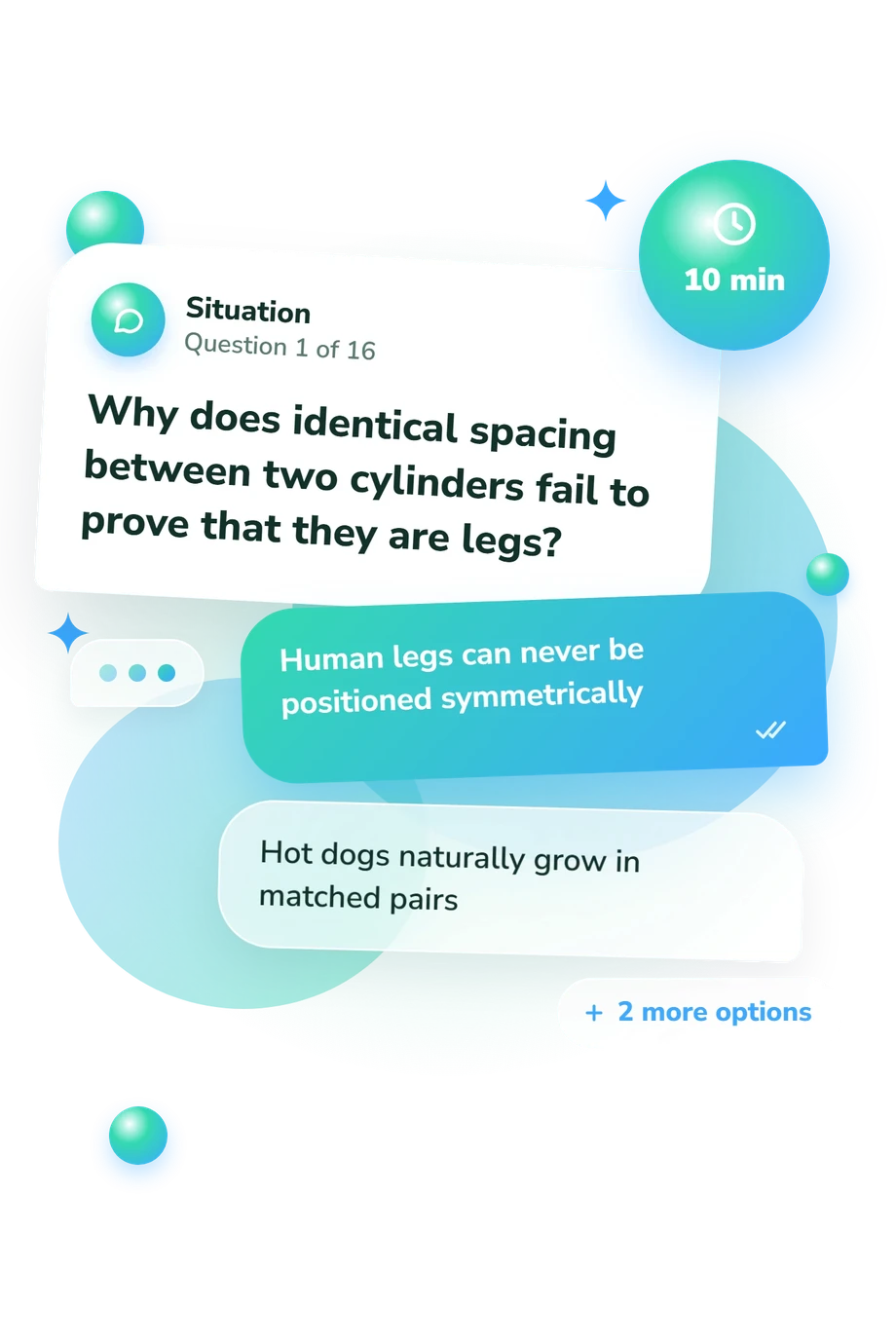
- Human legs can never be positioned symmetrically
- Hot dogs naturally grow in matched pairs
- Spacing reveals material but not shape
- Food items can be deliberately arranged in a symmetrical pair
- A narrow line of reflected light
- A uniformly rounded tip without joints
- A foot with toes arranged beyond an ankle
- A slight curve caused by gravity
- A smooth, warm-colored surface on both forms
- Kneecaps located where each form changes direction at a joint
- Nearly equal length and parallel placement
- A bright highlight running along each upper surface
Hot Dog or Legs Quiz - Description and methodology of the test
Readers who enjoy visual puzzles or want to examine how they weigh structural and contextual clues can use this assessment as a focused exercise. The Hot Dog or Legs Quiz suits people curious about reasoning in written cropped-photo scenarios. As a hot dog versus leg quiz, it examines how anatomy, food cues, perspective, lighting, and context influence interpretation, with the result focused on this exercise rather than general observation ability.
What This Assessment Explores
The questions examine visual discrimination under uncertainty. In the legs or hotdogs quiz, the task is to separate structural evidence from superficial resemblance in a described crop. The result suits readers examining reasoning when color or symmetry misleads.
The main clue groups are:
- Anatomy shows whether joints, feet, toes, and nails support a leg interpretation.
- Food features reveal whether buns, casings, grill marks, or condiments support a hot-dog interpretation.
- Context and image conditions show how surroundings, lighting, perspective, and cropping alter confidence.
Hot Dog or Legs Knowledge (0-16) reflects knowledge of visual cues and reasoning used to distinguish hot dogs from human legs in described cropped-photo scenarios, not performance on an actual image set. Foundation (0-6) calls for reviewing dependable cues; Developing Observer (7-12) recognizes many clues but may overvalue color, symmetry, or setting; Sharp Observer (13-16) combines structure with context and recognizes inconclusive crops.
Methodology and Evidence Base
Each item presents a written visual-reasoning prompt with four answer options. The hot dog or legs questions ask which clue is strongest, which inference is justified, or when evidence remains insufficient, rather than requiring a simple label. The score is reported in descriptive bands for this exercise rather than against a reference population.
Biederman's recognition-by-components framework offers a general part-based account of how component structure can support object recognition. Research by Davenport and Potter and by Oliva and Torralba treats surrounding scene context as a contributor to recognition, while Zhang et al. (2020) likewise examines contextual influence. These works are conceptual parallels, not validation studies for this questionnaire's items or scoring, and the questionnaire is conceptually consistent with them rather than an adaptation of them.
Interpret the outcome as a snapshot of evidence weighting. A higher band suggests more consistent use of shape, anatomy, food markers, and context within this exercise, not general visual ability. Written scenarios, familiarity with the cue vocabulary, and momentary attention can shift performance when several interpretations remain plausible.
- Zhang, Mengmi, Claire Tseng, and Gabriel Kreiman. “Putting Visual Object Recognition in Context.” Proceedings of the IEEE/CVF Conference on Computer Vision and Pattern Recognition (CVPR), 2020, pp. 12985-12994.
- Davenport, Jodi L., and Mary C. Potter. “Scene Consistency in Object and Background Perception.” Psychological Science, vol. 15, no. 8, 2004, pp. 559-564. 10.1111/j.0956-7976.2004.00719.x
- Biederman, Irving. “Recognition-by-Components: A Theory of Human Image Understanding.” Psychological Review, vol. 94, no. 2, 1987, pp. 115-147. 10.1037/0033-295X.94.2.115
- Oliva, Aude, and Antonio Torralba. “The Role of Context in Object Recognition.” Trends in Cognitive Sciences, vol. 11, no. 12, 2007, pp. 520-527. 10.1016/j.tics.2007.09.009
Updated: