
Manual Testing Quiz
How the Scales are Structured
Who Usually Takes This Test?
See How You Compare
Below is a preview of how scores are typically distributed across each scale.
Example Questions From the Test
- Decision table testing
- Boundary value analysis
- State transition testing
- Error guessing alone
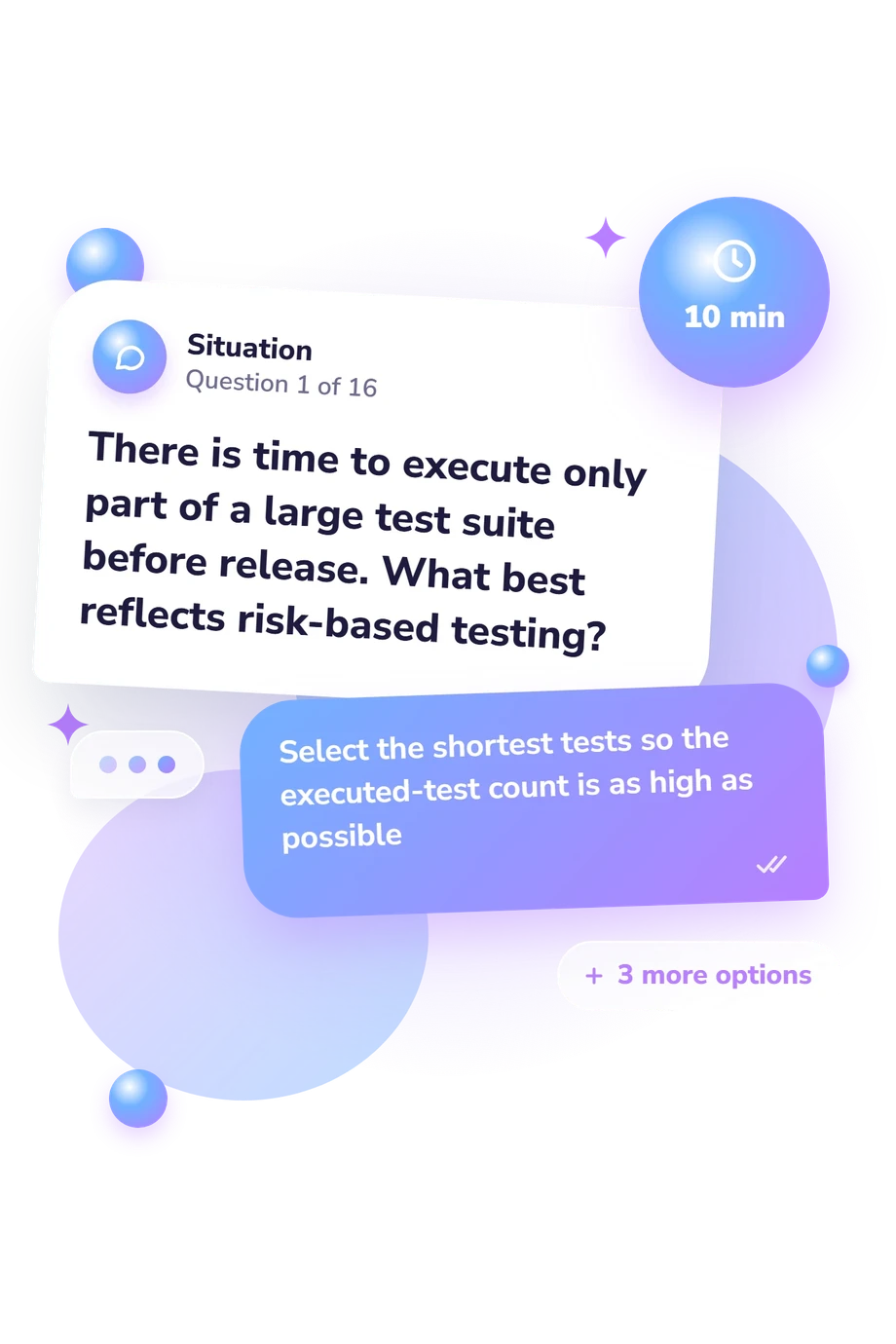
- Select the shortest tests so the executed-test count is as high as possible
- Test features alphabetically to avoid subjective choices
- Test only the newest screens because older functions have already been used
- Prioritize areas where failure is more likely or would have greater user or business impact
- 1, 25, 50, and 100
- 0, 1, 2, 99, 100, and 101
- 10, 20, 30, 40, and 50
- Only 0 and 101
Manual Testing Quiz - Description and methodology of the test
People who are learning software testing or refreshing workplace fundamentals can use this assessment to check whether core concepts translate into practical decisions. An online manual testing quiz supports focused revision for learners and working testers. The manual testing quiz questions show how confidently a respondent recognizes techniques, evaluates risk, handles defects, and considers release readiness. The result points to strengths and topics that merit further study.
What This Assessment Explores
These scenarios assess practical manual testing knowledge rather than tool-specific commands or programming. They ask the respondent to select an appropriate technique, action, artifact, or interpretation for situations involving requirements, user flows, data limits, changing builds, defects, and release decisions.
Across the manual testing questions, four connected areas are emphasized:
- Test design choices show whether you can match decision tables, equivalence partitioning, boundary value analysis, and state transition testing to a situation.
- Risk and prioritization indicate how you weigh likelihood, impact, and limited execution time.
- Defect and change handling reveal whether you distinguish retesting from regression and record usable evidence.
- Planning and quality information reflect understanding of smoke tests, exploratory testing, exit criteria, traceability, and test oracles.
The resulting profile indicates where core concepts are secure and where targeted review may help.
Methodology and Evidence Base
Response options are concise multiple-choice alternatives attached to testing scenarios. The best choice follows the principle being tested: decision tables organize combinations, boundary analysis probes limits, and risk-based testing directs scarce effort toward consequential exposure. Other items address defect reports, coverage, exit criteria, and expected results.
The methodology uses an applied knowledge-check approach. ISTQB CTFL Syllabus v4.0.1 (2024) supplies the closest framework for testing concepts. ISO/IEC/IEEE 29119-4:2021 supports test techniques, while ISO/IEC/IEEE 29119-3:2021 supports documentation topics. Ammann and Offutt add a complementary foundation for test design. This online manual testing assessment is conceptually consistent with these sources, but is not presented as a standardized adaptation of any one published instrument.
Results are summarized on one scale: Manual Testing Knowledge: 0-16. The bands are Foundation to build (0-6), Developing knowledge (7-12), and Strong knowledge (13-16). This educational score reflects answers in the questionnaire, not certification or job performance.
Guessing, current familiarity, or misunderstood terminology can affect a self-report knowledge check, so use the profile to guide review rather than as a complete evaluation of testing ability.
- Renzo Cerquozzi, Wim Decoutere, Jean-François Riverin, Arnika Hryszko, Martin Klonk, Meile Posthuma, Eric Riou du Cosquer, Adam Roman, Lucjan Stapp, Stephanie Ulrich, and Eshraka Zakaria (2024). Certified Tester Foundation Level Syllabus v4.0.1. International Software Testing Qualifications Board.
- ISO/IEC/IEEE (2021). ISO/IEC/IEEE 29119-4:2021: Software and systems engineering - Software testing - Part 4: Test techniques. International Organization for Standardization.
- ISO/IEC/IEEE (2021). ISO/IEC/IEEE 29119-3:2021: Software and systems engineering - Software testing - Part 3: Test documentation. International Organization for Standardization.
- Paul Ammann and Jeff Offutt (2016). Introduction to Software Testing (2nd ed.). Cambridge University Press. 10.1017/9781316771273
Updated: