
Have Has Quiz
How the Scales are Structured
Who Usually Takes This Test?
See How You Compare
Below is a preview of how scores are typically distributed across each scale.
Example Questions From the Test
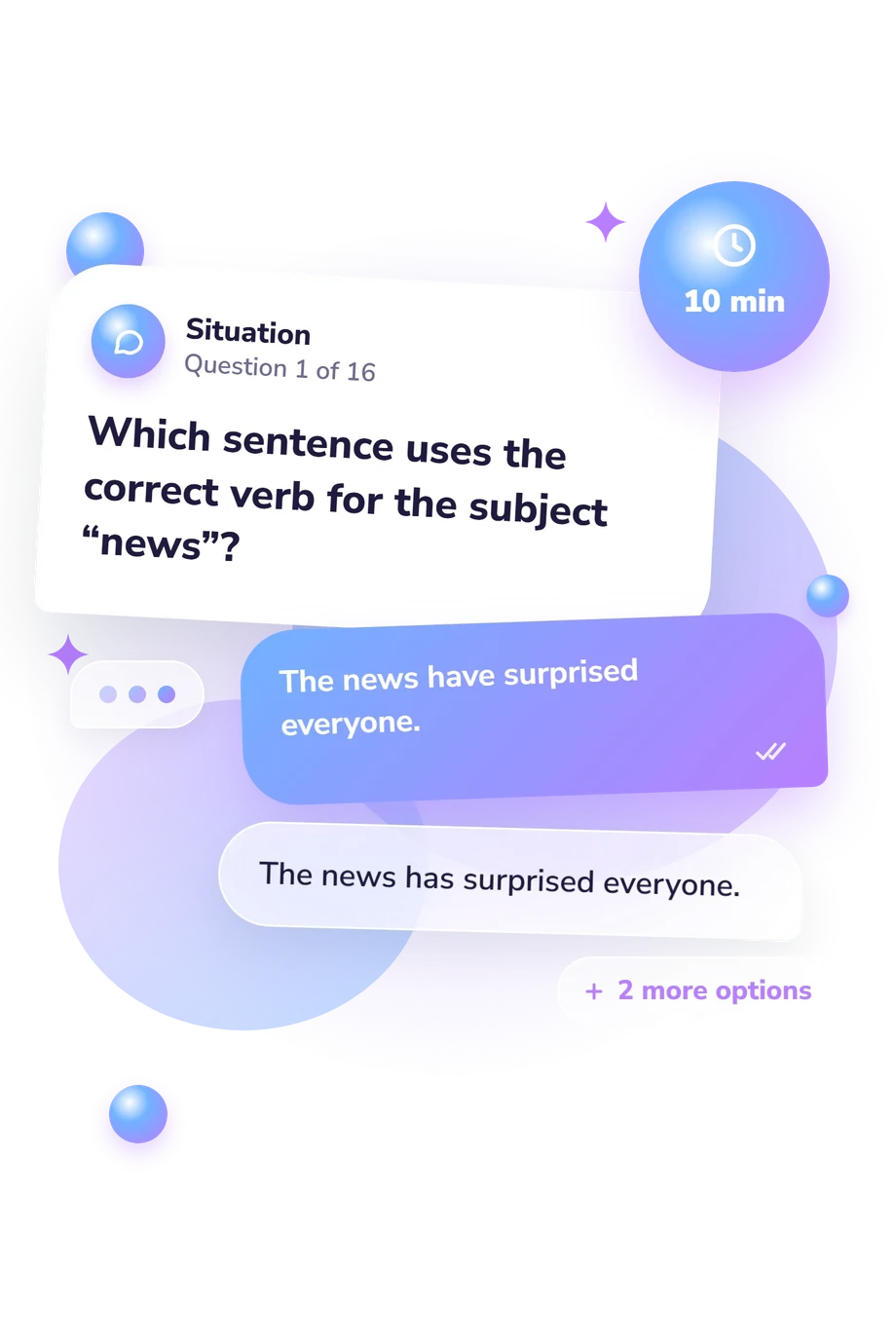
- The news have surprised everyone.
- The news has surprised everyone.
- The news are have surprised everyone.
- The news having surprised everyone.
- One of my friends have moved abroad.
- One of my friends having moved abroad.
- One of my friends has moved abroad.
- One of my friends are have moved abroad.
- have
- has
- having
- do have
Have Has Quiz - Description and methodology of the test
English learners who want to check subject-verb agreement can use the Have Has Quiz to see whether they choose the correct form in common sentence patterns. It offers focused practice with have and has through varied examples, helping learners identify patterns that need further practice. The result highlights the grammar points they can review next.
What This Assessment Explores
The test examines subject-verb agreement involving have and has, including cases where person, number, or sentence structure makes the choice less obvious. Items include singular and plural nouns, compound subjects, pronouns, each, neither, and noun phrases that can mislead learners. Questions, negatives, and present-perfect sentences extend the check beyond statements.
For a learner using this grammar quiz on have and has, the result indicates which patterns are secure and which deserve review. It can show whether errors cluster around singular or plural subjects, compound subjects, pronouns, or questions and negatives.
The result uses one scale:
- Have/Has Knowledge (0-16) shows how accurately the learner selects the two forms across the tested structures.
- Foundations to build (0-6) signals core pairings to review; Developing knowledge (7-12) indicates familiar patterns with some gaps; Strong knowledge (13-16) indicates accurate use in common and complex structures.
Methodology and Evidence Base
Each item presents a sentence or context with four answer choices. The learner selects the form that fits the subject and construction; distractors may use the wrong form, another auxiliary, or an incomplete combination. This format tests recognition and application rather than open-ended explanation.
Scoring is direct: every correct answer contributes one point. The displayed bands summarize performance on these 16 items without assigning external proficiency norms.
The grammar distinctions are conceptually consistent with the subject-verb agreement and auxiliary patterns discussed by Huddleston and Pullum. Parrott presents the same contrasts for English-language teaching, while Quirk and colleagues describe wider clause and verb patterns. These sources explain the grammatical rationale; they do not make this questionnaire a standardized adaptation of a published instrument.
Reviewing missed items by subject type or sentence structure can guide additional have and has exercises. The result is best read as feedback on tested choices, not a complete measure of English proficiency; guessing, attention, familiarity with examples, and current study context can affect performance.
- Huddleston, Rodney, and Geoffrey K. Pullum. 2002. The Cambridge Grammar of the English Language. Cambridge: Cambridge University Press. 10.1017/9781316423530
- Parrott, Martin. 2010. Grammar for English Language Teachers. 2nd ed. Cambridge: Cambridge University Press. 10.1017/9781009406536
- Quirk, Randolph, Sidney Greenbaum, Geoffrey Leech, and Jan Svartvik. 1985. A Comprehensive Grammar of the English Language. London: Longman.
Updated: