
Inner Demons Quiz
How the Scales are Structured
Who Usually Takes This Test?
See How You Compare
Below is a preview of how scores are typically distributed across each scale.
Example Questions From the Test
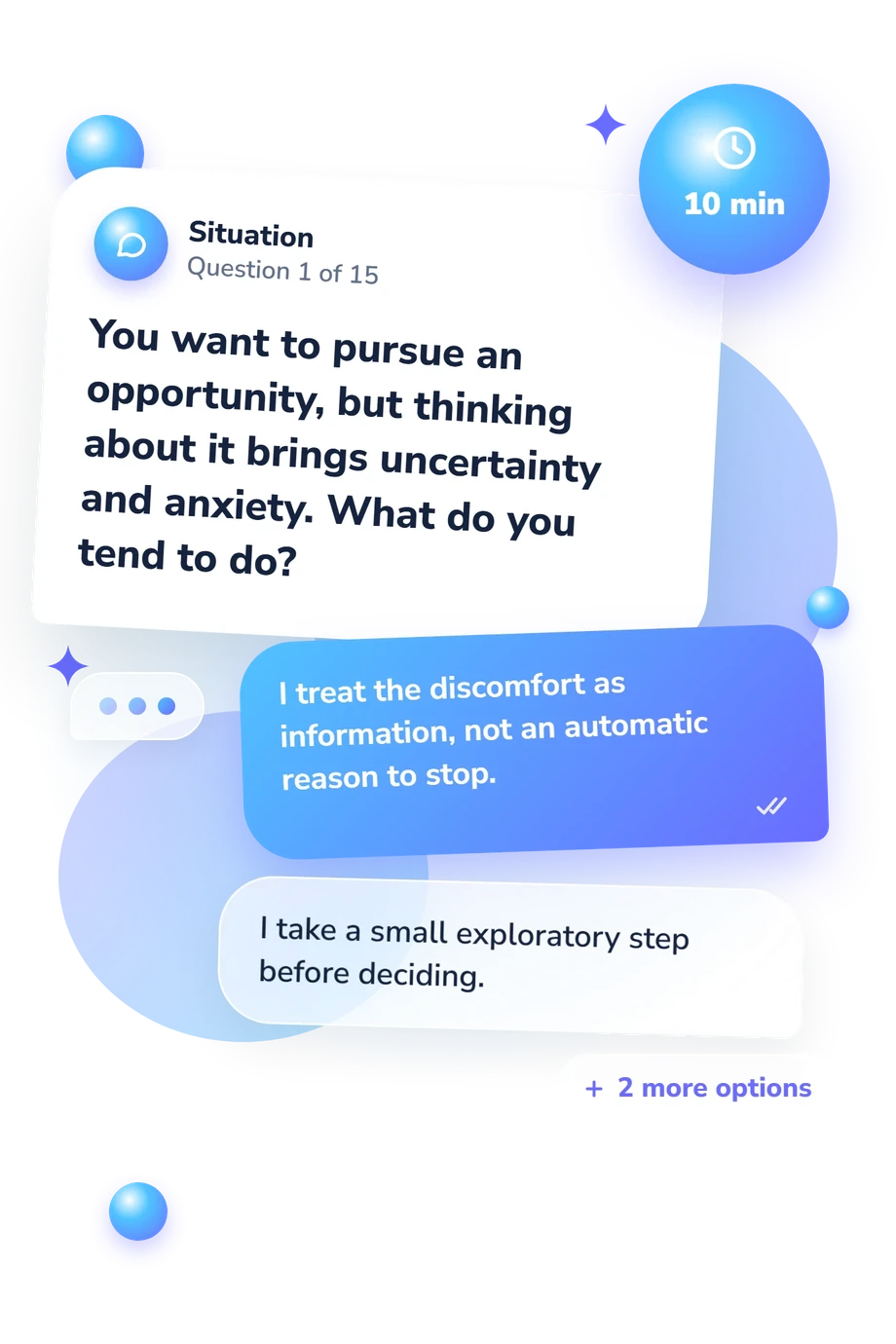
- I treat the discomfort as information, not an automatic reason to stop.
- I take a small exploratory step before deciding.
- I delay the decision while waiting to feel confident.
- I rule out the opportunity mainly so the uncomfortable feelings will end.
- I suspect they are being generous and focus on what was still imperfect.
- I appreciate it, though part of me checks whether the praise is justified.
- I accept the compliment as one reasonable view of my work.
- I dismiss it internally because they probably have not noticed my shortcomings.
- I feel a brief comparison, then return attention to my own path.
- I can recognize their achievement without using it to measure my worth.
- I start listing the ways I am behind.
- The comparison becomes a harsh verdict on my value or potential.
Inner Demons Quiz - Description and methodology of the test
People who want to understand why tension, criticism, uncertainty, or difficult feelings can influence their reactions may find the Inner Demons Quiz useful. Asking what is your inner demon quiz designed to explore can lead into personal reflection, helping readers notice patterns in conversations, decisions, self-evaluation, and emotional coping before a response becomes automatic.
What This Assessment Explores
As an inner demons test, this questionnaire places internal patterns in everyday settings: opportunity, praise, comparison, feedback, changed plans, difficult feelings, mistakes, rest, and conflict. These results help readers examine reactions without turning them into fixed traits. Results are organized as follows:
- Defensive Reactivity (0-15) captures rapid responses to criticism, rejection, embarrassment, or lost control: More response space (0-5), Variable response space (6-10), Fast defense pattern (11-15).
- Inner Critic (0-15) captures self-judgment around mistakes, praise, rest, and comparison: Occasional critic (0-5), Active critic (6-10), Strong critic signal (11-15).
- Emotional Avoidance (0-15) captures postponing, masking, or escaping discomfort: More willingness (0-5), Situational avoidance (6-10), Frequent escape pull (11-15).
These bands are prompts for noticing patterns, not permanent identities.
Methodology and Scientific Basis
In this inner demons assessment, each prompt uses four situational self-report choices, so the questionnaire functions as a structured reflection on emotional and interpersonal responses. Options generally move from noticing discomfort, tolerating uncertainty, or seeking clarification toward delay, suppression, defensiveness, and harsh self-judgment. This groups the items around threat interpretation, emotion management, feedback, conflict, and reactions to mistakes. Other prompts examine comparison, praise, rest, uncertainty, and waiting for a reply.
The questionnaire reports one result for each of the three dimensions, but it gives no item-by-item point key. The answer order should not be used to reconstruct scoring; the displayed bands are the questionnaire’s own summaries.
The three dimensions are conceptually consistent with the 2019 study by Moroz and Dunkley, work by Downey and Feldman on rejection sensitivity, the DERS, and Gilbert and colleagues’ research on self-criticism.
No norms, reliability estimates, or clinical cutoffs are stated. Since self-report reflects current stress, self-awareness, and impression management, results are reflective indicators rather than a diagnosis and cannot alone establish a clinical conclusion.
- Moroz, M., & Dunkley, D. M. (2019). Self-critical perfectionism, experiential avoidance, and depressive and anxious symptoms over two years: A three-wave longitudinal study. Behaviour Research and Therapy, 112, 18-27. 10.1016/j.brat.2018.11.006
- Downey, G., & Feldman, S. I. (1996). Implications of rejection sensitivity for intimate relationships. Journal of Personality and Social Psychology, 70(6), 1327-1343. 10.1037/0022-3514.70.6.1327
- Gratz, K. L., & Roemer, L. (2004). Multidimensional assessment of emotion regulation and dysregulation: Development, factor structure, and initial validation of the Difficulties in Emotion Regulation Scale. Journal of Psychopathology and Behavioral Assessment, 26(1), 41-54. 10.1023/B:JOBA.0000007455.08539.94
- Gilbert, P., Clarke, M., Hempel, S., Miles, J. N. V., & Irons, C. (2004). Criticizing and reassuring oneself: An exploration of forms, styles and reasons in female students. British Journal of Clinical Psychology, 43(1), 31-50. 10.1348/014466504772812959
Updated: