
InuYasha Character Quiz
How the Scales are Structured
Who Usually Takes This Test?
See How You Compare
Below is a preview of how scores are typically distributed across each scale.
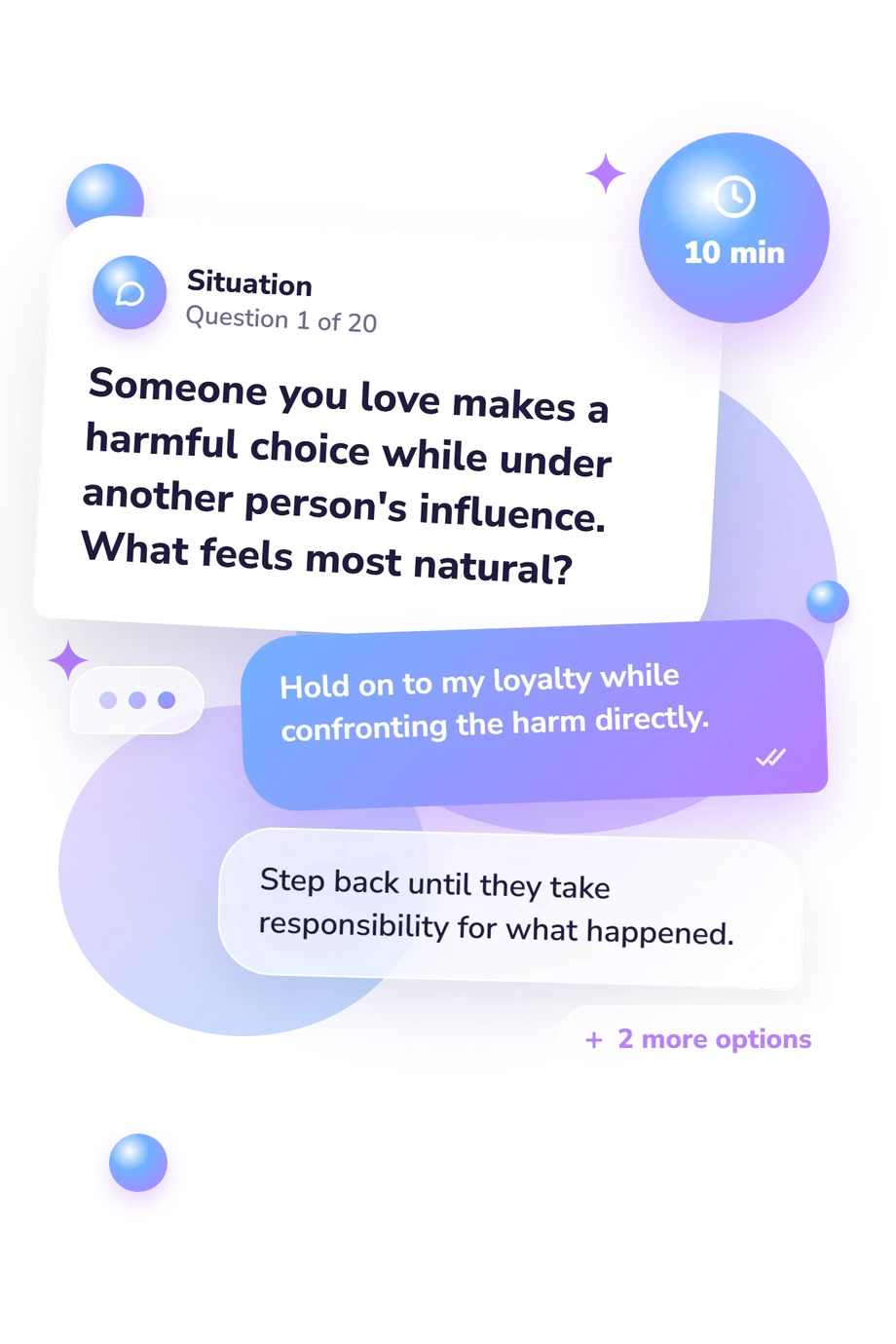
Example Questions From the Test
- Study the setting for clues and test a theory cautiously.
- Find an alternate route, even if it takes longer.
- Let the strongest group member handle the obstacle.
- Discuss several possibilities and choose by consensus.
- The commitments and rules attached to my role.
- The option that protects my closest circle.
- The human impact, especially on people who have little power.
- The choice most likely to produce a workable outcome.
- Taking the lead and meeting threats head-on.
- Keeping everyone coordinated and attentive to one another.
- Scouting independently but returning with useful information.
- Developing a careful route that minimizes confrontation.
InuYasha Character Quiz - Description and methodology of the test
Fans seeking a reflective character match can use the InuYasha Quiz Which Character Are You to examine how they respond to loyalty, conflict, affection, uncertainty, and shared responsibility. This InuYasha personality quiz suits readers who know the series and newcomers curious about its cast. Rather than forcing one label, the result presents a comparative profile of qualities that may shape choices in relationships and group situations.
What This Assessment Explores
Scenarios cover loyalty, setbacks, moral pressure, social tension, danger, affection, and group coordination. Their options contrast direct action, mediation, strategic observation, disciplined duty, emotional openness, and playful adaptation. For readers asking what InuYasha character you are, the profile compares five fictional patterns.
These dimensions appear in the result:
- InuYasha Affinity (0-12) shows direct protectiveness: Different Temperament (0-4), Shared Fire (5-8), Strong InuYasha Affinity (9-12).
- Kagome Affinity (0-12) shows empathy and bridge-building: Different Temperament (0-4), Shared Compassion (5-8), Strong Kagome Affinity (9-12).
- Miroku Affinity (0-12) shows strategic perception and composure: Different Temperament (0-4), Shared Cunning (5-8), Strong Miroku Affinity (9-12).
- Sango Affinity (0-12) shows disciplined resilience: Different Temperament (0-4), Shared Resolve (5-8), Strong Sango Affinity (9-12).
- Shippo Affinity (0-12) shows creative openness: Different Temperament (0-4), Shared Spark (5-8), Strong Shippo Affinity (9-12).
Methodology and Scientific Basis
Each item presents a situation with four responses. The options distinguish direct confrontation, mediation, strategic observation, disciplined duty, emotional openness, and playful adaptation, so the task measures preferred reactions rather than factual recall. Answers are combined into five affinity scores: the highest is the strongest resemblance, while any result within one point becomes a blended match. The ranges describe displayed bands, not an undisclosed point-weighting formula.
The interpretive framework is conceptually consistent with Wanderley (2006), whose semiotic analysis emphasizes recurring contrasts, relationships, and choices in character construction. Bryce (2013) offers a related account of shifting subjectivities. Takahashi’s manga supplies the fictional source, and McCarthy and Clements add anime context. This InuYasha character test is not an adaptation of those publications or a standardized psychological scale.
Results represent a snapshot of self-reported preferences. Mood, current relationships, familiarity with the series, and self-awareness can influence answers. The profile does not diagnose personality or establish clinical traits; its value lies in prompting reflection on qualities that may appear together, especially when the result is blended.
- Wanderley, Aline Majuri. "A Semiotic Description in the InuYasha Manga: Character Analysis." Estudos Semióticos, no. 2, 2006. 10.11606/issn.1980-4016.esse.2006.49178
- Bryce, Mio. "All Is Relative, Nothing Is Reliable: Inuyasha and Japanese Subjectivities." In Subjectivity in Asian Children's Literature and Film: Global Theories and Implications, edited by John Stephens, 163-180. Routledge, 2013. 10.4324/9780203098646
- Takahashi, Rumiko. Inuyasha. 18 vols. VIZ Media, 2009-2011.
- McCarthy, Helen, and Jonathan Clements. The Anime Encyclopedia: 3rd Revised Edition: A Century of Japanese Animation. Stone Bridge Press, 2015. ISBN 978-1-61172-018-1
Updated: