
Name of Quiz
How the Scales are Structured
Who Usually Takes This Test?
See How You Compare
Below is a preview of how scores are typically distributed across each scale.
Example Questions From the Test
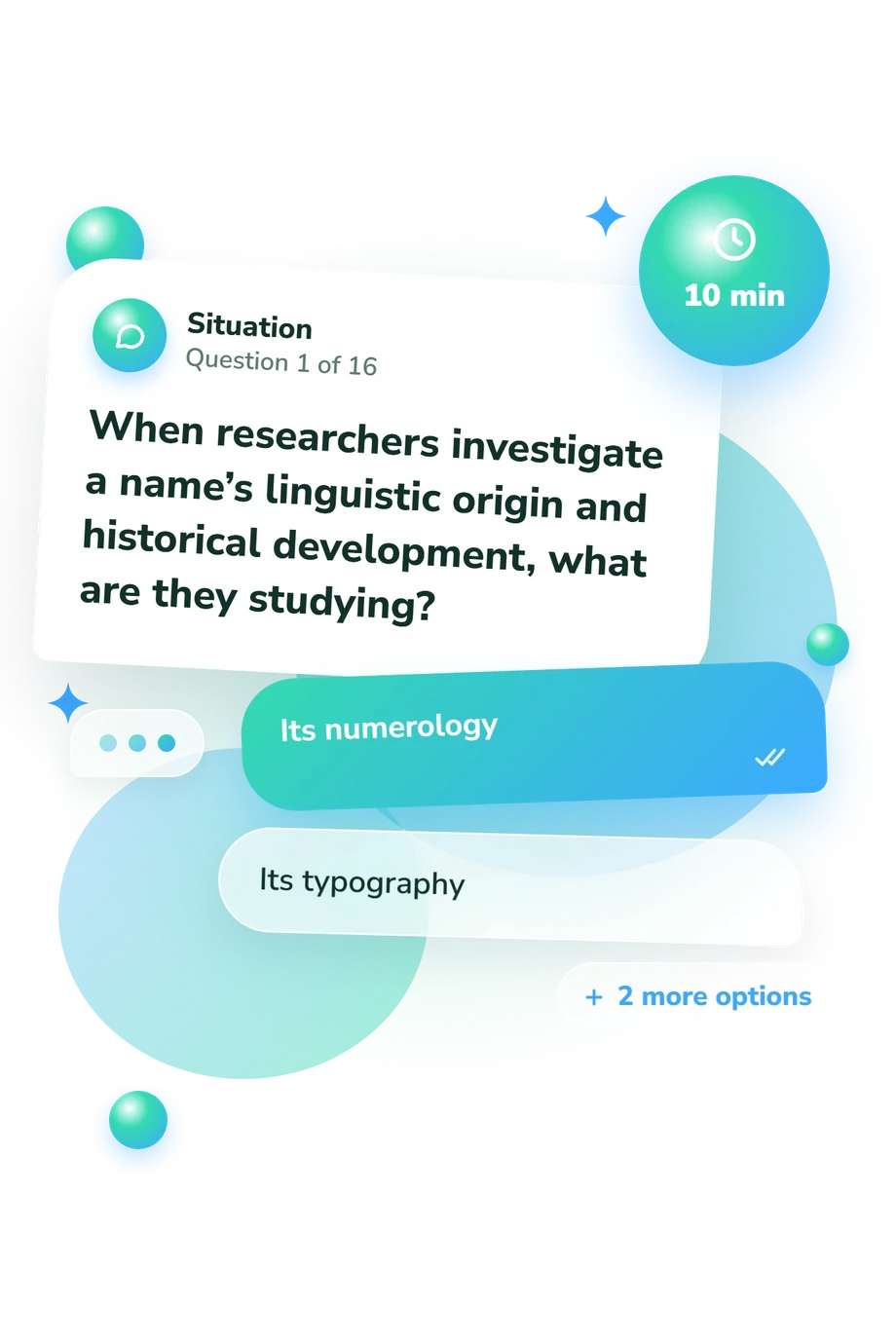
- Its numerology
- Its typography
- Its etymology
- Its syntax
- Rose and Lily
- John and Juan
- Taylor and Tyler
- Faith and Hope
- Elín is a daughter of Jón
- Elín belongs to the Jónsdóttir occupation group
- Elín comes from a place called Jón
- Elín chose Jónsdóttir as a pen name
Name of Quiz - Description and methodology of the test
Readers who want a compact name trivia quiz can use this assessment to check how comfortably they handle the language of names. Name of Quiz is suited to curious learners, students, writers, researchers, and anyone exploring naming across cultures. It turns recognition of terminology and conventions into an overall indication of performance and a general starting point for further study.
What This Assessment Explores
This questionnaire measures knowledge of terminology used for personal and place names, rather than a person's naming preferences. It covers name origins, relationships between forms in different languages, naming systems that encode family information, and conventions for using or representing names.
Questions move among etymology, cognates, patronymics, endonyms and exonyms, pseudonyms, mononyms, surname origins, diminutives, onomastics, and transliteration. This assessment is a names knowledge test for curious learners and readers interested in language, history, culture, genealogy, or literature. The result gives an overall indication of performance in this area.
The Names Knowledge scale is reported in three bands:
- Foundations to build (0-6) indicates that key terms or conventions may still be confused.
- Developing knowledge (7-12) indicates understanding of many common concepts, with room to broaden.
- Strong knowledge (13-16) indicates a well-developed grasp of terminology, origins, and conventions.
Methodology and Evidence Base
Each item presents a short scenario or definition with four answer choices. The task is recognition: select the term that best matches an example such as a regnal name, patronymic, endonym, or transliteration. This name terminology quiz samples applied vocabulary rather than personal opinions or free-form explanations.
The questionnaire reports a Names Knowledge result in the displayed bands. Its concepts are consistent with onomastic scholarship, especially Ainiala, Saarelma, and Sjöblom; Hough and Van Langendonck provide broader frameworks for naming practices and proper-name theory. The United Nations glossary supports the geographical distinctions used here. These works support the concepts tested; the questionnaire is not an adaptation of those publications, and the cited works do not validate its online scoring.
The bands are quiz-specific categories rather than population norms. Because it is self-administered, performance can reflect prior reading, language exposure, cultural familiarity, and uncertainty about one option. Naming practices also vary by family, community, language, and context, so use the result to choose topics for further study rather than infer comprehensive expertise.
- Ainiala, Terhi, Minna Saarelma, and Paula Sjöblom. Names in Focus: An Introduction to Finnish Onomastics. Translated by Leonard Pearl. Helsinki: Finnish Literature Society, 2012. DOI 10.21435/sflin.17
- Hough, Carole, editor. The Oxford Handbook of Names and Naming. Oxford: Oxford University Press, 2016. DOI 10.1093/oxfordhb/9780199656431.001.0001
- Van Langendonck, Willy. Theory and Typology of Proper Names. Berlin: De Gruyter Mouton, 2007. DOI 10.1515/9783110197853
- United Nations Group of Experts on Geographical Names. Glossary of Terms for the Standardization of Geographical Names. New York: United Nations, 2002.
Updated: