
I Have a Dream Quiz
How the Scales are Structured
Who Usually Takes This Test?
See How You Compare
Below is a preview of how scores are typically distributed across each scale.
Example Questions From the Test
- Unequal access to university scholarships
- Travelers being denied lodging at motels and hotels
- Unequal access to public health insurance
- Workers being excluded from retirement plans
- The Montgomery Bus Boycott
- The Selma to Montgomery march
- The March on Washington for Jobs and Freedom
- The Poor People’s Campaign
- Economic reform should replace demands for civil rights
- The civil rights movement needed more private donations
- The federal banking system caused racial inequality
- Rights promised by the nation had not been fully honored
I Have a Dream Quiz - Description and methodology of the test
For readers who want to examine their grasp of Martin Luther King Jr.’s landmark address, the I Have a Dream Quiz offers a focused way to revisit its historical setting, argument, and language. Students, teachers, history readers, and others can use this I Have a Dream speech quiz to connect famous lines with the ideas behind them. The result gives a picture of current knowledge rather than a personality profile.
What This Assessment Explores
The questions test recognition and interpretation rather than isolated quotation recall. They connect the speech’s historical setting with claims about unfulfilled rights, urgent justice, nonviolent action, racial equality, and collective responsibility. A speech comprehension test of this kind also asks what a metaphor, repeated phrase, sequence, or geographic pattern accomplishes.
The main themes are:
- Historical context links the March on Washington, emancipation, founding documents, and the national promise King invokes.
- Rhetorical language shows how images such as the “bad check,” “cup of bitterness,” and transformed landscape carry the argument.
- Justice and collective vision measure recognition of urgency, disciplined protest, shared effort, dignity, interracial fellowship, and freedom across the country.
The catalogue reports one result scale, I Have a Dream Knowledge (0-16). Foundation to build covers 0-6, Developing command covers 7-12, and Strong command covers 13-16. These bands describe answer-based command, from basic familiarity to integrated understanding.
Methodology and Evidence Base
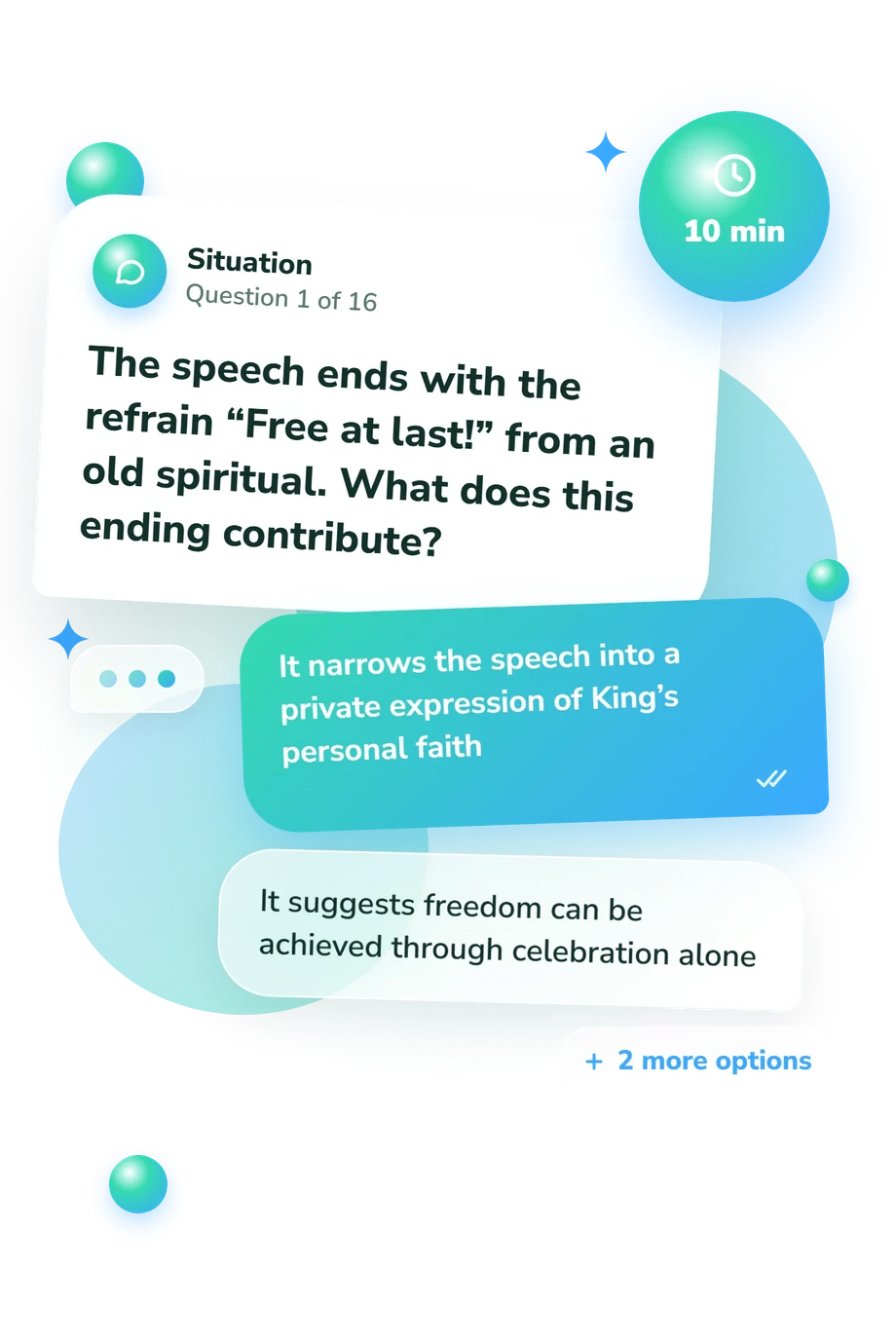
Each item presents a short prompt followed by four answer choices. The format combines factual recall with interpretation: some questions ask for a historical detail, while others ask how a passage, metaphor, repetition, or sequence functions. The total equals the number of correct answers, making the result a direct measure of performance on the tested content.
The assessment is conceptually consistent with Martin Luther King Jr.’s I Have a Dream speech, which supplies the events, images, language, and claims examined by the questions. Sundquist’s historical study supports reading the address as both a response to an unfulfilled national promise and a lasting public statement. Weitzel’s analysis helps explain why repetition, cadence, audience address, and oral performance matter to the speech’s rhetoric. These sources provide an interpretive frame; the online questionnaire is not presented as an adaptation of them.
As a historical speech quiz, the result is best read as a descriptive knowledge profile. The displayed bands describe performance on these items and do not provide a comparison with a reference population. Performance can vary with prior exposure, classroom teaching, language familiarity, and momentary recall across factual and interpretive questions.
- King, Martin Luther, Jr. “I Have a Dream,” Address Delivered at the March on Washington for Jobs and Freedom, 28 August 1963. In A Call to Conscience: The Landmark Speeches of Dr. Martin Luther King, Jr., edited by Clayborne Carson and Kris Shepard, IPM in association with Warner Books, 2001, pp. 81-87.
- Sundquist, Eric J. King’s Dream: The Legacy of Martin Luther King’s “I Have a Dream” Speech. Yale University Press, 2009.
- Weitzel, Al. “King’s ‘I Have a Dream’ Speech: A Case Study of Incorporating Orality in Rhetorical Criticism.” Communication Reports, vol. 7, no. 1, 1994, pp. 50-56. 10.1080/08934219409367583
Updated: