
Jonah Bible Quiz
How the Scales are Structured
Who Usually Takes This Test?
See How You Compare
Below is a preview of how scores are typically distributed across each scale.
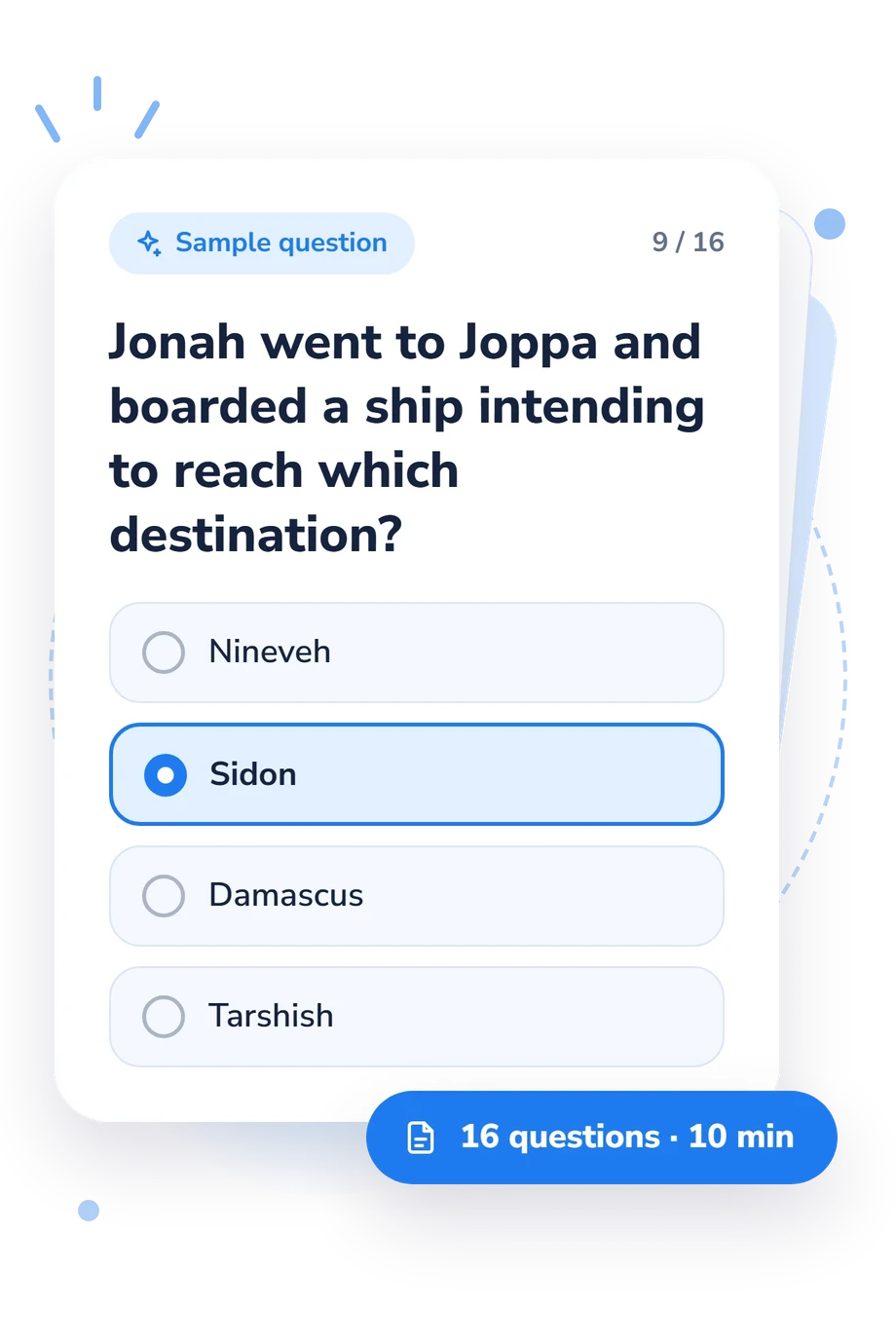
Example Questions From the Test
- They believed God, proclaimed a fast, and wore sackcloth
- They drove Jonah from the city without listening
- They asked Jonah to perform a sign before deciding
- They prepared their army to resist the announced judgment
- As the god responsible only for Israel’s farmland
- As the god of Joppa’s harbor and ships
- As one of several gods who governed the winds
- As the Lord, the God of heaven, who made the sea and dry land
- A message Jonah would compose after meeting the king
- The prayer Jonah had spoken inside the fish
- The message God would give him
- A promise that Nineveh would become Israel’s ally
Jonah Bible Quiz - Description and methodology of the test
Readers preparing for personal study, group discussion, or a Bible class can decide whether the Jonah Bible Quiz fits their purpose. It focuses on knowledge of Jonah’s narrative rather than broad biblical expertise, covering the people, places, sequence, and turning points that shape the book. A Bible knowledge test focused on Jonah is a practical choice when you want a structured starting point for discussing the text.
What This Assessment Explores
The questionnaire checks knowledge of Jonah’s narrative and central themes rather than personal opinion. Its items cover the prophet’s commission and flight, the storm, the fish, Nineveh’s response, Jonah’s anger, and God’s closing challenge. They also ask about motives, settings, sequence, and contrasts across the four chapters.
For readers taking this Jonah quiz, the result offers a snapshot of recall that can guide rereading or group discussion. It appears on one displayed scale:
- Jonah Knowledge (0-16) awards one point per correct answer: Foundation to build (0-6) marks basic familiarity; Developing knowledge (7-12) shows substantial understanding with details to sharpen; Strong knowledge (13-16) indicates a well-developed grasp of events, motivations, and the central lesson across the four chapters.
Methodology and Evidence Base
Each item uses four-option multiple choice, asking the reader to identify the best-supported detail from the biblical narrative. The question topics are conceptually consistent with Graybill et al. (2023) on Jonah’s structure, characters, and theological tensions, and with Tillema (2023), which places these interpretive issues within modern Jonah scholarship. Neither publication created or validated this questionnaire.
Each correct response adds one point, and the total reflects performance on the selected Jonah knowledge items, including recall of sequence, setting, motives, and the characters’ responses. The displayed bands make the result easy to understand without extending its meaning beyond these narrative details. The Jonah Bible questions sample one short book, so a result may change with translation wording, prior study, memory, or familiarity with particular passages.
Because the questionnaire is a text-focused online assessment, it does not measure the respondent’s faith, character, spiritual maturity, or ability to interpret every theological issue in Jonah. Use the outcome to guide rereading, checking the cited text, and discussing questions where interpretive emphasis differs.
- Graybill, Rhiannon, John Kaltner, and Steven L. McKenzie. Jonah: A New Translation with Introduction and Commentary. The Anchor Yale Bible Commentaries. New Haven: Yale University Press, 2023. ISBN 9780300206678.
- National Council of the Churches of Christ in the United States of America. New Revised Standard Version Updated Edition. 2021.
- Tillema, Aron. “The Book of Jonah in Recent Research.” Currents in Biblical Research 21, no. 2 (2023): 145-177. 10.1177/1476993X221150655
Updated: