
Plant Nutrition Quiz
How the Scales are Structured
Who Usually Takes This Test?
See How You Compare
Below is a preview of how scores are typically distributed across each scale.
Example Questions From the Test
- Plants require a macronutrient in a larger quantity.
- A macronutrient is always absorbed directly from the air.
- Only macronutrients take part in plant metabolism.
- Micronutrients are beneficial but not essential.
- More nitrate is converted into atmospheric nitrogen.
- Phosphorus can no longer be stored in seeds.
- Chlorophyll immediately loses its magnesium atoms.
- Less carbon dioxide enters the leaf for carbon fixation.
- Phloem transport driven only from roots toward leaves
- Xylem transport with the upward water stream
- Diffusion through stomata from the atmosphere
- Movement through pollen tubes into leaf veins
Plant Nutrition Quiz - Description and methodology of the test
Students, growers, and curious plant owners can use this plant nutrition quiz to check how well they understand nutrient functions, uptake, deficiency patterns, practical interactions, and observed plant responses. The assessment suits readers seeking a structured plant-science refresher or a way to connect classroom concepts with observations in growing situations. As a quiz on nutrition in plants, it offers an educational indication of stronger and weaker understanding.
What This Assessment Explores
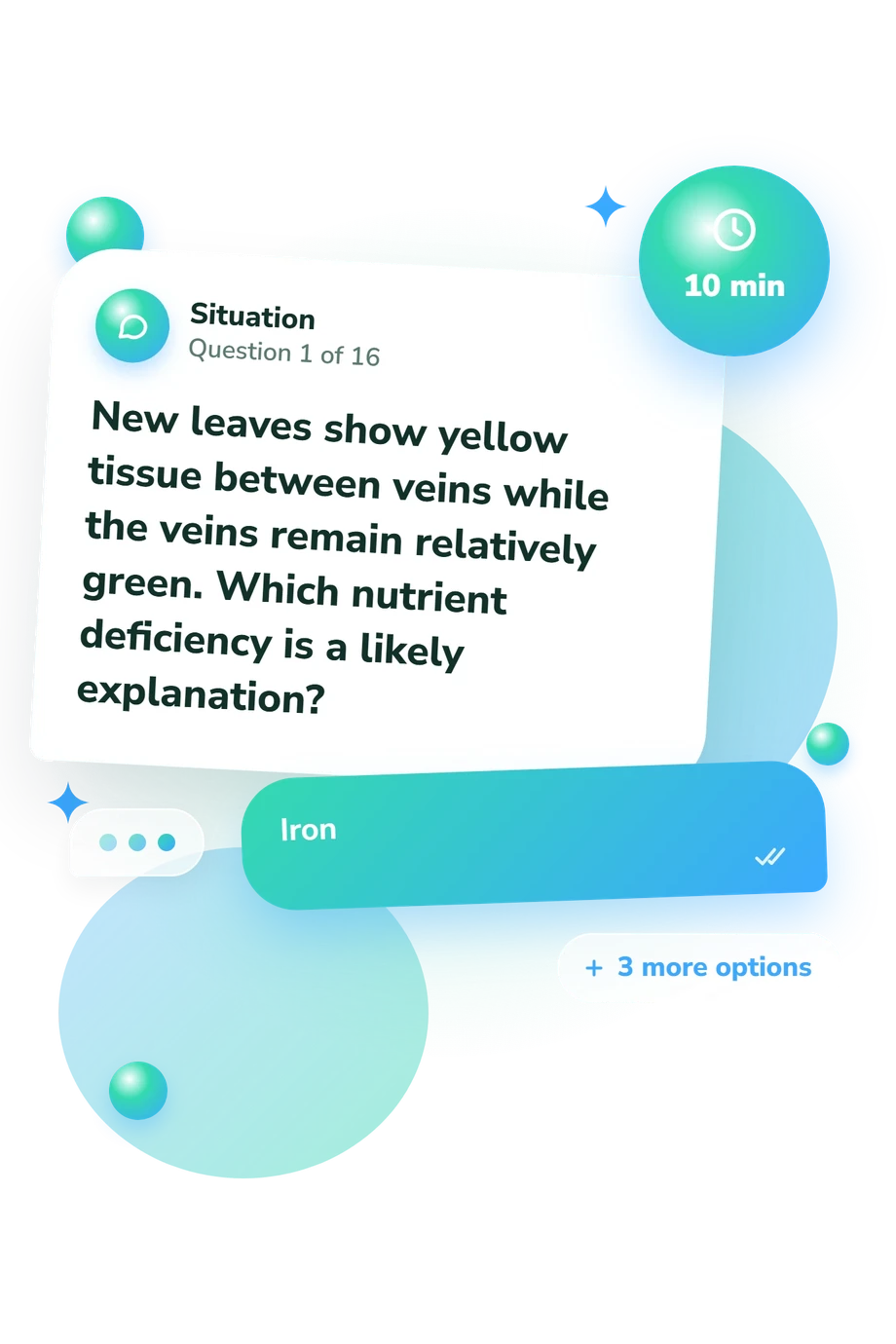
Rather than testing isolated vocabulary, this plant nutrition test examines whether you can apply core ideas. Items cover essential macronutrients and micronutrients, root uptake, transport, deficiency symptoms, fertilizer analysis, and environmental effects on availability. Several require you to connect a visible pattern-such as interveinal chlorosis, older-leaf yellowing, or damaged young tissue-with the nutrient or process most likely involved.
The main topic groups are:
- Nutrient functions show how key elements support growth and metabolism.
- Uptake and transport explain the roles of root hairs, xylem, respiration, and water movement.
- Deficiency patterns use symptom location and nutrient mobility to distinguish likely shortages.
- Growing conditions connect pH, drought, flooding, and concentrated fertilizer with plant nutrition.
The result reflects how well you handle these linked situations, helping you identify concepts to revisit and strengths to build on.
Methodology and Scientific Basis
Each item presents four answer choices about a concrete plant-nutrition situation. Selecting the best explanation requires linking nutrient mobility, ion competition, water potential, and pH-dependent solubility to observed outcomes. As a plant nutrition assessment, it uses an applied knowledge approach rather than a personality or symptom checklist.
Scoring is reported on Plant Nutrition Knowledge, 0-16. Its bands are Foundations to build (0-6), Developing knowledge (7-12), and Strong knowledge (13-16). The scale represents understanding of nutrient functions, uptake, deficiency patterns, and practical interactions. It is an educational score, not a diagnosis of a specific plant problem.
The content is conceptually consistent with learning issues discussed by Köse, Uşak, and Bahar (2009) and Mosothwane (2011), while Marschner (2012) provides the mineral-nutrition framework for functions, transport, and deficiencies. Together, they frame the concepts tested here: nutrient roles, movement through soil and plants, deficiency patterns, fertilizer interpretation, and the effects of pH, water supply, and other growing conditions.
Results can reflect prior study, wording interpretation, or guessing. Treat the band as a learning signal, then consider species, growing conditions, and direct observation when investigating an actual plant.
- Köse, Sacit, Muhammet Uşak, and Mehmet Bahar. (2009). A Cross-Age Study of Students' Understanding and Their Misconceptions About Plant Nutrition. Didactica Slovenica - Pedagoška Obzorja, 24(1), 109-122.
- Mosothwane, Modise. (2011). Senior Secondary School Children's Understanding of Plant Nutrition. Journal of College Teaching & Learning, 8(8), 15-24. 10.19030/tlc.v8i8.5318
- Marschner, Petra (Ed.). (2012). Marschner's Mineral Nutrition of Higher Plants (3rd ed.). Academic Press. 10.1016/C2009-0-63043-9
Updated: