
Possessive Pronouns Quiz
How the Scales are Structured
Who Usually Takes This Test?
See How You Compare
Below is a preview of how scores are typically distributed across each scale.
Example Questions From the Test
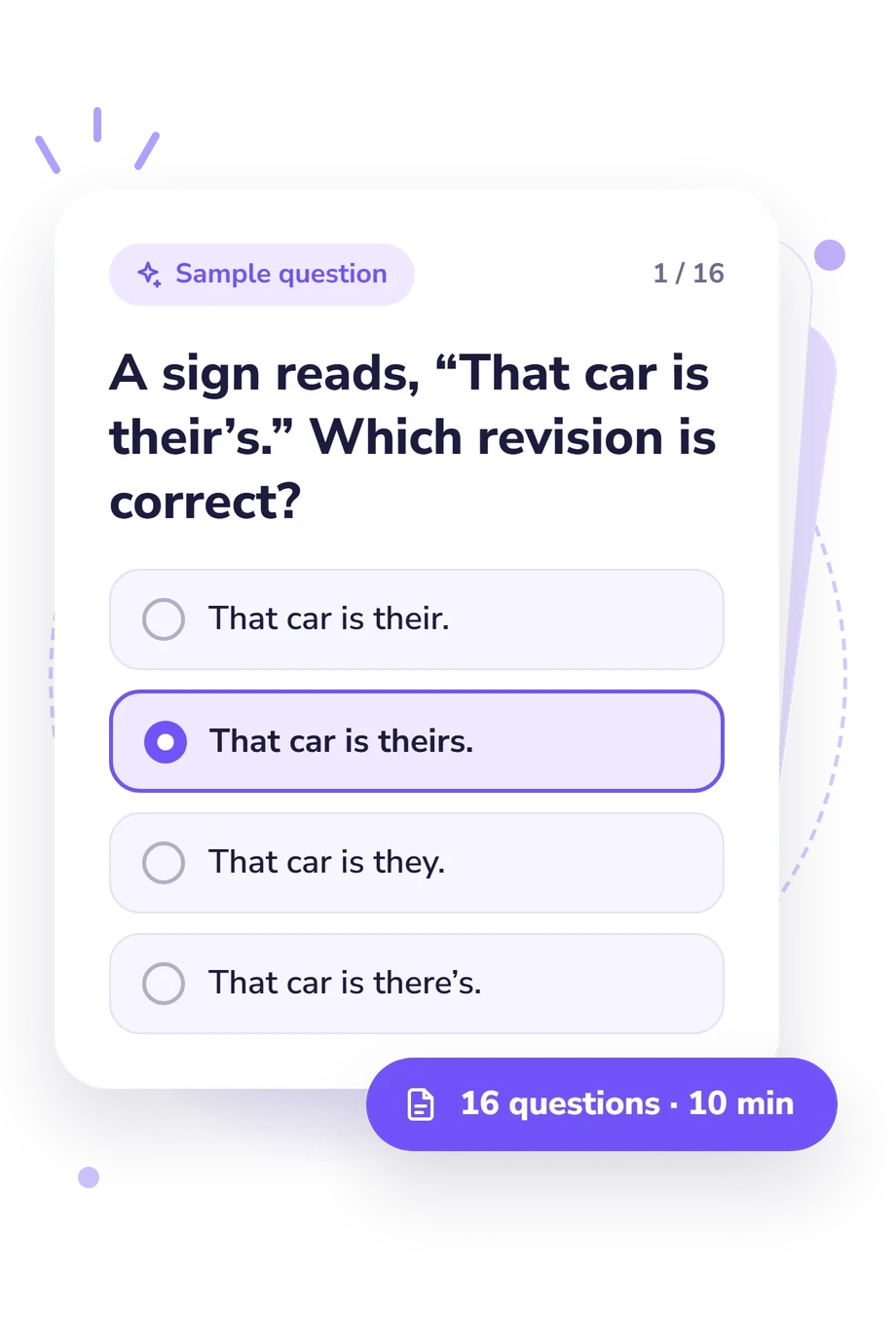
- That car is their.
- That car is theirs.
- That car is they.
- That car is there’s.
- Our table is by the window.
- Their train leaves at noon.
- Her idea received support.
- The final choice was theirs.
- your
- you’re
- yours
- you
Possessive Pronouns Quiz - Description and methodology of the test
For learners who want to write clearer English, this assessment focuses on choosing possessive forms accurately in real sentence contexts. The possesive pronouns quiz can help students, editors, and independent learners see whether they distinguish a pronoun that stands alone from a determiner before a noun. Its results can also identify forms that merit further grammar review. This quiz on possessive pronouns offers a concise way to focus that review.
What This Assessment Measures
The questionnaire tests whether you can choose a possessive pronoun when ownership is clear and the noun is omitted. It distinguishes these forms from determiners such as my and their, object pronouns such as me and them, and the contractions its/it's. That focus makes this possessive pronoun test useful for learners checking grammar, proofreading, or editing.
The reported scale is Possessive Pronouns Knowledge (0-16): Foundation to build (0-6), Developing knowledge (7-12), and Strong knowledge (13-16). The question themes are:
- Standalone ownership forms show whether you can select mine, yours, hers, ours, or theirs.
- Comparisons show whether the form matches the people who own an item.
- Apostrophes show whether you separate its from it's and theirs from the incorrect their's.
- Sentence context shows whether you can apply the distinction beyond a definition.
Methodology and Evidence Base
Each item presents a short sentence or correction task with four answer choices. The alternatives contrast forms that look or sound similar, so the respondent must identify grammatical function and the intended owner. The questionnaire reports one result on the displayed scale; no separate subscores or weighting rule is specified.
The framework is consistent with Huddleston, Pullum, and Reynolds's treatment, which distinguishes pronouns from determiners and explains contrasts such as its and it's. Huddleston and Pullum's broader reference grammar provides additional grammatical context, while Taylor's work examines possession through cognitive grammar. These works support the concepts tested here, but the online questionnaire is not presented as an adaptation or validation of those publications.
The result can guide possessive pronoun practice by pointing to errors involving ownership, standalone forms, or apostrophes. Its standardization status and population norms are not stated, so the outcome is best read as a focused grammar snapshot. Attention, prior instruction, and editing experience can affect performance.
- Huddleston, Rodney, Geoffrey K. Pullum, and Brett Reynolds. A Student's Introduction to English Grammar. 2nd ed. Cambridge University Press, 2022. 10.1017/9781009085748.
- Huddleston, Rodney, and Geoffrey K. Pullum. The Cambridge Grammar of the English Language. Cambridge University Press, 2002. 10.1017/9781316423530.
- Taylor, John R. Possessives in English: An Exploration in Cognitive Grammar. Oxford University Press, 1996. 10.1093/oso/9780198235866.001.0001.
Updated: