
Malala the Powerful Quiz
How the Scales are Structured
Who Usually Takes This Test?
See How You Compare
Below is a preview of how scores are typically distributed across each scale.
Example Questions From the Test
- Expanding professional sports programs for young people
- Equal access to education, especially for girls
- Preserving historic buildings in South Asia
- Promoting international tourism in Pakistan
- New York City, United States
- Geneva, Switzerland
- Oslo, Norway
- Birmingham, England
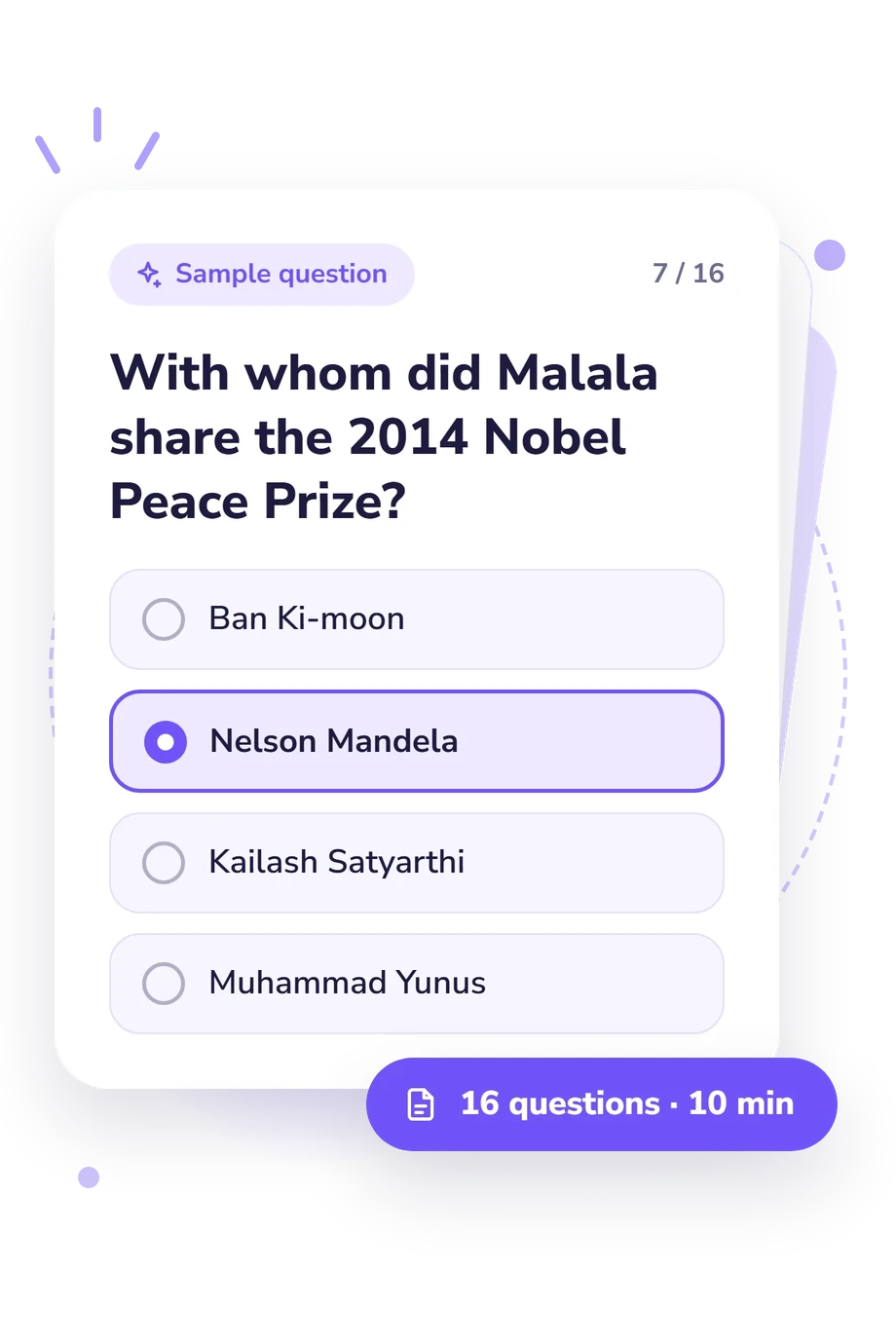
- Ban Ki-moon
- Nelson Mandela
- Kailash Satyarthi
- Muhammad Yunus
Malala the Powerful Quiz - Description and methodology of the test
Readers who want to organise or revisit prior knowledge of Malala Yousafzai’s life can use the Malala the Powerful Quiz as a focused knowledge exercise. It suits students, educators, and anyone reviewing her activism, public speeches, threats, recovery, and work for girls’ education. The coverage brings these connected parts of her story into one structured review.
What This Assessment Explores
Questions assess factual knowledge and simple interpretation. They cover Malala’s childhood in Pakistan’s Swat Valley, restrictions on girls’ schooling, her BBC Urdu writing as Gul Makai, the 2012 attack, recovery in Birmingham, the United Nations speech, the Nobel Peace Prize, and the Malala Fund. Other items ask you to order events or connect an action with its significance.
It reflects familiarity with her experiences and advocacy, including Malala’s educational message about access to education.
The displayed scale is Malala the Powerful Knowledge (0-16), with these bands:
- Foundation to build (0-6) indicates that some details are familiar but the timeline or context needs review.
- Developing understanding (7-12) shows knowledge of the main events and messages, with connections to refine.
- Strong understanding (13-16) reflects a clear grasp of her experiences, advocacy, and educational message.
Methodology and Evidence Base
Each item presents four answer choices and asks for the best-supported statement. This four-choice knowledge-question format samples dates, places, people, chronology, motives, consequences, and the meaning of Malala’s public message, so it tests recognition and basic comprehension rather than personality or attitudes.
Historical and primary-source references, including Lewis’s account of Malala’s early activism, Yousafzai and Lamb’s memoir, the 12 July 2013 UN address, and Olesen’s analysis of her global iconicity, supply context for the events and ideas represented here. They do not validate or standardize this online quiz, which uses its own selection of questions rather than adapting a published instrument.
No item-weighting rule or population norms are stated for the questionnaire, so the overall result is best read as an indication of general familiarity. Reviewing material about Malala’s story or individual answers may require returning to the relevant historical material; performance also depends on prior reading, memory, and how a short prompt is understood.
- Lewis, Kristin. “Malala the Powerful: The Amazing True Story of a 15-Year-Old Girl Who Stood Up to a Deadly Terrorist Group.” Scholastic Scope, September 2013.
- Yousafzai, Malala, with Christina Lamb. I Am Malala: The Girl Who Stood Up for Education and Was Shot by the Taliban. Little, Brown and Company, 2013.
- United Nations. “Malala Yousafzai, UN Youth Assembly.” 12 July 2013.
- Olesen, Thomas. “Malala and the Politics of Global Iconicity.” The British Journal of Sociology, vol. 67, no. 2, 2016, pp. 307-327. 10.1111/1468-4446.12195
Updated: