
Plant Structure and Function Quiz
How the Scales are Structured
Who Usually Takes This Test?
See How You Compare
Below is a preview of how scores are typically distributed across each scale.
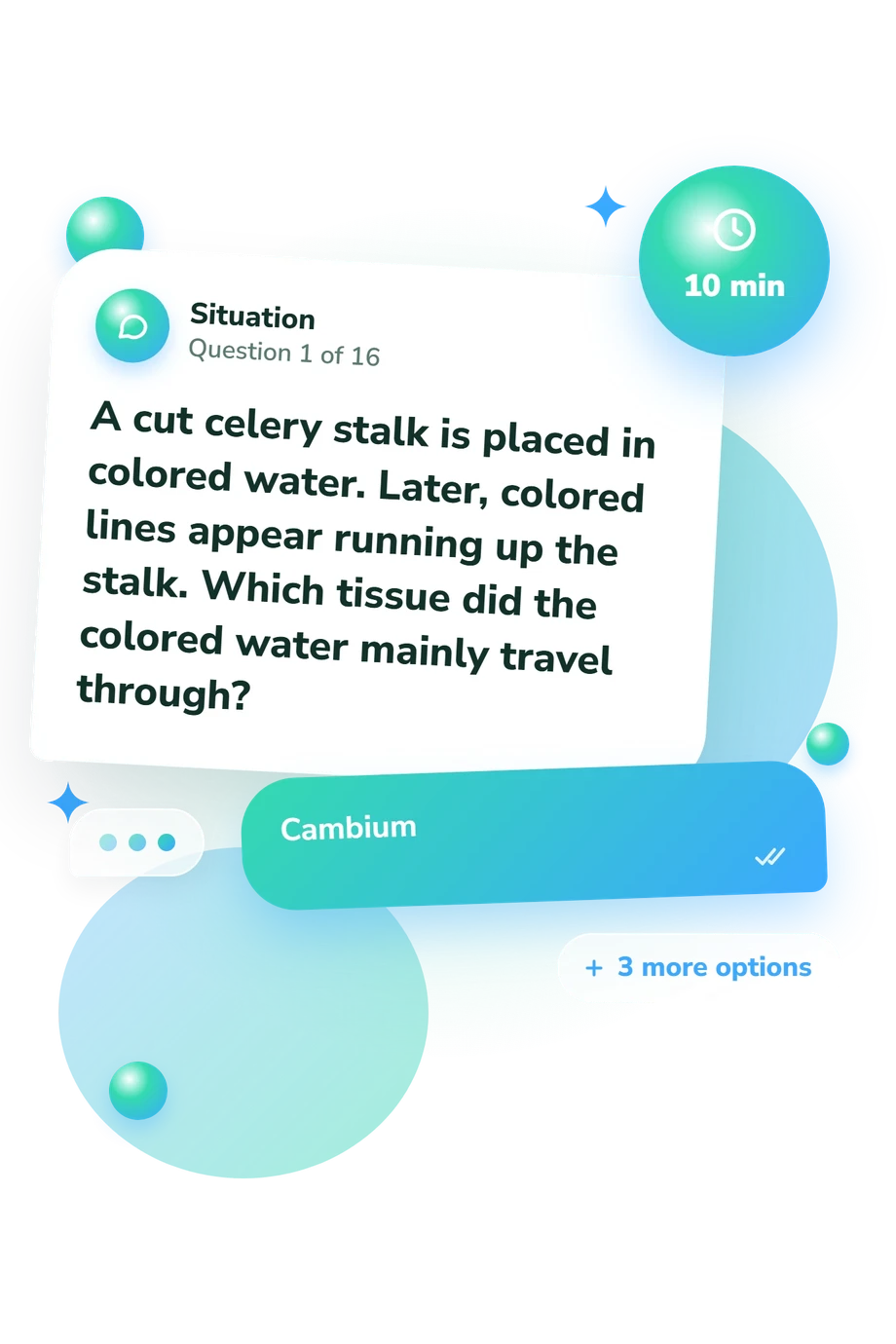
Example Questions From the Test
- Vascular bundles that strengthen stems
- Root extensions that absorb mineral ions
- Reproductive cells produced inside anthers
- Adjustable pores that permit gas exchange and water-vapor loss
- Phloem
- Epidermis
- Xylem
- Cortex
- It reduces water loss from the leaf surface.
- It transports sugars more rapidly through the leaf.
- It increases the leaf's absorption of mineral ions.
- It allows roots to grow directly from the leaf.
Plant Structure and Function Quiz - Description and methodology of the test
Students, teachers, and curious readers who want a focused biology review can use this plant structure and function quiz to check how confidently they connect form with function. A plant biology quiz like this can help locate gaps before revision, classroom instruction, or more advanced study. The result summarizes how accurately you apply core concepts in familiar biological situations.
What This Assessment Explores
Questions connect plant parts with processes across cells, tissues, roots, leaves, stems, transport, gas exchange, photosynthesis, and reproduction. In this plant structures quiz, each answer requires you to link a structure to its function rather than simply recall a term.
The result is reported as Plant Structure and Function Knowledge: 0-16. It falls into Foundations to build (0-6), Developing knowledge (7-12), or Strong knowledge (13-16), describing how securely you connect structures with transport, growth, photosynthesis, and reproduction.
The themes show what the score draws on:
- Cell and tissue roles show whether you understand support, protection, absorption, and specialization.
- Transport relationships show whether you can distinguish xylem from phloem and apply source-sink reasoning.
- Leaf processes show how well you connect stomata, cuticles, chloroplasts, and photosynthesis.
- Growth and reproduction items show whether you identify meristems, root caps, floral structures, and fruit formation.
Methodology and Evidence Base
Each item presents a short scenario or direct question with four answer choices. You select the option that best matches a structure-function relationship, such as xylem movement, phloem transport, stomatal control, or fruit development. Because items in this plant biology test have right and wrong options, the result reflects performance on the tested biology content.
Its scientific framework is consistent with Raven Biology of Plants (Evert and Eichhorn, 2013), which explains relationships among plant cells, tissues, organs, and transport systems. Plant physiology concepts from Taiz, Zeiger, Møller, and Murphy clarify water relations, photosynthesis, source-sink transport, and growth. Clark, Douglas, and Choi add coverage of cell structure, plant tissues, and reproduction. The references clarify tested content: structures support transport, growth, photosynthesis, and reproduction.
The displayed scale uses its bands to summarize performance on these questions, not comparison with a verified reference population. Results may reflect prior coursework, terminology familiarity, attention, or guessing, so use them to identify topics to revisit. One quiz cannot capture all plant biology, but it can show where understanding is secure and where study may help.
- Ray F. Evert and Susan E. Eichhorn. Raven Biology of Plants. 8th ed. W. H. Freeman and Company, 2013. 10.1007/978-1-319-15626-8.
- Lincoln Taiz, Eduardo Zeiger, Ian M. Møller, and Angus Murphy. Plant Physiology and Development. 6th ed. Sinauer Associates, 2015.
- Mary Ann Clark, Matthew Douglas, and Jung Choi. Biology 2e. OpenStax, 2018.
Updated: