
Indian Quiz for Kids
How the Scales are Structured
Who Usually Takes This Test?
See How You Compare
Below is a preview of how scores are typically distributed across each scale.
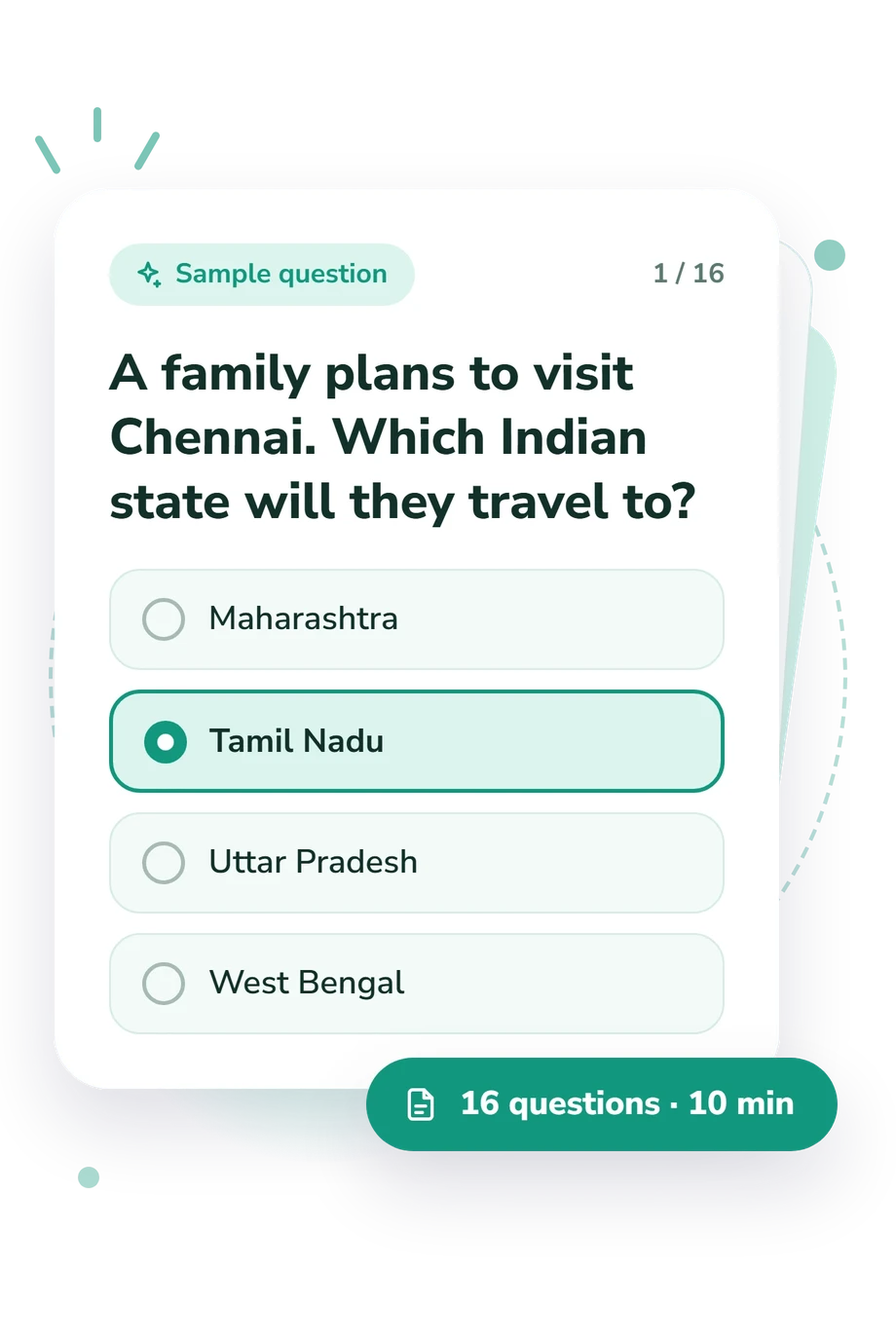
Example Questions From the Test
- Maharashtra
- Tamil Nadu
- Uttar Pradesh
- West Bengal
- Goa
- Gujarat
- Rajasthan
- Assam
- Bihar
- Jharkhand
- Haryana
- Kerala
Indian Quiz for Kids - Description and methodology of the test
Families, teachers, and young learners can use the Indian Quiz for Kids as a shared activity for talking about places in India and how children reason from geographic clues. The result gives learners a starting point for a learning conversation, whether it follows a lesson, a trip, or an interest in maps. As a kids quiz about India, it turns choices into prompts for discussion at home or school.
What This Assessment Explores
The questions in this Indian geography quiz for kids examine India’s location, regions, physical features, and destinations. Learners connect places with states, cities, rivers, seas, landforms, climate, and travel settings, so the result reflects geographic recognition and application rather than opinion.
The main content groups are:
- Places and destinations show how well a learner matches cities, states, and travel locations.
- Landforms and environments test recognition of mountains, plateaus, deserts, forests, coasts, and monsoon conditions.
- Rivers, seas, and orientation reveal whether a learner can connect waterways with directions and surrounding regions.
Together, these areas support the Indian Geography Knowledge scale, which ranges from 0-16. Starting Explorer (0-6) indicates an emerging foundation, Developing Traveler (7-12) reflects useful but incomplete understanding, and India Geography Star (13-16) indicates strong coverage of the tested material. The profile points toward topics to revisit rather than judging ability.
Methodology and Evidence Base
Each item presents a geographic question with four answer choices, asking the learner to select the best match. The displayed result is reported on the questionnaire’s geography-knowledge scale; individual answers are not assigned a stated contribution to the score. It describes performance on these questions rather than general academic ability.
The structure is conceptually consistent with the Geographical Concept Test, a published approach to children’s geographic concepts. This online questionnaire is not that instrument or a documented adaptation. Its subject matter also corresponds with place, landform, water, and map-related learning in NCERT’s Class VI geography textbook.
During revision or discussion, this quiz about Indian geography can provide a concrete topic to explore next. Familiarity with Indian place names, previous lessons, reading comprehension, attention, and guessing may influence performance. The questions do not assess map drawing, physical-process explanations, or transfer of knowledge to unfamiliar locations.
The bands describe performance on this questionnaire and are not established population norms. A learner’s score is best understood alongside classroom work, discussion, and further exploration of India’s geography, including its regions, waterways, landforms, and destinations.
- Baysan, Sultan, and Selcen Aydoğan. “Development of Geographical Concept Test (GCT) for Preschool and Primary School Children.” Journal of Human Sciences, vol. 13, no. 3, 2016, pp. 5500-5514. 10.14687/jhs.v13i3.4010
- National Council of Educational Research and Training. The Earth: Our Habitat: Textbook in Geography for Class VI. Revised ed. New Delhi: NCERT, 2022. ISBN 81-7450-491-5
Updated: