
Guinea Pig Breed Quiz
How the Scales are Structured
Who Usually Takes This Test?
See How You Compare
Below is a preview of how scores are typically distributed across each scale.
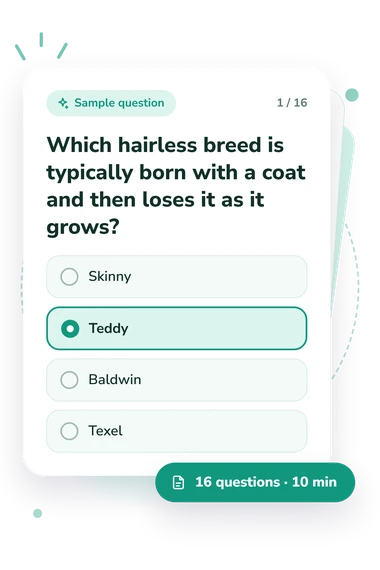
Example Questions From the Test
- Skinny
- Teddy
- Baldwin
- Texel
- Coronet
- Abyssinian
- Teddy
- American
- American and Crested
- Skinny and Baldwin
- Peruvian and Texel
- Teddy and Rex
Guinea Pig Breed Quiz - Description and methodology of the test
Owners, prospective owners, and readers learning breed terminology can use the guinea pig breed quiz to connect coat features with breed labels. It measures practical recognition rather than preference. Its coat-based comparisons help readers identify guinea pig breeds by weighing visual clues before considering care needs and temperament.
What This Assessment Explores
This assessment suits readers who want to understand how visible coat features relate to breed labels. Readers deciding what breed of guinea pig should I get quiz can use this assessment to organize a choice, while remembering that appearance does not predict temperament.
The questions connect descriptions with breed names. The main clue groups are:
- Coat length and direction show whether hair is short, forward-growing, or backward-flowing.
- Texture, density, curl, and sheen distinguish smooth, dense, coarse, woolly, curly, or glossy coats.
- Crests and rosettes identify localized growth patterns that narrow the likely label.
- Hairlessness helps distinguish Skinny and Baldwin types, while ancestry limits mean visible traits cannot prove pedigree.
Together, these clues produce the Guinea Pig Breed Knowledge scale (0-16). Foundation (0-6) reflects recognition of a few clues; Developing (7-12) reflects broader recognition with close comparisons still to refine; Strong (13-16) reflects broad knowledge of common traits, care implications, and identification limits.
Methodology and Scientific Basis
Each item is multiple choice: a coat or ancestry description is paired with several labels or conclusions, and the respondent selects the closest answer. Every correct answer adds one point, so the total reflects content knowledge rather than a hidden personality calculation.
Zarbock (2017) and the 4-H leader guide provide practical distinctions among coat types, growth patterns, and breed names. The American Rabbit Breeders Association standard anchors formal terminology, while Festing’s genetics chapter supports the caution that appearance cannot establish pedigree. The questionnaire is conceptually consistent with these sources, not a validated adaptation of any one of them.
As a guinea pig breed knowledge test, it functions as a structured learning profile. A higher result means more of the tested distinctions were answered correctly; it does not certify show-standard expertise or identify an animal’s ancestry. Registry terminology can vary, and mixed-breed animals may not fit one label cleanly.
No published norm sample, reliability estimate, or clinical interpretation is attached to the result. Performance may also reflect prior exposure, attention to wording, and the limits of appearance-based identification, so the score is best used for self-reflection rather than diagnosis.
- Zarbock, Marylou. “What Breed Is My Guinea Pig?” Lafeber Company, February 3, 2017.
- Bruce, Heather, Karen Parks, Anne Hirning, Jerry Newman, and Joy Faerber. 4-H Cavy Project Leader Guide. Pacific Northwest Extension Publication PNW 573. University of Idaho Extension, Oregon State University Extension, and Washington State University Extension, 2005.
- American Rabbit Breeders Association. Standard of Perfection 2026-2030. American Rabbit Breeders Association, 2025.
- Festing, Michael F. W. “Genetics.” In The Biology of the Guinea Pig, edited by Joseph E. Wagner and Patrick J. Manning, 99-120. Academic Press, 1976. DOI 10.1016/B978-0-12-730050-4.50013-2.