
Liquid Penetrant Testing Quiz
How the Scales are Structured
Who Usually Takes This Test?
See How You Compare
Below is a preview of how scores are typically distributed across each scale.
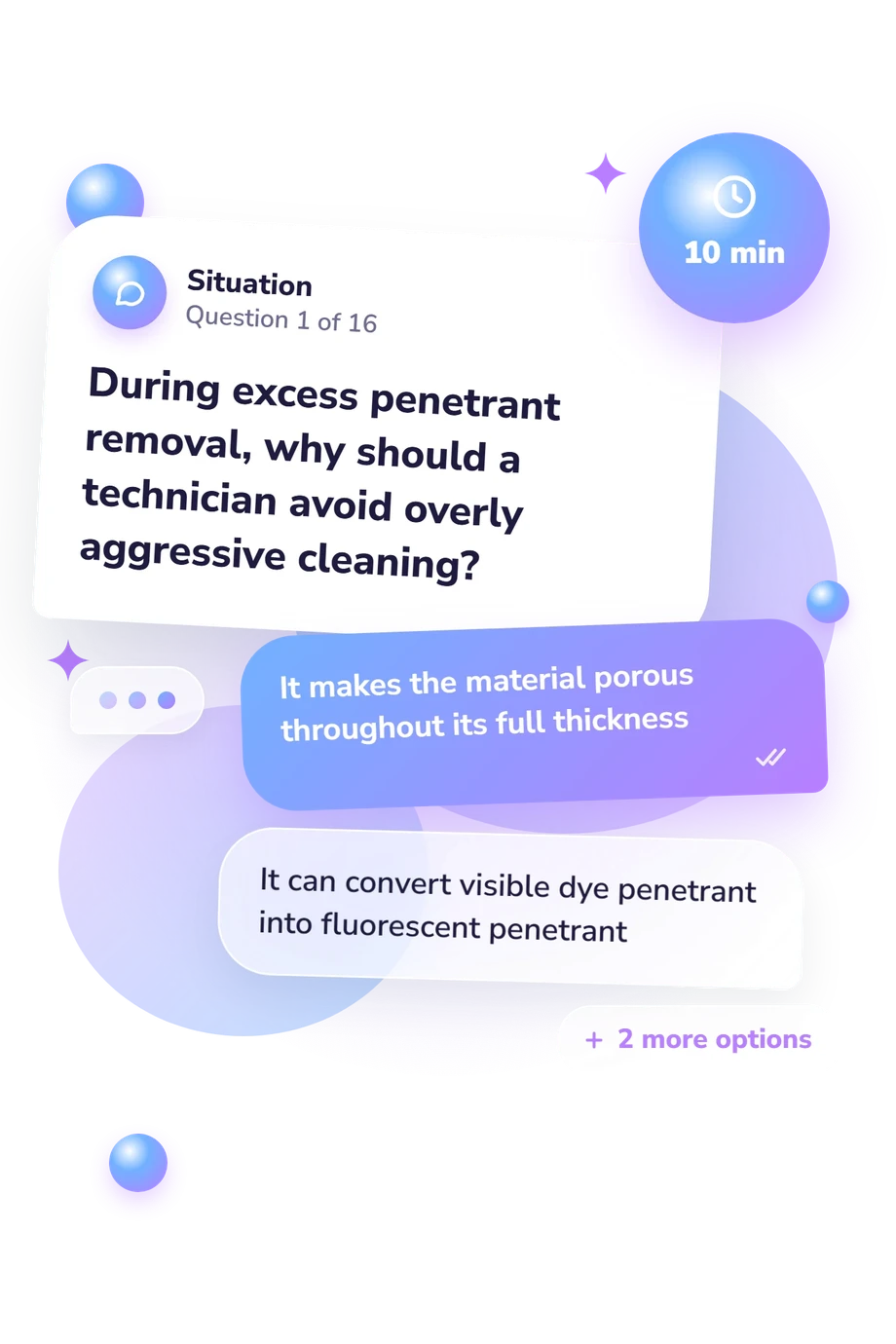
Example Questions From the Test
- An unsealed, highly porous concrete block
- A wooden panel with a rough, absorbent surface
- A foam component with interconnected surface pores
- A clean, nonporous aluminum casting
- The part should immediately receive a final post-cleaning
- The component should be struck lightly to open discontinuities
- The developer should be removed before it dries
- The penetrant should remain for the specified dwell time
- Adequate white light on the inspection surface
- An infrared lamp directed across the surface
- A strobing light that alternates between bright and dark
- A completely dark area illuminated only by UV-A light
Liquid Penetrant Testing Quiz - Description and methodology of the test
For technicians, students, and anyone revising inspection fundamentals, this liquid penetrant testing quiz checks whether core process decisions are understood rather than merely memorized. It is useful before training, during refresher study, or when reviewing written procedures. As a penetrant testing quiz, it emphasizes preparation, process control, viewing conditions, and interpretation, allowing the result to point to areas needing closer study.
What This Assessment Explores
The method suits generally nonporous surfaces where discontinuities reach the surface. The questions cover preparation, process control, viewing, and interpretation, making the assessment useful for learners and practitioners refreshing fundamentals. It measures inspection knowledge, not hands-on performance.
One scale reports Liquid Penetrant Testing Knowledge (0-16): Foundation to build (0-6), Developing knowledge (7-12), and Strong knowledge (13-16). The bands indicate whether to rebuild basics, revisit controls, or show command of common principles. This educational score does not establish certification or practical competence.
To show what the result covers, the liquid penetrant inspection test groups its content into four practical areas:
- Surface preparation and drying show whether contaminants or moisture could reduce detectability.
- Process sequence and dwell control show whether each stage follows a controlled procedure.
- Penetrant systems and suitable materials clarify removal methods, surface limits, and background risks.
- Viewing and indication evaluation connect lighting, developer action, geometry, and acceptance criteria.
Methodology and Scientific Basis
Each item presents a practical inspection situation with four answer choices. The respondent selects the best explanation, sequence, precaution, or next step. Themes move from surface suitability and cleaning to dwell time, removal, developer, lighting, contamination, and evaluation of relevant versus nonrelevant indications. This is applied knowledge testing, not live inspection.
Responses are converted into the displayed knowledge result and its band. The questionnaire does not publish a per-answer weighting rule, so the score should not be used to infer how every option contributes. Familiarity with technical terminology may also affect performance.
Methodologically, the content is conceptually consistent with ASNT Liquid Penetrant Testing Handbook (Tracy and Moore, 1999), especially its treatment of materials, process stages, indications, and viewing. ASTM E1417/E1417M-21 and ASTM E165/E165M-23 supply the relevant practice framework for process control and evaluation. The questionnaire is not presented as an adaptation of these sources; they are its technical reference point.
No standardized norms, reliability estimates, or certification status are established by the questionnaire itself. It can support liquid penetrant testing practice, but competence also depends on equipment, qualification requirements, surface conditions, written procedures, and disciplined interpretation.
- Tracy, Noel A., and Patrick O. Moore, eds. Nondestructive Testing Handbook, Third Edition, Volume 2: Liquid Penetrant Testing. Columbus, OH: American Society for Nondestructive Testing, 1999. ISBN 978-1-57117-028-6.
- ASTM International. ASTM E1417/E1417M-21, Standard Practice for Liquid Penetrant Testing. West Conshohocken, PA: ASTM International, 2021. 10.1520/E1417_E1417M-21.
- ASTM International. ASTM E165/E165M-23, Standard Practice for Liquid Penetrant Testing for General Industry. West Conshohocken, PA: ASTM International, 2023. 10.1520/E0165_E0165M-23.
Updated: