
Mental Health Nursing Quiz
How the Scales are Structured
Who Usually Takes This Test?
See How You Compare
Below is a preview of how scores are typically distributed across each scale.
Example Questions From the Test
- A fixed false belief that others are monitoring the person
- Hearing a voice comment on one’s actions
- Disorganized speech that is difficult to follow
- Reduced emotional expression and diminished motivation
- Consistent difficulty recalling recent events
- A gradual decline in memory over several years
- An acute, fluctuating disturbance in attention and awareness
- Progressive loss of independent daily functioning
- Avolition
- Anhedonia
- Echolalia
- Derealization
Mental Health Nursing Quiz - Description and methodology of the test
Learners and practicing nurses may take this mental health nursing quiz when they want a concise check of readiness for further study or supervised clinical learning. Its overall result helps them decide whether broad review is warranted. Presented as a psychiatric mental-health nursing quiz, it emphasizes applied judgment rather than memorized terminology alone.
What This Assessment Explores
The questions examine whether a learner can recognize safe, therapeutic and rights-respecting responses in mental health situations. They cover symptom recognition, suicide assessment, psychosis, mania, substance withdrawal, medication toxicity, capacity, informed refusal and trauma-sensitive care. Mental health nursing questions focus on priorities and decisions, not personality traits.
The displayed Mental Health Nursing Knowledge scale runs from 0-16: Foundations to strengthen (0-6), Developing knowledge (7-12) and Strong foundation (13-16). The band summarizes performance on the quiz’s correct-answer total and offers broad study guidance.
The content clusters around four areas:
- Therapeutic communication shows how distress is met without reinforcing unsafe interpretations.
- Assessment and recognition show whether symptoms and changing mental states are identified accurately.
- Safety and urgent care show how risks and emergencies are prioritized.
- Rights-based practice shows whether capacity, refusal, least-restrictive care and trauma-informed choices are respected.
Methodology and Scientific Basis
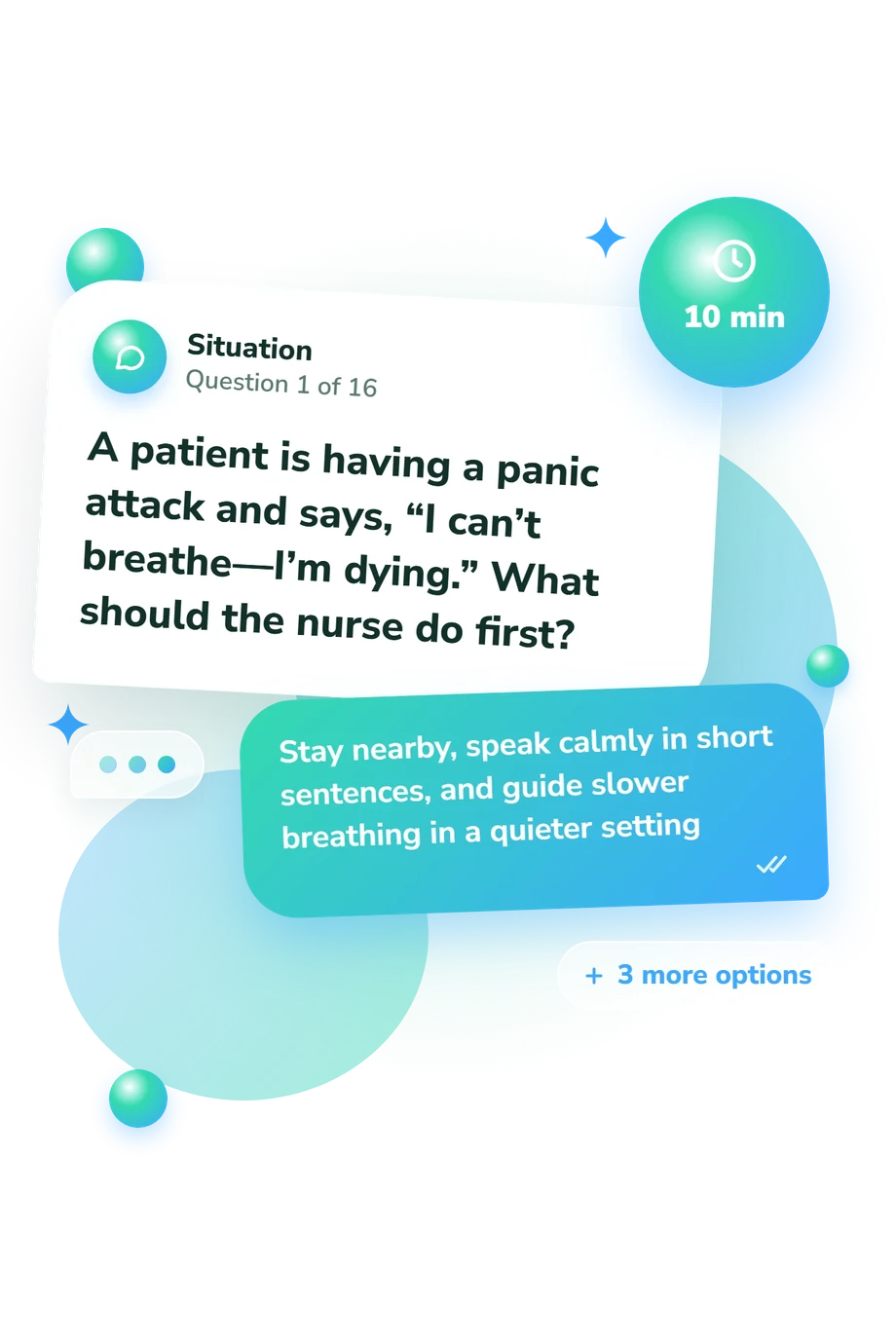
Each item presents a brief clinical situation with four answer choices and asks for the most appropriate response, interpretation or priority action. The total reflects correct answers across the quiz, so it measures knowledge of tested content rather than symptom severity or personal experience.
Its content is conceptually consistent with the priorities described by Halter (2022), including therapeutic communication, mental-status assessment, psychiatric emergencies, medication safety and patient rights. De-escalation items align with the Project BETA consensus approach, while questions about permission, explanation and choice reflect SAMHSA’s trauma-informed framework. The questionnaire is not an adaptation of any one source.
Learners may use a mental health nursing test to identify topics to revisit before study or clinical practice, but the scale is an unvalidated educational summary and does not establish clinical competence; scores may reflect prior study, wording interpretation and current knowledge, so read the bands as broad study guidance for communication, assessment, safety and rights-based decisions, and apply clinical decisions with supervision, local policy and attention to the patient’s immediate condition.
- Halter, Margaret Jordan. Varcarolis' Foundations of Psychiatric-Mental Health Nursing: A Clinical Approach. 9th ed. St. Louis, MO: Elsevier; 2022.
- Richmond, Janet S., Jon S. Berlin, Avrim B. Fishkind, Garland H. Holloman Jr., Scott L. Zeller, Michael P. Wilson, Muhamad Aly Rifai, and Anthony T. Ng. Verbal De-escalation of the Agitated Patient: Consensus Statement of the American Association for Emergency Psychiatry Project BETA De-escalation Workgroup. Western Journal of Emergency Medicine. 2012;13(1):17-25. 10.5811/westjem.2011.9.6864
- Substance Abuse and Mental Health Services Administration. SAMHSA's Concept of Trauma and Guidance for a Trauma-Informed Approach. HHS Publication No. (SMA) 14-4884. Rockville, MD: Substance Abuse and Mental Health Services Administration; 2014.
Updated: