
Indian Sports Quiz
How the Scales are Structured
Who Usually Takes This Test?
See How You Compare
Below is a preview of how scores are typically distributed across each scale.
Example Questions From the Test
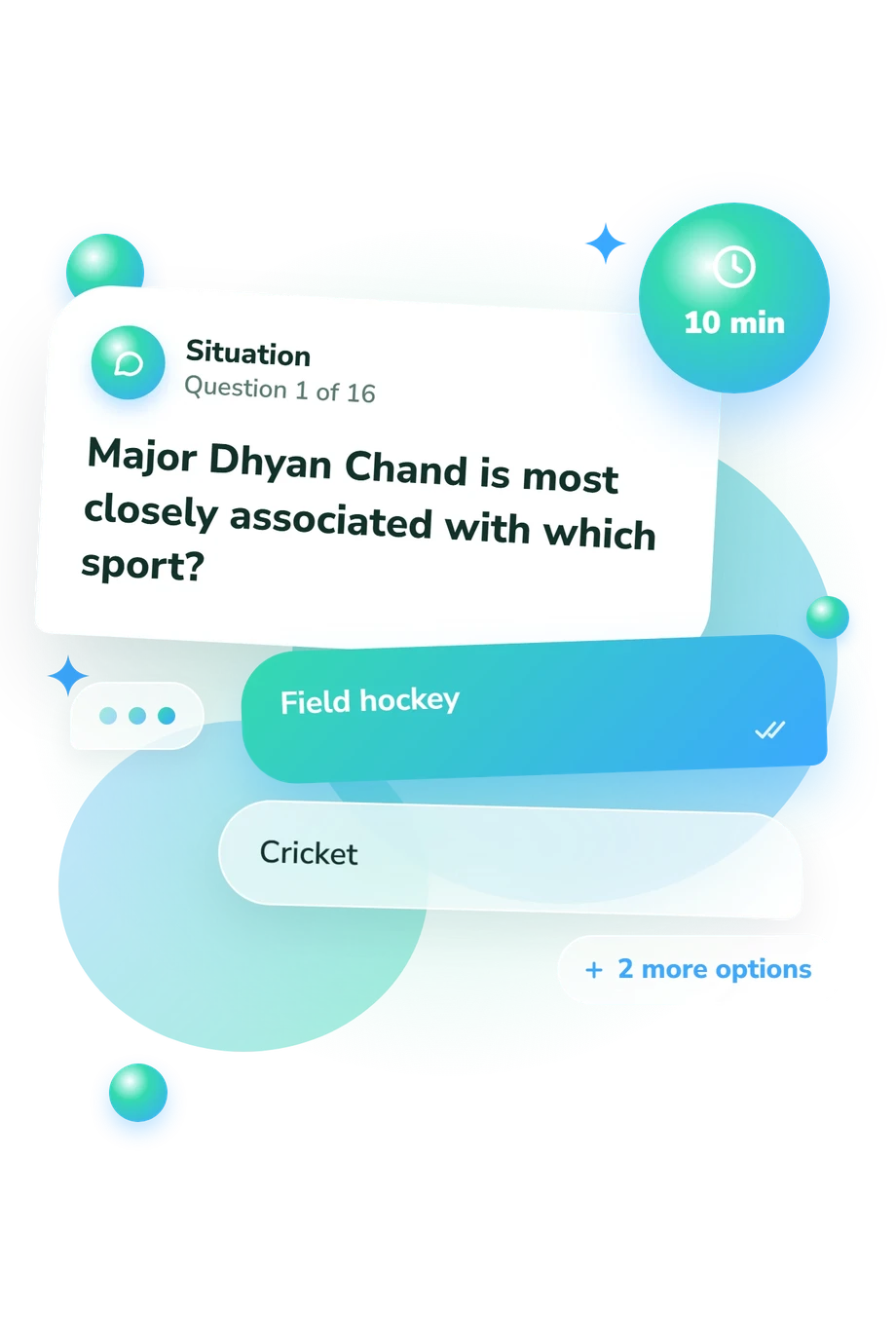
- Field hockey
- Cricket
- Football
- Polo
- Weightlifting
- Wrestling
- Archery
- Boxing
- Cricket
- Football
- Field hockey
- Kabaddi
Indian Sports Quiz - Description and methodology of the test
Readers who want to test their familiarity with India’s sporting heritage can use an indian sports quiz as a recall exercise. It suits curious sports followers, students, and lifelong learners who want to see which areas they recognize most readily. Each question presents four response options, and the task is to identify the best answer. It works well as an Indian sports history quiz for revising familiar names and events.
What This Assessment Measures
This assessment measures recognition of Indian sporting figures, athletes, achievements, disciplines, awards, events, and competitions. Some items also ask about rules, equipment, or competition formats, but these are routes into the same knowledge measure rather than separate dimensions. The Indian sports knowledge test therefore reflects breadth of recognition and recall, not physical skill or athletic performance.
Questions move across hockey, wrestling, boxing, badminton, football, chess, kabaddi, cricket, athletics, and other events. Each prompt asks the respondent to identify a sport, athlete, award, tournament, event, or competition format from four alternatives. The displayed scale is Indian Sports Knowledge, with these result bands:
- Starting Line (0-6) indicates that several athletes, events, or competitions remain unfamiliar.
- Strong Contender (7-12) indicates broad working knowledge with some gaps across sports or eras.
- Podium Knowledge (13-16) indicates excellent command of sporting figures, achievements, awards, and competitions.
Methodology and Evidence Base
The format is a structured online knowledge questionnaire. Sixteen multiple-choice items offer one best answer among four options and test factual recall. The items sample recognition of athletes, sports, awards, tournaments, events, and selected rules, equipment, and competition formats. Because no separate weighting rule is stated, read the result as the displayed knowledge total rather than an assumed scoring formula.
Its approach is closest to educational sports-knowledge testing. The Olympic Awareness Scale (Hergüner et al., 2023) and Joshi and Kanwar’s sports knowledge test are methodological analogies, not validation sources: they illustrate awareness measurement and item-based game knowledge. This questionnaire is conceptually consistent with those methods, not an adaptation of either instrument.
As an Indian sports trivia quiz, it can reveal strong recall and topics worth revisiting, but this online version is not presented with standardized norms, reliability estimates, or diagnostic status. Scores may reflect memory, prior exposure to sports news, cultural familiarity, and how a respondent interprets a question. Treat the result as a focused snapshot of knowledge rather than a complete measure of sporting expertise.
- Hergüner, Gülten, Malik Beyleroğlu, Seda Yalçın, M. Sibel Yaman, and Ahmet Dönmez. “Olympics Awareness of High School Students: Study on Scale Development, Validity and Reliability.” SPORMETRE Journal of Physical Education and Sport Sciences, vol. 21, no. 3, 2023, pp. 21-31. 10.33689/spormetre.1215812.
- Joshi, Anant Ravi Darshan, and Ramesh Chand Kanwar. “A Study of Officiating Sports Knowledge Test of Volley Ball Game between State and National Level Officials of Uttarakhand State: A Comparison of Sports Knowledge Test between State and National Level Officials in Uttarakhand Volleyball.” International Journal of Physical Education & Sports Sciences, vol. 14, no. 2, 2019.
- Press Information Bureau, Ministry of Youth Affairs & Sports, Government of India. “National Sports Awards 2023.” 8 January 2024.
- International Olympic Committee. “Olympic Values Shared in Odisha, India through Major Programmes in Art, Culture and Education.” IOC Newsroom, 27 September 2023.
Updated: