
Hemospectrum Quiz
How the Scales are Structured
Who Usually Takes This Test?
See How You Compare
Below is a preview of how scores are typically distributed across each scale.
Example Questions From the Test
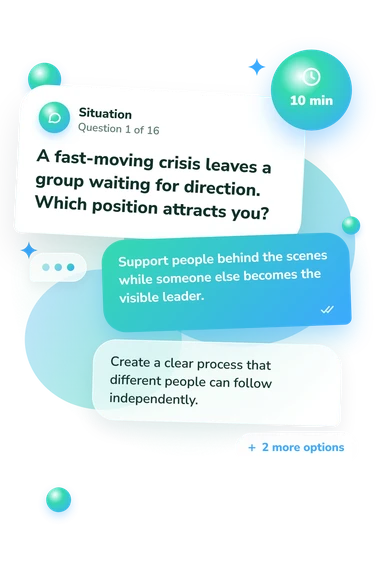
- Support people behind the scenes while someone else becomes the visible leader.
- Create a clear process that different people can follow independently.
- Coordinate the individuals who already hold influence over the situation.
- Take visible command, set the immediate objective, and accept the pressure.
- Keep attention on my own assignment so I can deliver something dependable.
- Record the overlooked ideas and raise them when the group reviews its plan.
- Help one contributor develop an idea until it is ready to present.
- Show how the overlooked contributions can solve the team’s immediate problems.
- Reduce chance wherever possible and protect the outcome I already have.
- Accept only gambles whose probabilities and costs I can evaluate.
- Wait for a charged moment, then trust my sense of timing.
- Make a high-stakes wager whose success would transform the whole situation.
Hemospectrum Quiz - Description and methodology of the test
People who enjoy Homestuck’s fictional social symbolism can use the hemospectrum quiz to see which blood-color ideals resemble their preferred ways of acting. As a troll blood color quiz, it suits readers interested in character archetypes, imaginative worldbuilding, and playful self-reflection. Rather than assigning a literal identity, the result organizes choices around strategic authority, practical resilience, dramatic influence, and protective or intuitive care.
What This Assessment Explores
Questions cover crises, disputes, gambles, presentations, and care. They examine authority, evidence, improvisation, resilience, visibility, legacy, stewardship, and emotional awareness. The result compares instincts with fictional archetypes without fixing identity.
The four result dimensions are:
- Azure Affinity - Teal, Cerulean, and Indigo (0-12) measures strategy and authority: Loose Current 0-4; Directed Current 5-8; Deep Azure 9-12.
- Ember Affinity - Rust, Bronze, and Gold (0-12) measures resourcefulness and adaptable planning: Distant Spark 0-4; Steady Ember 5-8; Burning Ember 9-12.
- Royal Affinity - Purple, Violet, and Fuchsia (0-12) measures command and memorable legacy: Muted Tide 0-4; Rising Tide 5-8; Royal Tide 9-12.
- Verdant Affinity - Lime, Olive, and Jade (0-12) measures care and subtle instinct: Quiet Trace 0-4; Growing Instinct 5-8; Deep Verdancy 9-12.
The result, read as a Hemospectrum personality quiz, treats the highest score as strongest; any profile within one point of it joins the blend.
Methodology and Evidence Base
Each item presents a brief situation with four response options. Choices contrast evidence-led reasoning, influence, improvisation, visible command, and quiet care. In this Homestuck blood color quiz format, responses aggregate into four 0-12 affinity scores: the highest is strongest, while any profile within one point joins a blend. Because the questionnaire does not state each option’s point value, equal weighting should not be assumed.
Its themes are conceptually consistent with Hemospectrum (Hussie, 2009-2016), the fictional blood-color system associated with Homestuck, but this online questionnaire is not presented as a direct adaptation of that source. What Pumpkin Games’ 2017 zodiac framework and Glaser (2020) support the setting’s personality-style and participatory, game-like context, but they do not standardize or clinically validate this questionnaire.
Read the result as a snapshot of self-reported preferences. Current mood, situation, and self-knowledge can affect answers, so profiles may change. The bands are entertainment categories, not literal caste assignments or diagnoses; the score is thematic rather than norm-referenced.
- Hussie, Andrew. Homestuck. MS Paint Adventures, 2009-2016.
- What Pumpkin Games. The Extended Zodiac. Hiveswap, 2017.
- Glaser, Tim. “Homestuck as a game: A webcomic between playful participation, digital technostalgia, and irritating inventory systems.” In Comics and Videogames: From Hybrid Medialities to Transmedia Expansions, edited by Andreas Rauscher, Daniel Stein, and Jan-Noël Thon, Routledge, 2020, pp. 96-112. 10.4324/9781003035466-8.