
One and Two Step Equations Quiz
How the Scales are Structured
Who Usually Takes This Test?
See How You Compare
Below is a preview of how scores are typically distributed across each scale.
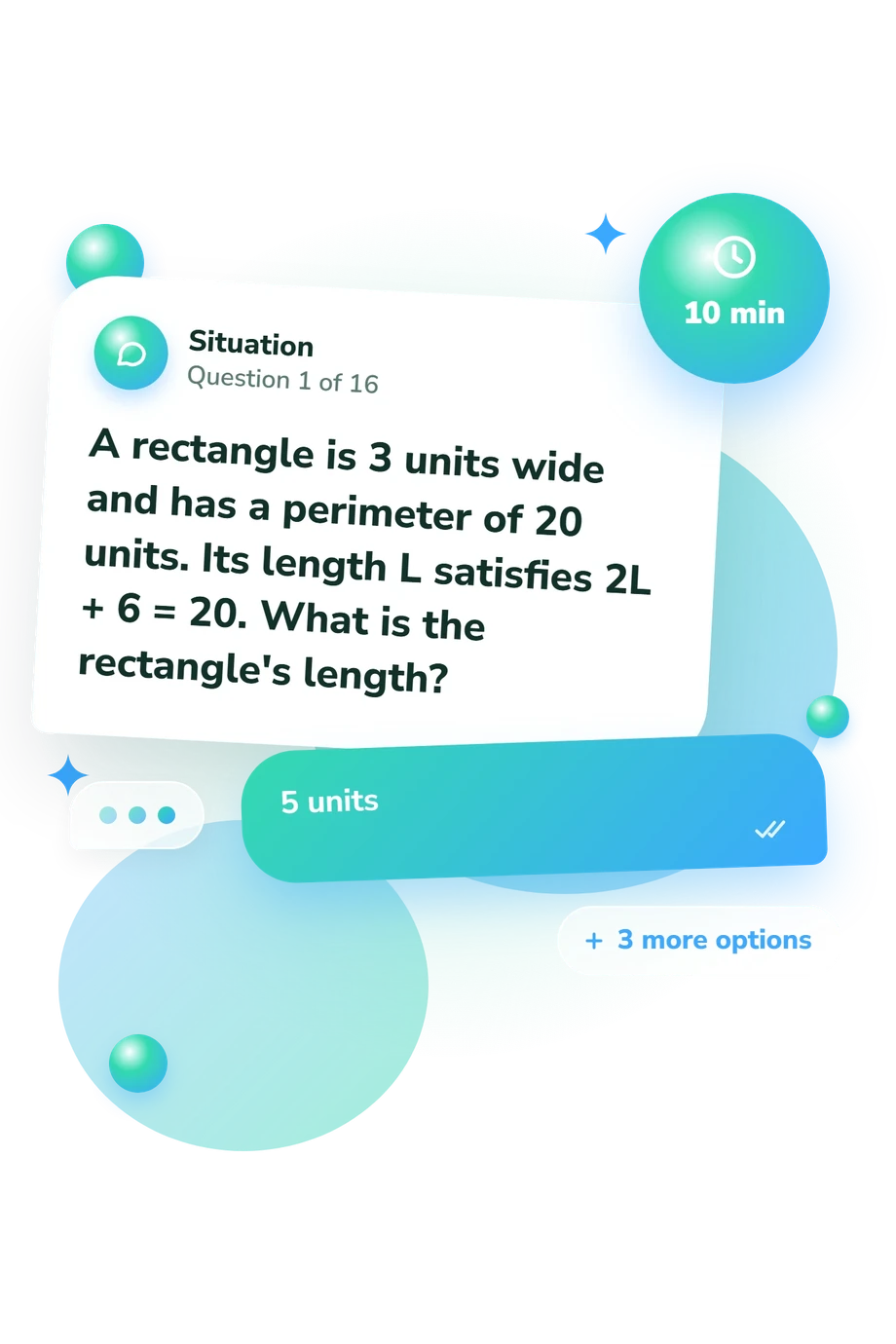
Example Questions From the Test
- 5 units
- 13 units
- 10 units
- 7 units
- Subtracting 8 from 17 gives m
- Adding 8 to m gives 17
- Subtracting m from 8 gives 17
- Subtracting 8 from m gives 17
- x equals negative 7
- x equals negative 4
- x equals 6
- x equals 3
One and Two Step Equations Quiz - Description and methodology of the test
For learners strengthening equation fluency, the One and Two Step Equations Quiz examines how they translate situations into symbols and apply inverse operations. It suits students reviewing foundational algebra, teachers checking prerequisite skills, and anyone seeking a snapshot of current performance. Learners can use it to practise solving one- and two-step equations and connect mistakes with topics for review rather than treating a score as a judgment.
What This Assessment Explores
Questions cover one- and two-step linear equations in symbolic and real-world problems involving money, fractions, negative numbers, and unknowns. They ask learners to isolate variables, preserve equality, compare solutions, and verify answers in the original equation.
Inverse operations precede several-step problems and contribute to one overall knowledge score:
- Modeling shows how well learners turn words into an equation.
- Inverse operations show whether the learner undoes operations while preserving equality.
- Signs and fractions show how reliably the learner handles negative and fractional values.
- Comparison and verification show whether the learner relates solutions and checks answers in the original equation.
One and Two Step Equations Knowledge ranges from 0-16: Foundations to build is 0-6, Developing knowledge is 7-12, and Strong knowledge is 13-16. These bands describe performance and suggest review topics.
Methodology and Evidence Base
Each item presents an equation or a word problem with four answer choices. The respondent selects one option, and every correct answer contributes one point to the total. Items ask for a solution, a next step, a comparison between solved values, or a check that both sides agree, so the method samples reasoning as well as calculation.
When practising two-step equations, the questionnaire is conceptually consistent with Ngu et al. (2023), which examined inverse and balance approaches to learning linear equations. It also aligns with Ngu and Phan (2017) on difficulties in one-step equation solving and with Capraro and Joffrion (2006) on translating verbal situations into mathematical symbols. This online questionnaire is not presented as an adaptation of those studies.
Interpretation should remain tied to the included equation types. A strong band indicates accurate performance across the sampled skills, while a lower band identifies areas such as maintaining equality, managing signs, or modeling a context for practice. The bands describe performance on this questionnaire rather than a population norm. Reading demands, prior instruction, guessing, attention, and test-taking conditions can influence one sitting, especially when a learner is still developing fluency with signs or fractions.
- Ngu, Bing Hiong, Phan, Huy P., Hong, Kian Sam, and Usop, Hasbee. (2023). Is the inverse method more effective than the balance method on learning linear equations? A cross-cultural experimental study between Australia and Malaysia. Asian Journal for Mathematics Education, 2(3), 325-349. 10.1177/27527263231194470
- Ngu, Bing Hiong, and Phan, Huy P. (2017). Will learning to solve one-step equations pose a challenge to 8th grade students? International Journal of Mathematical Education in Science and Technology, 48(6), 876-894. 10.1080/0020739X.2017.1293856
- Capraro, Mary Margaret, and Joffrion, Heather. (2006). Algebraic equations: Can middle-school students meaningfully translate from words to mathematical symbols? Reading Psychology, 27(2-3), 147-164. 10.1080/02702710600642467
Updated: