
Pop Culture Quiz 2015
How the Scales are Structured
Who Usually Takes This Test?
See How You Compare
Below is a preview of how scores are typically distributed across each scale.
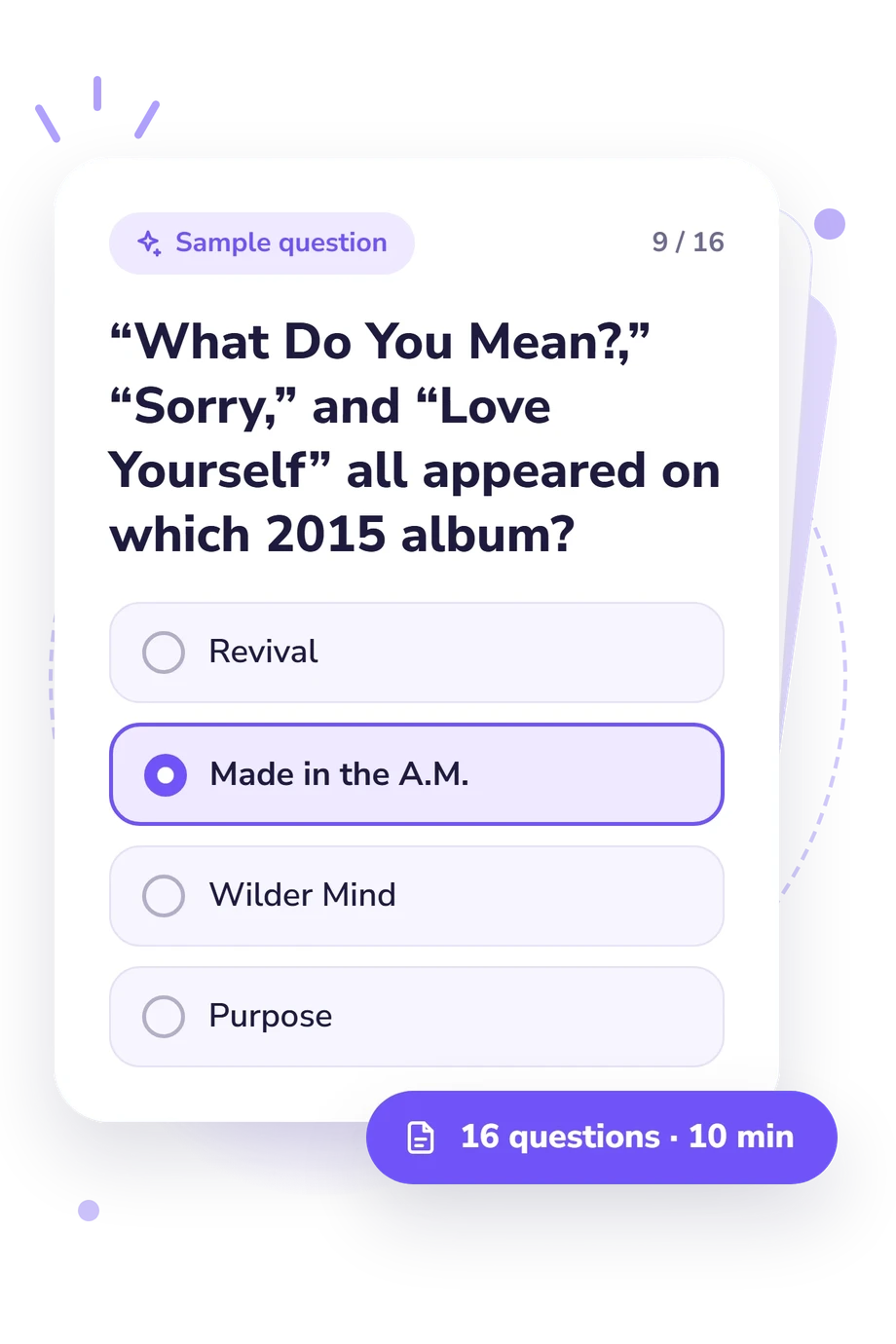
Example Questions From the Test
- Can’t Feel My Face
- Uptown Funk
- Bad Blood
- Cool for the Summer
- Finding Dory
- Zootopia
- Coco
- The Good Dinosaur
- The Jinx
- Chef’s Table
- Making a Murderer
- Wild Wild Country
Pop Culture Quiz 2015 - Description and methodology of the test
Readers who want to revisit the entertainment conversation of 2015 can use this Pop Culture Quiz 2015 to check how well its defining moments remain in memory. It is intended for people curious about films, music, television, celebrity news, and viral culture rather than for anyone seeking a personality profile. As a 2015 entertainment quiz, it turns familiar headlines into a compact reflection on cultural recall.
What This Quiz Measures
The questionnaire tests recognition of cultural events and releases associated with 2015. As pop culture quiz questions and answers about 2015, the items cover titles, performers, characters, events, and viral moments. Correct responses depend on recall, not personal taste.
Its subject matter falls into five areas:
- Film knowledge checks plots, characters, franchises, and major releases.
- Music knowledge measures recall of songs, albums, performers, and music-video moments.
- Television and streaming knowledge covers notable episodes and documentary series.
- Stage and celebrity culture tests memory for Broadway, comedy, casting, and announcements.
- Viral and public-event knowledge captures discussed images, pageants, and online moments.
The result combines these areas into 2015 Pop Culture Knowledge (0-16). Scene Starter (0-6) means some major moments are recognized; Culture Catch-Up (7-12) indicates developing knowledge; 2015 Headliner (13-16) reflects strong recognition of defining entertainment stories and moments.
Methodology and Evidence Base
Each item presents a factual prompt with four answer choices, and one point is awarded for every correct response. The total directly counts recognized 2015 facts rather than weighting cultural importance. Multiple choice keeps the task focused on recognition instead of written recall.
Performance may reflect media exposure, region, age, language, and unaided recall. Its value as 2015 pop culture trivia comes from its breadth, but the score remains a snapshot of familiarity.
The evidence base is conceptual: this questionnaire is consistent with these studies, not an adaptation of any one of them. The Harry Potter knowledge quiz (Troyer & Kutas, 2020) is relevant because prior knowledge can shape processing of familiar material; it does not validate this quiz. Goecke et al. (2022) examines multiple-choice format and fact knowledge without establishing this quiz’s validity. Edelsbrunner et al. (2025) shows that reliability in domain-specific knowledge tests can vary across studies and learning contexts.
The displayed bands are descriptive levels within this quiz, not population norms. Read the result with the answers, since memory, familiarity, and chance can influence the score.
- Troyer, Melissa, and Marta Kutas. "Harry Potter and the Chamber of What?: The Impact of What Individuals Know on Word Processing During Reading." Language, Cognition and Neuroscience, 35(5), 641-657, 2020. 10.1080/23273798.2018.1503309
- Goecke, Benjamin, Marlena Staab, Catherine Schittenhelm, and Oliver Wilhelm. "Stop Worrying about Multiple-Choice: Fact Knowledge Does Not Change with Response Format." Journal of Intelligence, 10(4), Article 102, 2022. 10.3390/jintelligence10040102
- Edelsbrunner, Peter A., Bianca A. Simonsmeier, and Michael Schneider. "The Cronbach’s Alpha of Domain-Specific Knowledge Tests Before and After Learning: A Meta-Analysis of Published Studies." Educational Psychology Review, 37, Article 4, 2025. 10.1007/s10648-024-09982-y
Updated: