
Is He a Narcissist or Sociopath Quiz
How the Scales are Structured
Who Usually Takes This Test?
See How You Compare
Below is a preview of how scores are typically distributed across each scale.
Example Questions From the Test
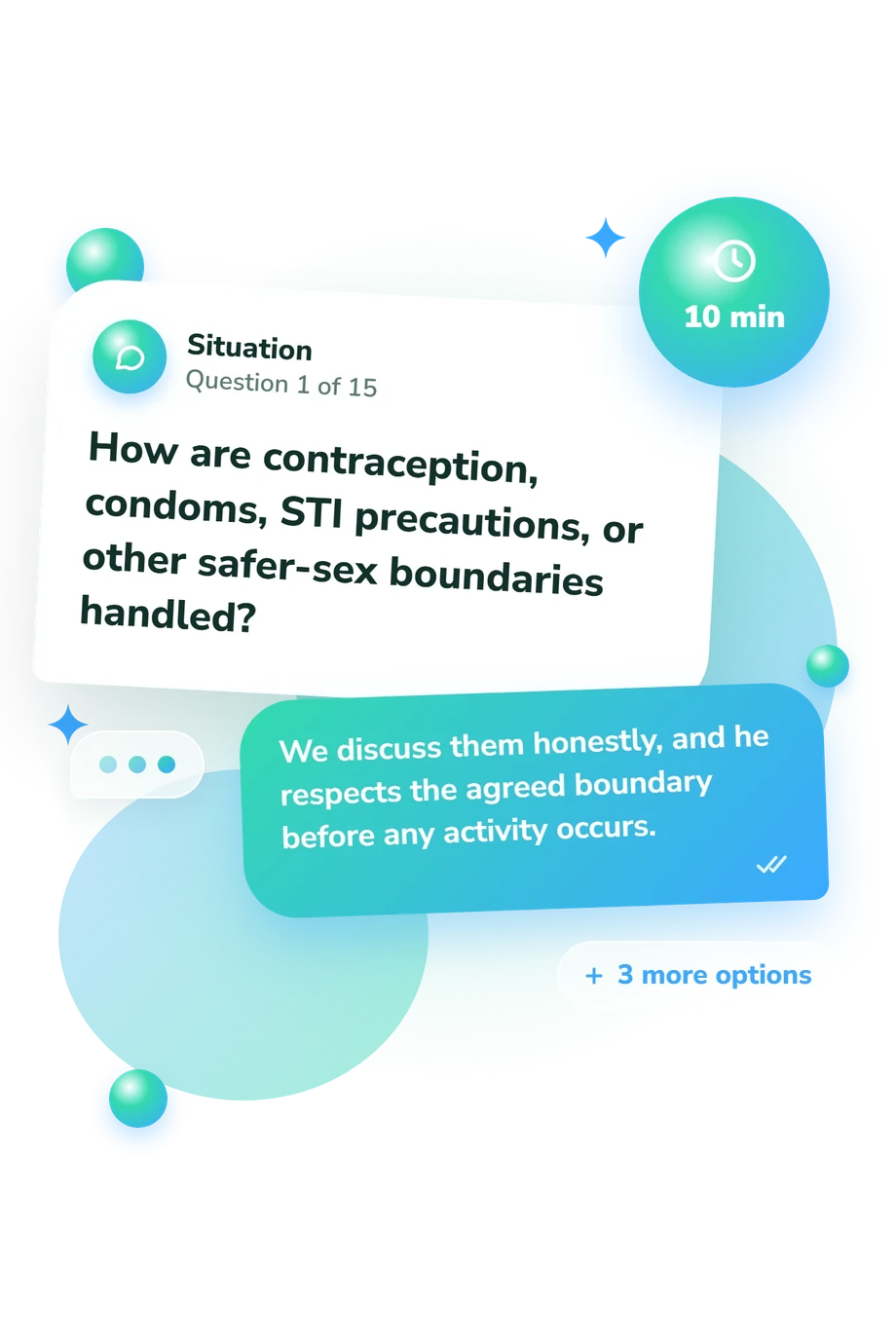
- We discuss them honestly, and he respects the agreed boundary before any activity occurs.
- He has initially argued about a boundary but accepted it before sexual activity continued.
- He repeatedly pressures me to abandon precautions or makes affection conditional on doing so.
- He has sabotaged or secretly removed protection, or knowingly lied about information needed for informed consent.
- He has not used unwanted physical proximity or contact to influence me.
- He has crowded or touched me after I asked for space, but stopped immediately when corrected.
- He repeatedly crowds, pursues, or intimidates me physically after I request distance.
- He has pushed, grabbed, restrained, hit, kicked, choked, injured, or otherwise forced physical contact.
- He keeps the situation controlled or pauses the discussion until it can continue safely.
- He becomes visibly irritated but continues to follow ordinary safety rules.
- He drives or handles the situation aggressively despite my requests to slow down or stop.
- He threatens a crash or injury, deliberately creates immediate danger, or prevents me from leaving after stopping.
Is He a Narcissist or Sociopath Quiz - Description and methodology of the test
When uncertainty about consent, independence, physical safety, or retaliation makes a relationship hard to read, the Is He a Narcissist or Sociopath Quiz helps examine what is happening. This relationship safety quiz records relationship conduct, not personality type. It directs attention to controlling behavior, physical danger, consent, and responses to boundaries so that context and next steps are easier to consider.
What This Assessment Explores
These questions examine conduct affecting autonomy, emotional security, safety, and consent. They suit someone reflecting on a relationship where a partner’s reactions make disagreement, independence, or intimacy feel unsafe. This sociopath vs narcissist quiz examines controlling behavior, physical intimidation, and consent violations in lived situations. Results have three areas:
- Emotional Control and Regard (0-15) reflects controlling, retaliatory, exploitative, or dismissive behavior; bands are No items endorsed (0), Concern to notice (1-2), and Action warranted (3-15).
- Physical Force and Immediate Safety (0-15) reflects intimidation, confinement, threats, dangerous conduct, force, or injury; bands are No items endorsed (0-0), Concern to notice (1-2), and Action warranted (3-15).
- Sexual Boundaries and Consent (0-15) reflects pressure, deception, exploitation, or nonconsensual behavior; bands are No items endorsed (0-0), Concern to notice (1-2), and Action warranted (3-15).
A red-flag experience matters independently of the total.
Methodology and Scientific Basis
Each item describes a concrete situation with four response choices. Options move from respectful, consensual conduct through increasingly concerning behavior, so the respondent selects the description closest to lived experience. The four choices in this narcissist vs sociopath assessment classify relationship conduct as respectful behavior, a limited concern, repeated concern, or an acute violation.
Scores are shown separately for the three domains. Because option weighting is not stated, no point-per-answer rule or severity estimate should be inferred. The displayed bands are unvalidated and should not be treated as diagnostic, clinical, severity, or legal thresholds.
Content is conceptually consistent first with CASR-SF (Ford-Gilboe et al., 2016), an instrument measuring intimate-partner-violence experiences. It also overlaps with CTS2 (Straus et al., 1996); Chapman and Gillespie (2019) review its reliability and validity across community and clinical samples. This questionnaire is not presented as an adaptation of either instrument.
Self-report can be shaped by memory, fear, current circumstances, and self-awareness. Context such as poverty, disability, or unavailable care may affect neglect-like experiences without erasing impact. Immediate danger requires local emergency help.
- Ford-Gilboe, Marilyn, C. Nadine Wathen, Colleen Varcoe, Harriet L. MacMillan, Kelly Scott-Storey, Tara Mantler, Kelsey Hegarty, and Nancy Perrin. “Development of a brief measure of intimate partner violence experiences: the Composite Abuse Scale (Revised)-Short Form (CASR-SF).” BMJ Open 6(12) (2016): e012824. 10.1136/bmjopen-2016-012824
- Straus, Murray A., Sherry L. Hamby, Sue Boney-McCoy, and David B. Sugarman. “The Revised Conflict Tactics Scales (CTS2): Development and Preliminary Psychometric Data.” Journal of Family Issues 17(3) (1996): 283-316. 10.1177/019251396017003001
- Chapman, Harriet, and Steven M. Gillespie. “The Revised Conflict Tactics Scales (CTS2): A Review of the Properties, Reliability, and Validity of the CTS2 as a Measure of Partner Abuse in Community and Clinical Samples.” Aggression and Violent Behavior 44 (2019): 27-35. 10.1016/j.avb.2018.10.006
Updated: