
Fenrir Dog Quiz
How the Scales are Structured
Who Usually Takes This Test?
See How You Compare
Below is a preview of how scores are typically distributed across each scale.
Example Questions From the Test
- I focus more on the shared experience than on the result.
- I make a reasonable effort but keep the competition light.
- I become noticeably more focused when there is something to win.
- I lock onto the finish and push hard until the contest is over.
- Consider whether the goal still fits the life I want now.
- Reduce the scope so I can continue without excessive pressure.
- Revise the plan and establish a realistic way to regain momentum.
- Increase my effort and focus until I have closed the gap.
- Let the judgment pass; their opinion does not need an answer.
- Keep it in mind and wait for a useful chance to correct them.
- Demonstrate through my actions that their judgment was wrong.
- Confront the assumption and make my strength unmistakable.
Fenrir Dog Quiz - Description and methodology of the test
For readers curious about how they respond to freedom, uncertainty, and pursuit, the Fenrir Dog Quiz offers a myth-inspired comparison of three symbolic orientations. Although its playful title gives it a fenrir guard dog quiz feel, the test uses wolf imagery to explore autonomy, inward guidance, and determined progress rather than literal breed behavior. The result helps you notice which orientation feels most familiar.
What This Assessment Explores
The items focus on everyday responses to limits, uncertainty, changing energy, competition, social pressure, and impressions that are difficult to explain with facts alone. They suit readers using the questionnaire for self-reflection: the result describes a mythic affinity that feels familiar, not a fixed personality type.
The displayed outcomes are:
- Fenrir - The Unbound Power (0-15) reflects autonomy, resistance to unfair limits, and forceful self-definition: Measured Independence (0-5), Boundary Breaker (6-10), or Unbound Power (11-15).
- Hati - The Moonlit Navigator (0-15) reflects inward guidance, changing rhythms, subtle observation, and adaptive movement: Grounded Observer (0-5), Twilight Navigator (6-10), or Moonlit Navigator (11-15).
- Sköll - The Relentless Pursuer (0-15) reflects visible goals, forward momentum, competition, and determined pursuit: Open Horizon (0-5), Purposeful Chase (6-10), or Relentless Pursuer (11-15).
Together, these three affinities give this Norse wolf quiz a practical focus on choices and reactions.
Methodology and Evidence Base
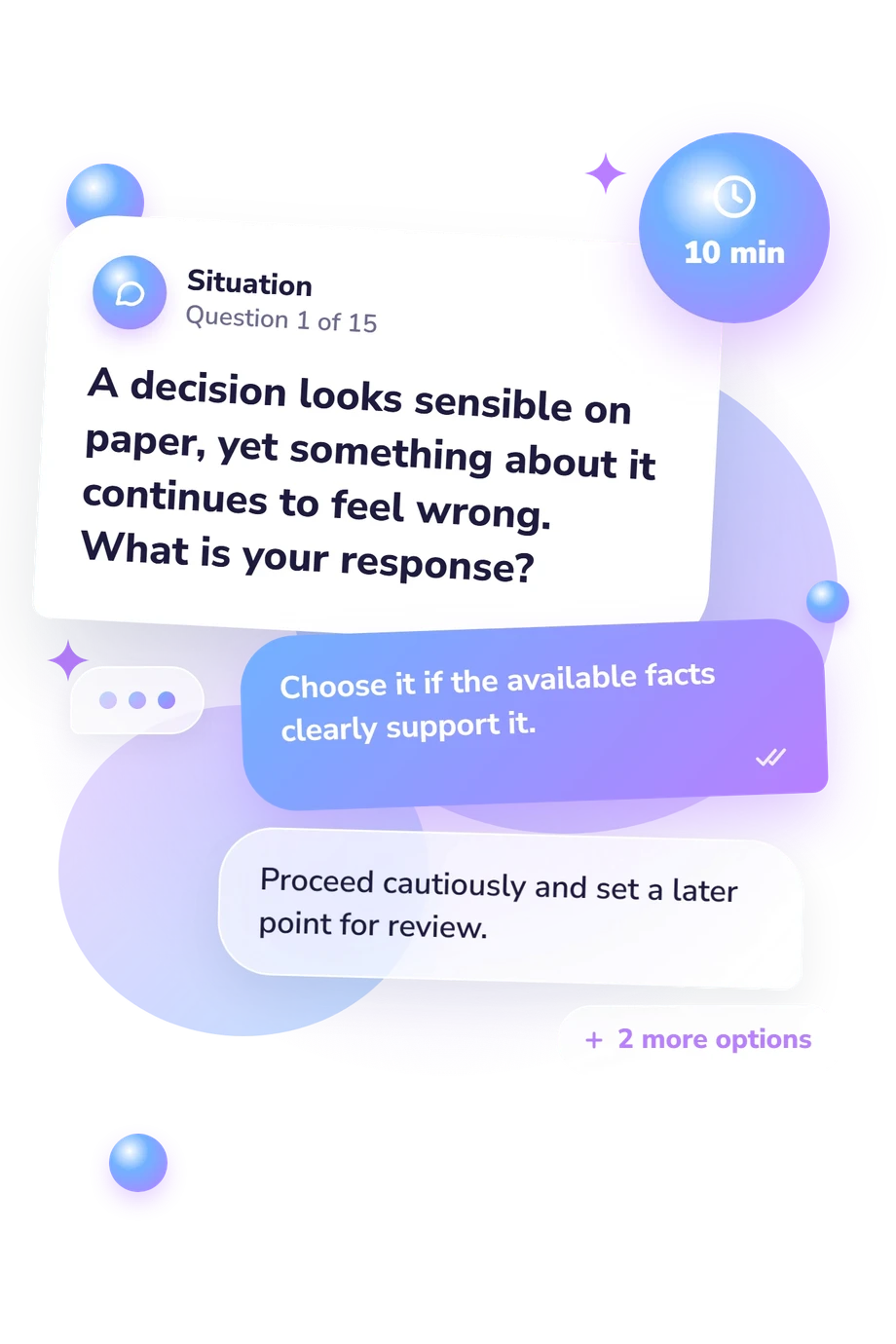
Each item presents a situation with four response options. You select the reaction closest to your usual way of handling freedom, uncertainty, changing conditions, goals, or social friction; the alternatives represent different orientations rather than a single desirable response.
The result reports three separate scores: the highest is your strongest affinity, while scores within one point of the highest can be read together as a blended result. The displayed bands show whether each orientation is expressed at a lower, middle, or higher level.
In its symbolic design, this Fenrir wolf quiz uses figures from the Norse Eddic tradition as metaphors: Fenrir represents resistance to limits, Hati inward guidance and changing rhythms, and Sköll visible goals and pursuit.
Current context, self-perception, and response style can affect the balance among scores, so recent mood and how you interpret each scenario matter when reading the result.
- Sturluson, Snorri. Prose Edda: Tales from Norse Mythology. Translated by Anthony Faulkes. Dent, 1987.
- Simek, Rudolf. A Dictionary of Northern Mythology. Translated by Angela Hall. D.S. Brewer, 1993.
- Lindow, John. Norse Mythology: A Guide to the Gods, Heroes, Rituals, and Beliefs. Oxford University Press, 2002. 10.1093/oso/9780195153828.001.0001
Updated: