
MBTI Quiz
How the Scales are Structured
Who Usually Takes This Test?
See How You Compare
Below is a preview of how scores are typically distributed across each scale.
Example Questions From the Test
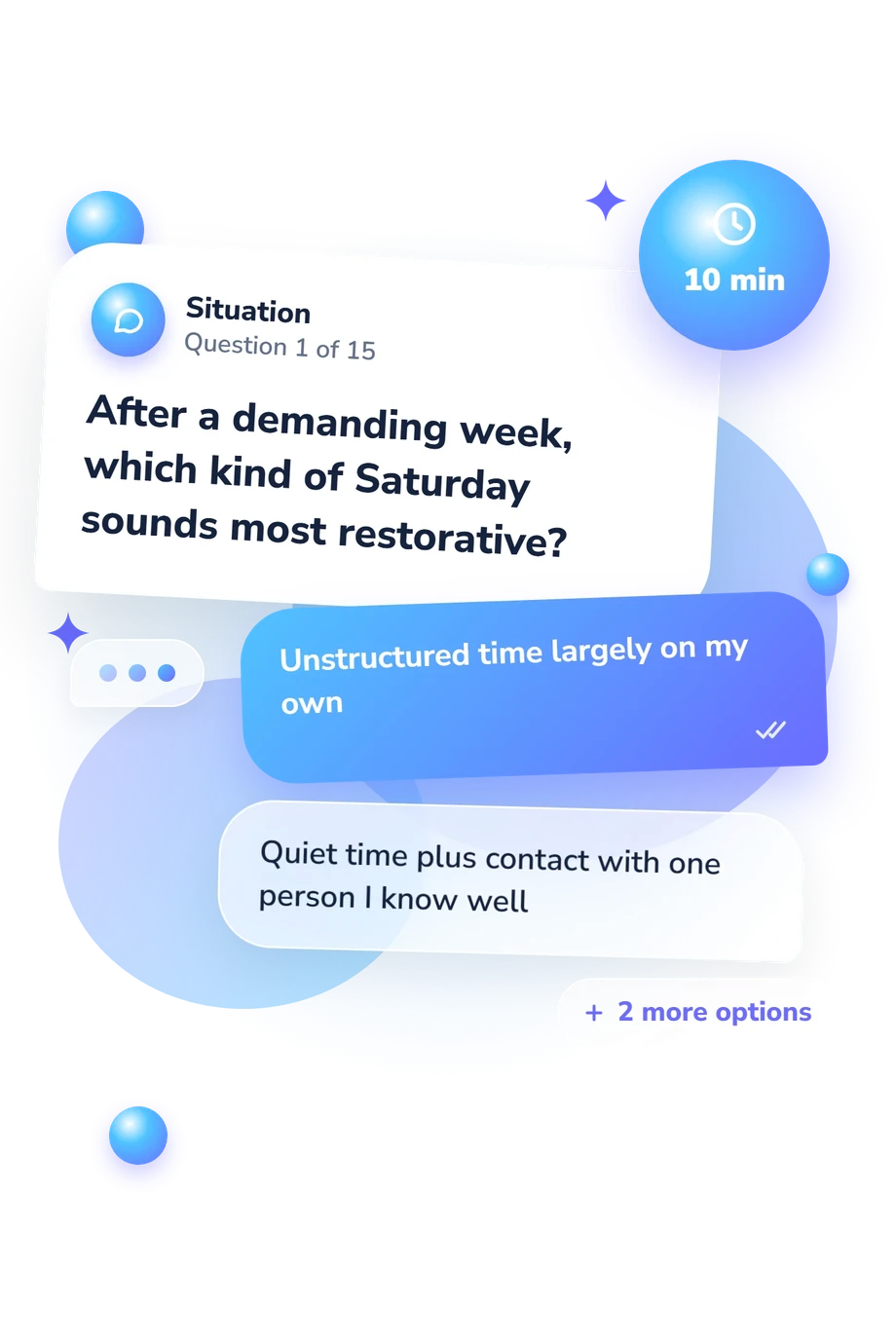
- Unstructured time largely on my own
- Quiet time plus contact with one person I know well
- A relaxed activity with a small group
- A lively event where I can interact with many people
- A timed itinerary with the main stops decided in advance
- One or two priorities, with most of the day left open
- A general area to explore, choosing activities as I go
- A short list of planned stops plus a flexible time block
- I compare them and feel relieved once one is firmly selected
- I choose a direction while leaving limited room to switch
- I delay commitment until I have seen how the options develop
- I narrow the field but keep a couple of possibilities active
MBTI Quiz - Description and methodology of the test
For readers who want to understand everyday preferences without forcing them into a complete type, the MBTI-Inspired Introvert-Extrovert Quiz (Ne Quiz) offers a structured way to examine familiar choices. Its practical value lies in comparing your responses with real decisions, conversations, and changing demands rather than treating one result as a permanent identity. An MBTI personality profile can give those observations a clearer framework for discussion.
What This Assessment Explores
It examines three preferences: how interaction affects energy, how readily you explore alternatives and associations, and whether you prefer settled structure and early closure or open options and revised plans. Stories, tools, conversations, and social situations turn these themes into choices. It suits people examining patterns rather than seeking a complete type.
The displayed dimensions are:
- Flexibility with Plans (0-15) describes settled structure and early closure versus open options and adaptation: Closure-led (0-5), Selectively flexible (6-10), or Open-ended (11-15).
- Possibility Exploration (Ne) (0-15) summarizes branching associations and emerging possibilities versus concrete evidence: Concrete focus (0-5), Selective explorer (6-10), or Possibility generator (11-15).
- Social Energy Orientation (0-15) describes quieter recovery versus outward exchange: Introverted recharge (0-5), Mixed energy (6-10), or Extraverted recharge (11-15).
As an Ne-associated preference summary, this dimension does not measure Ni or establish a full MBTI type.
Methodology and Scientific Basis
Each item presents one situation with four response options, covering social recovery, emerging associations, planning, unfamiliar tools, and unexpected changes. The completed questionnaire reports three dimension scores and their bands; these bands summarize direction within this questionnaire rather than symptoms or abilities.
The conceptual reference point is the Myers-Briggs Type Indicator and its MBTI Manual, alongside Jung’s typological model and type explanations associated with Myers and Myers. This MBTI-inspired online questionnaire is conceptually consistent with those works and uses its own descriptive bands. Its possibility dimension samples a preference associated with Ne without establishing a function stack or full four-letter type.
Interpret the profile as a pattern that may vary with setting, role, mood, and recent experience. McCrae and Costa’s analysis cautions against treating MBTI categories as interchangeable with Five-Factor Model traits. Self-report also depends on recall and self-awareness, while the displayed bands do not provide published population norms or clinical cutoffs. Compare the result with ordinary decisions and examples rather than treating it as a fixed identity.
- Myers, Isabel Briggs, Mary H. McCaulley, Naomi L. Quenk, and Allen L. Hammer. MBTI Manual: A Guide to the Development and Use of the Myers-Briggs Type Indicator. 3rd ed. Palo Alto, CA: Consulting Psychologists Press, 1998. ISBN 978-0-89106-130-4.
- Myers, Isabel Briggs, with Peter B. Myers. Gifts Differing: Understanding Personality Type. Mountain View, CA: Davies-Black Publishing, 1995. ISBN 0-89106-074-X.
- Jung, C. G. Psychological Types. In The Collected Works of C. G. Jung, Vol. 6. 2nd ed. Princeton, NJ: Princeton University Press, 1971.
- McCrae, Robert R., and Paul T. Costa Jr. Reinterpreting the Myers-Briggs Type Indicator From the Perspective of the Five-Factor Model of Personality. Journal of Personality, 57(1), 17-40, 1989. 10.1111/j.1467-6494.1989.tb00759.x.
Updated: