
Pointless Quiz
How the Scales are Structured
Who Usually Takes This Test?
See How You Compare
Below is a preview of how scores are typically distributed across each scale.
Example Questions From the Test
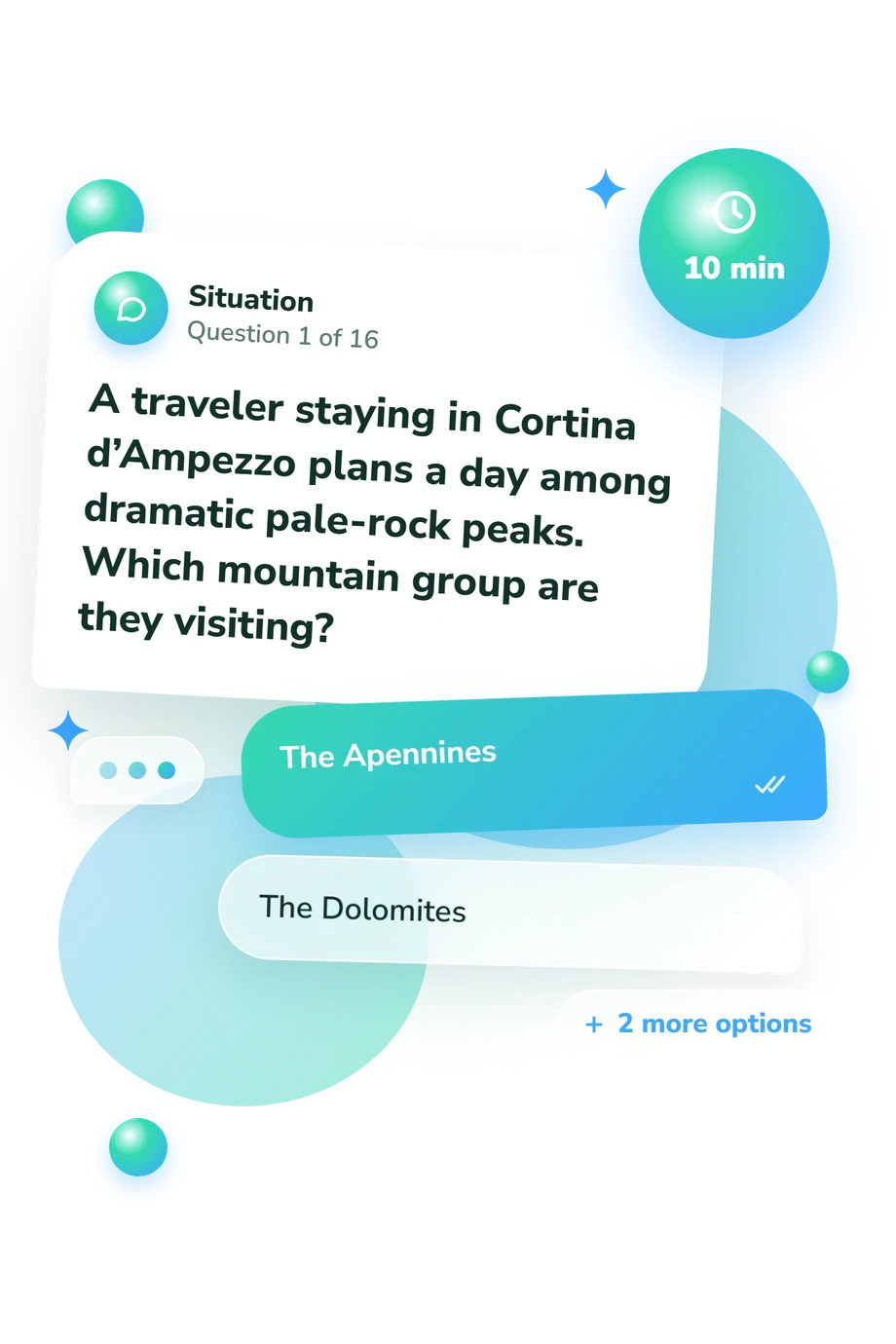
- The Apennines
- The Dolomites
- The Pyrenees
- The Carpathians
- San Marino
- Monaco
- Vatican City
- Andorra
- A horse race
- A rowing competition
- A historical fencing tournament
- A masked theatrical contest
Pointless Quiz - Description and methodology of the test
Curious travelers, language learners, and general-interest readers can use this assessment: its pointless quiz questions provide a light way to check factual knowledge of Italy. The four-option challenge suits anyone who enjoys Italian quiz questions without needing specialist preparation. Its result gives an overall indication of performance across the sampled material, rather than a topic-by-topic profile or a complete measure of expertise.
What This Quiz Measures
Travel and cultural situations test recognition of places, borders, landmarks, regional food, Italian words, literature, art, and ancient history. It suits general-interest readers whose knowledge comes from study, travel, media, or curiosity.
These Italian trivia questions test factual knowledge by asking readers to recognize the best answer, rather than measuring a personal trait.
The main themes are:
- Geography checks recognition of regions, cities, islands, borders, and physical landmarks.
- Culture identifies traditions, districts, theatres, and notable destinations.
- Food and language show familiarity with regional dishes and practical Italian vocabulary.
- Art and history cover major works, artists, archaeological sites, and historical settings.
Together they feed the Italian Knowledge scale (0-16), with Curious Guesser (0-6), Informed Explorer (7-12), and Knowledge Standout (13-16). The result describes performance across these topics, not complete Italian expertise.
Methodology and Evidence Base
Each item uses a brief travel scenario or direct factual prompt with four answer choices. Selecting the best option tests factual knowledge and recognition of the correct answer; without a confidence rating, the format cannot show whether a correct response reflects firm knowledge or a lucky guess.
The scoring is number-right: one point is given for each correct answer, and the total is placed in the quiz's displayed descriptive band. Reviewing your pointless quiz answers can show which facts merit a second look without treating the total as a precise estimate.
This is an online Italian knowledge quiz with its own right-answer scoring, not an adaptation or validation of a published instrument. It is designed for self-reflection about general knowledge, not as a standardized psychological measure.
The quiz has no stated population norms, reliability estimate, or diagnostic cutoff. Current exposure, memory, and chance can affect the total, so read it as a snapshot of sampled topics rather than a comprehensive measure of expertise.
- Kosic, Ankica; Kruglanski, Arie W.; Pierro, Antonio; Mannetti, Lucia. (2004). The Social Cognition of Immigrants' Acculturation: Effects of the Need for Closure and the Reference Group at Entry. Journal of Personality and Social Psychology, 86(6), 796-813. 10.1037/0022-3514.86.6.796
- Kosic, Ankica. (1998). Immigrants' Adaptation in Relation to Their Need for Cognitive Closure and Coping Strategies. Unpublished doctoral dissertation, University of Rome "La Sapienza".
- Aski, Janice M. (1998). Theory into Practice: Italian Quizzes and Exams as a Reflection of the Curriculum. Italica, 75(4), 477-494. 10.2307/479608
- Abu-Ghazalah, Rashid M.; Dubins, David N.; Poon, Gregory M. K. (2023). Dissecting Knowledge, Guessing, and Blunder in Multiple Choice Assessments. Applied Measurement in Education, 36(1), 80-98. 10.1080/08957347.2023.2172017
Updated: