
Nonfiction Writing Quiz
How the Scales are Structured
Who Usually Takes This Test?
See How You Compare
Below is a preview of how scores are typically distributed across each scale.
Example Questions From the Test
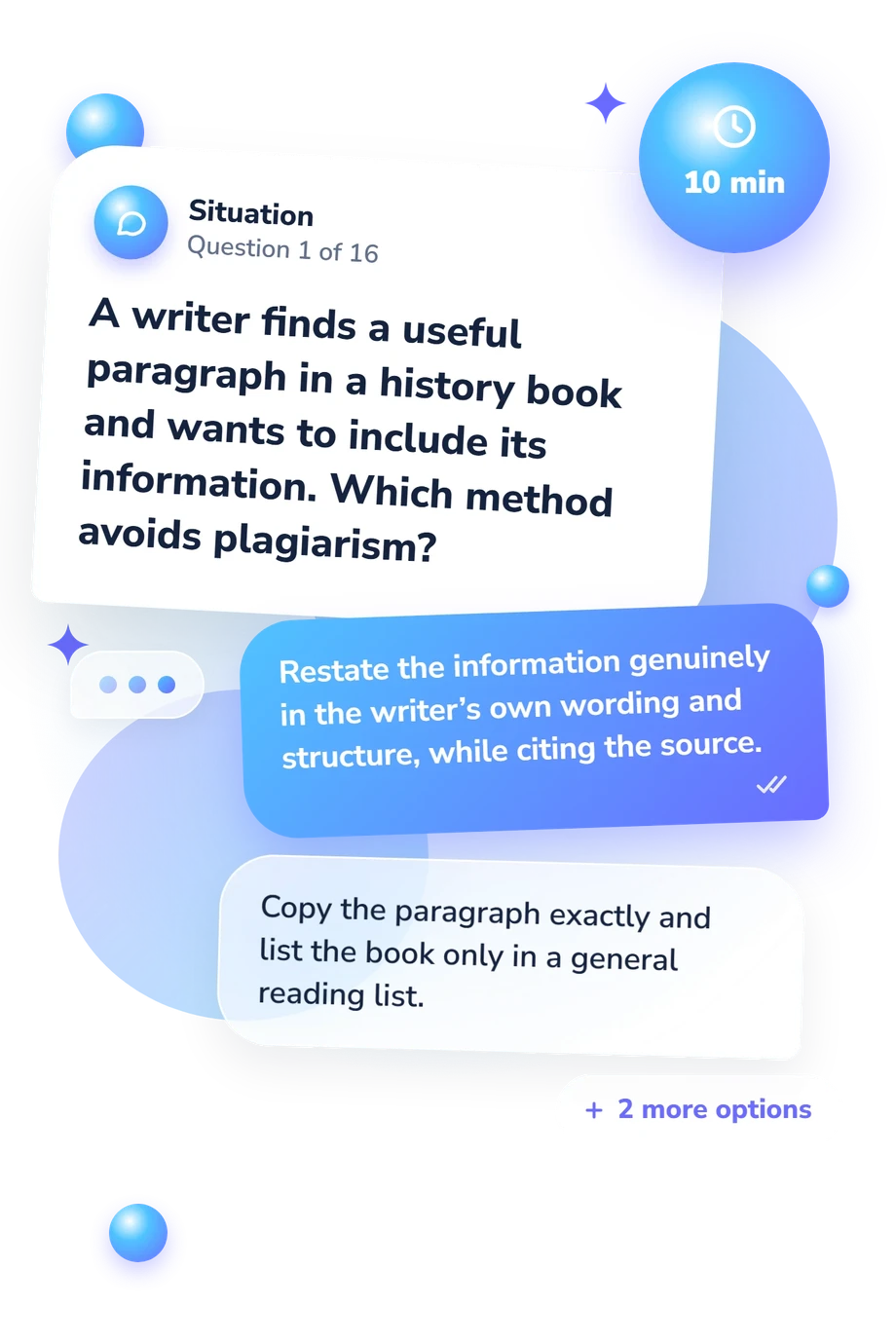
- Restate the information genuinely in the writer’s own wording and structure, while citing the source.
- Copy the paragraph exactly and list the book only in a general reading list.
- Change several nouns and verbs while keeping the original sentence structure, with no citation.
- Use the paragraph without citation because historical information belongs to everyone.
- Open with the particular decision, moment, or image that drives the essay.
- Add more broad statements about the history of decision-making.
- Replace “difficult” with a more sophisticated adjective.
- Insert a dictionary definition of the word “decision.”
- Publish promptly so the allegation reaches readers before anyone else reports it.
- Remove the source’s name but leave every allegation unchanged.
- Add vivid descriptive language to make the source’s account more persuasive.
- Seek corroborating evidence and give the organization a fair opportunity to respond.
Nonfiction Writing Quiz - Description and methodology of the test
Writers, students, and readers can use this assessment to examine how confidently they handle the responsibilities and craft decisions of factual storytelling. This assessment uses a nonfiction writing 2 quiz format: practical judgment questions, not a polished sample. It focuses on decisions that arise before, during, and after a draft. Its result offers a nonfiction writing assessment of strengths worth preserving and choices that may need attention.
What This Assessment Explores
Factual writing requires fluent sentences plus sound evidence, fair source use, and a clear purpose. The assessment suits people developing essays, memoir, profiles, reported features, or other factual narratives.
Together, these themes contribute to one result measuring factual responsibility and effective nonfiction craft across research, drafting, and revision:
- Nonfiction Writing Knowledge (0-16) places the single result in Foundation (0-6), Developing (7-12), or Strong Command (13-16), and reports no separate subscores.
- Research ethics and attribution show how the writer protects accuracy, credits sources, corroborates claims, and separates quotation from paraphrase.
- Structure and focus show how the writer selects an angle, builds a lead, orders events, and creates a meaningful ending.
- Literary nonfiction craft shows whether scenes, reflection, memory, and detail deepen factual accounts without invented certainty.
Judgment comes through the nonfiction writing questions, where accuracy and readable storytelling must work together.
Methodology and Evidence Base
The questionnaire combines short scenarios with direct questions about nonfiction craft and offers four answer choices; respondents select the strongest answer. This tests applied knowledge rather than terminology alone, distinguishing responsible practice from tempting but weaker alternatives.
The Nonfiction Writing Quiz uses one knowledge result for skills in nonfiction writing II quiz content, not separate trait scores. The approach is consistent with the Student Knowledge of Writing Test (Troia et al., 2023), a model for measuring writing knowledge through selected-response tasks. This questionnaire is conceptually consistent with that work, not an adaptation of it.
Content also aligns with Miller and Paola’s craft discussions, Craig’s ethical narrative principles, and the Society of Professional Journalists’ emphasis on accuracy, attribution, corroboration, and fairness. The online questionnaire has no reported standardization, reliability, validity, or population norms; its bands are descriptive guides for this self-check, not normative thresholds.
As a structured self-check, a higher band suggests broader command across the situations represented; a lower band identifies topics for review rather than a fixed ability level. Performance can shift with experience, current knowledge, and the scenario at hand.
- Troia, Gary A., Frank R. Lawrence, Julie S. Brehmer, Kaitlin Glause, and Heather L. Reichmuth. "Efficient measurement of writing knowledge with forced-choice tasks: Preliminary data using the student knowledge of writing tests." Journal of Writing Research, 15(2), 395-427 (2023). 10.17239/jowr-2023.15.02.06
- Miller, Brenda, and Suzanne Paola. Tell It Slant: Creating, Refining, and Publishing Creative Nonfiction. 3rd ed. McGraw Hill, 2019.
- Craig, David. The Ethics of the Story: Using Narrative Techniques Responsibly in Journalism. Lanham, MD: Rowman & Littlefield, 2006.
- Society of Professional Journalists. SPJ Code of Ethics. Revised September 6, 2014. Society of Professional Journalists.
Updated: