
Hidradenitis Suppurativa Quiz
How the Scales are Structured
Who Usually Takes This Test?
See How You Compare
Below is a preview of how scores are typically distributed across each scale.
Example Questions From the Test
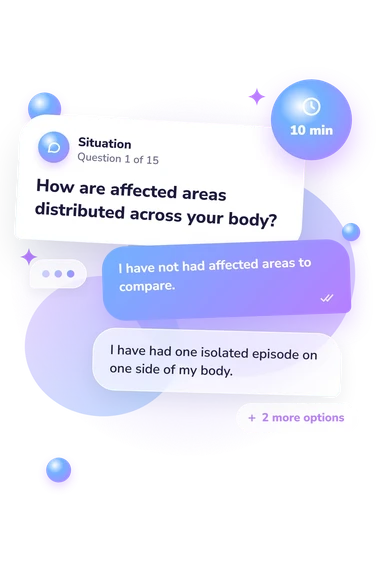
- I have not had affected areas to compare.
- I have had one isolated episode on one side of my body.
- One side or one fold has been affected repeatedly.
- Both sides of a paired area, such as both armpits or both sides of the groin, or several related folds have been affected.
- I have not experienced this type of inflammation.
- The area settles completely within a few days and has not returned.
- Tenderness or swelling often lasts a week or returns after appearing to heal.
- The area remains painful, repeatedly reopens, or never seems to heal fully between episodes.
- I have not experienced drainage.
- One spot released a small amount of clear fluid or blood and then closed.
- A spot has repeatedly released pus, blood, or noticeable-smelling fluid.
- Drainage is ongoing, unexpectedly soaks clothing or dressings, or comes from several openings.
Hidradenitis Suppurativa Quiz - Description and methodology of the test
People noticing recurring painful lumps, inflammation, or changes in skin folds may use this hidradenitis suppurativa quiz to organize observations before speaking with a healthcare professional. It is intended for anyone who wants a clearer picture of patterns that can be difficult to describe from memory. The hs quiz turns personal experiences into focused signals for reflection and preparation.
What This Assessment Explores
The questions focus on recurring or deep lumps, inflammation, drainage, openings, scarring, affected skin-fold sites, and the way symptoms interrupt ordinary activities. For someone using a hidradenitis suppurativa questionnaire, these themes organize observations into patterns worth documenting and discussing.
The displayed dimensions organize those observations as follows:
- Drainage, Scarring, and Care Signals (0-15) reflects drainage, persistent openings, tunnels, substantial scarring, disrupted activity, or acute illness signs. The bands are No signal selected (0), Worth noting (1-2), and Action signal (3-15).
- Inflammatory Skin Changes (0-15) reflects endorsed changes such as painful, warm, red, or worsening areas. The bands are No signal selected (0), Worth noting (1-2), and Action signal (3-15).
- Location and Recurrence Pattern (0-15) reflects repeated symptoms, multiple skin-fold sites, or overlapping episodes. The bands are No pattern selected (0), Worth noting (1-2), and Action signal (3-15).
Methodology and Scientific Basis
Each item offers four response choices in a structured self-report format, moving from no relevant experience through increasing persistence, extent, or functional impact. The topics can be read in groups: symptom change, recurrence and location, drainage and openings, lasting marks, daily impact, and acute worsening.
Responses are converted into three displayed totals. The questionnaire does not state a response-by-response point key, so the arithmetic should not be reverse-engineered from the ranges. Those result bands are unvalidated reflective summaries, not diagnostic or severity cutoffs.
Its content is conceptually consistent with Visual-aided HS self-assessment questionnaire (Cazzaniga et al., 2018), the diagnostic and severity framework of Zouboulis et al. (2015), and related self-assessment validation work by Senthilnathan et al. (2019). It is not presented as a standardized adaptation of those published tools.
As a hidradenitis suppurativa self-assessment, it can help structure a symptom history and identify questions to raise in care. Current context, memory, and willingness to disclose details can affect self-report. Any concerning response deserves attention independently of the total, especially fever, faintness, confusion, rapidly spreading redness, or severe worsening pain, which require urgent help.
- Cazzaniga S, Naldi L, Damiani G, Atzori L, Patta F, Guidarelli G, Bettoli V. Validation of a visual-aided questionnaire for the self-assessment of hidradenitits suppurativa. Journal of the European Academy of Dermatology and Venereology. 2018;32(11):1993-1998. 10.1111/jdv.15050
- Zouboulis CC, Del Marmol V, Mrowietz U, Prens EP, Tzellos T, Jemec GBE. Hidradenitis Suppurativa/Acne Inversa: Criteria for Diagnosis, Severity Assessment, Classification and Disease Evaluation. Dermatology. 2015;231(2):184-190. 10.1159/000431175
- Senthilnathan A, Kolli SS, Cardwell LA, Richardson I, Feldman SR, Pichardo RO. Validation of a Hidradenitis Suppurativa Self-Assessment Tool. Journal of Cutaneous Medicine and Surgery. 2019;23(4):388-390. 10.1177/1203475419839965
Updated: