
How Positive Are You Quiz
How the Scales are Structured
Who Usually Takes This Test?
See How You Compare
Below is a preview of how scores are typically distributed across each scale.
Example Questions From the Test
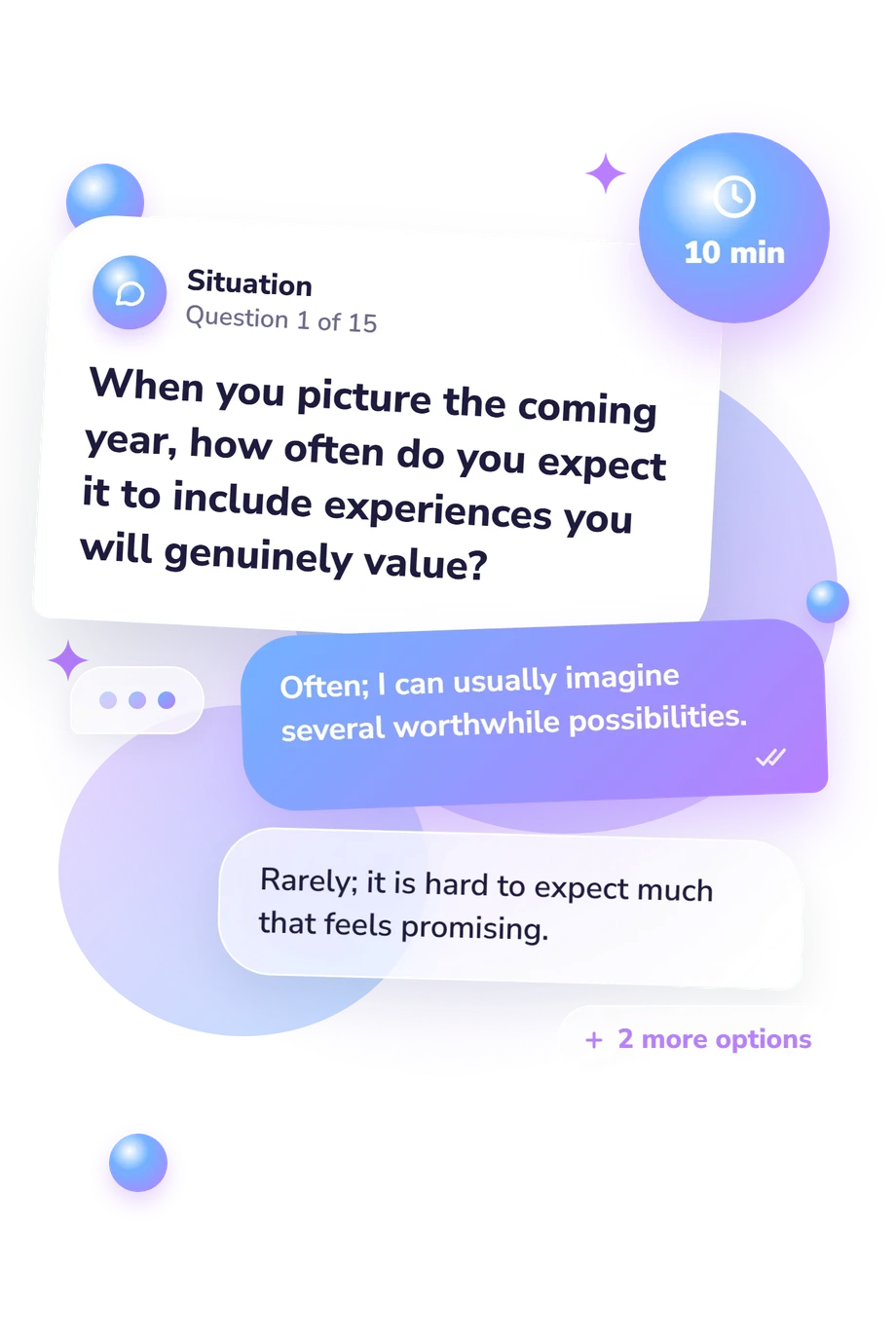
- Often; I can usually imagine several worthwhile possibilities.
- Rarely; it is hard to expect much that feels promising.
- Almost always; future possibilities are easy for me to anticipate.
- Sometimes, especially when I already have encouraging plans.
- I will wait and see; I do not expect either a good or bad outcome yet.
- The delay may create a different route or even improve the final outcome.
- This is usually how promising plans begin to fall apart.
- The goal may still work out if the next few steps go reasonably well.
- I appreciate it briefly before my attention returns to what could be improved.
- I let myself enjoy it and connect it with the effort I made.
- I acknowledge it, though praise does not affect my mood much.
- I mostly discount it because the person may just be trying to be kind.
How Positive Are You Quiz - Description and methodology of the test
People who want to understand how they respond to disappointment, possibility, and everyday enjoyment can use the How Positive Are You Quiz as a focused self-reflection exercise. It suits anyone curious about habitual outlook rather than seeking a fixed label. Familiar situations let the quiz assess how outlook appears in attention, hope, and recovery, making it a positive attitude quiz rather than a label based on abstract claims.
What This Assessment Explores
Questions about future expectation, recovery, and attention define the quiz as a positive outlook quiz by examining three connected tendencies: recovering after disruption, anticipating worthwhile possibilities, and noticing pleasant or meaningful details. The result describes patterns, not character; responses can vary with stress, circumstances, and attention habits.
The three displayed dimensions are:
- Constructive Recovery (0-15) measures regaining perspective and returning to useful action. Bands: Slow reset (0-5), Gradual reset (6-10), Flexible reset (11-15).
- Hopeful Outlook (0-15) measures anticipating worthwhile outcomes when the future is uncertain. Bands: Guarded outlook (0-5), Situational hope (6-10), Expansive hope (11-15).
- Positive Attention (0-15) measures noticing, absorbing, and remembering pleasant or meaningful moments. Bands: Positives pass quickly (0-5), Selective appreciation (6-10), Active appreciation (11-15).
Methodology and Scientific Basis
The situations cover delayed plans, criticism, mistakes, rejection, change, compliments, ordinary pleasures, and tense interactions. Four response options describe different ways of interpreting or handling each situation, allowing the result to reflect patterns across recovery, future expectation, and attention.
The questionnaire is conceptually consistent with the Positivity Scale, which describes positivity as a broad orientation toward life. As a positivity assessment, its recovery items also echo the Brief Resilience Scale, while attention to ordinary enjoyment is consistent with the Savoring Beliefs Inventory. These are conceptual reference points, not proof that this questionnaire is an adaptation or validated equivalent.
Each scale has a displayed score within its stated range, but the points assigned to individual options are not specified, so no extra scoring rule should be inferred. The displayed bands are descriptive prompts rather than population norms or clinical thresholds; they indicate how each score range is described rather than classifying clinical status. Current mood, memory, self-awareness, and candidness can shape self-report, making the result a context-dependent snapshot.
- Caprara, G. V., Alessandri, G., Eisenberg, N., Kupfer, A., Steca, P., Caprara, M. G., Yamaguchi, S., Fukuzawa, A., & Abela, J. (2012). The positivity scale. Psychological Assessment, 24(3), 701-712. 10.1037/a0026681
- Smith, B. W., Dalen, J., Wiggins, K., Tooley, E., Christopher, P., & Bernard, J. (2008). The brief resilience scale: Assessing the ability to bounce back. International Journal of Behavioral Medicine, 15(3), 194-200. 10.1080/10705500802222972
- Bryant, F. B. (2003). Savoring Beliefs Inventory (SBI): A scale for measuring beliefs about savouring. Journal of Mental Health, 12(2), 175-196. 10.1080/0963823031000103489
Updated: