
Guess the Song Picture Quiz
How the Scales are Structured
Who Usually Takes This Test?
See How You Compare
Below is a preview of how scores are typically distributed across each scale.
Example Questions From the Test
- Back to Black
- Black Hole Sun
- Fade to Black
- Paint It, Black
- Cake by the Ocean
- Sugar, Sugar
- Strawberry Fields Forever
- Watermelon Sugar
- Touch Me
- Hold On
- I Want to Hold Your Hand
- Hand in My Pocket
Guess the Song Picture Quiz - Description and methodology of the test
People who enjoy popular music, visual wordplay, or memory challenges may use the Guess the Song Picture Quiz to see how well they connect compact images with exact song titles. It offers a focused snapshot of title recall and clue interpretation, making it useful for a light self-check rather than a judgment of musical ability. This song title picture quiz gauges overall recognition across the set, not particular knowledge gaps.
What This Test Measures
This quiz measures how accurately you turn visual combinations into exact song titles, rather than asking you to sing or identify a melody by sound. It suits people who enjoy popular music and want a snapshot of title recall. The quiz presents a song picture guessing game in which success depends on integrating the whole image instead of matching one isolated symbol.
The displayed scale is Song Picture Knowledge (0-16). It places the result in Song Starter (0-6), Rebus Regular (7-12), or Picture-Quiz Headliner (13-16). These bands describe performance on this visual clue task, not musical taste or intelligence.
The clues involve three recurring processes:
- Visual association shows how images suggest words or ideas.
- Rebus integration shows how symbols combine into one title.
- Title precision reflects choosing the exact answer among plausible alternatives.
Methodology and Evidence Base
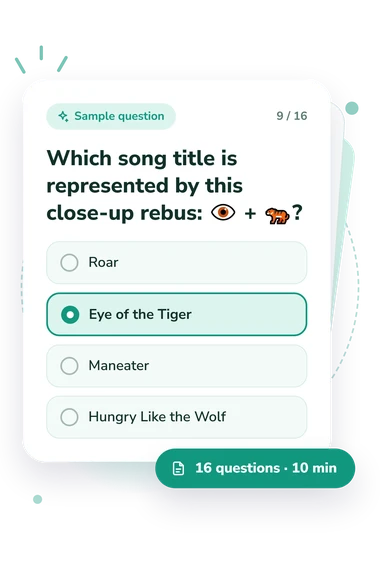
Each item shows a compact visual construction-an object pair, action, setting, or sequence-and offers four song-title choices. Because several alternatives are recognizable titles, success depends on matching the complete clue rather than spotting one word. Correct choices are summed into one total; no separate subscale scores are produced.
The quiz's guess the song game format uses visual title retrieval through multiple-choice rebuses, not auditory melody recognition. Rebus puzzles (MacGregor & Cunningham, 2008) provide the closest conceptual framework: the images require restructuring and integration to reach a title. This questionnaire is not presented as an adaptation or reproduction of that task.
Visual title retrieval is central here: each respondent infers an exact song name from a rebus and selects it among competing options. The task therefore measures visual title retrieval rather than auditory recognition or self-rated confidence.
No standardized reliability estimate or diagnostic cutoff is supplied, so the score is best read as a snapshot of visual title recognition; variation can reflect prior exposure, cultural familiarity, attention, and guessing strategy.
- James N. MacGregor and J. Barton Cunningham. “Rebus puzzles as insight problems.” Behavior Research Methods, 40(1), 263-268, 2008. 10.3758/BRM.40.1.263
- Bogdan N. Kostic and Anne M. Cleary. “Song recognition without identification: When people cannot “name that tune” but can recognize it as familiar.” Journal of Experimental Psychology: General, 138(1), 146-159, 2009. 10.1037/a0014584
- Amy M. Belfi and Kaelyn Kacirek. “The famous melodies stimulus set.” Behavior Research Methods, 53(1), 34-48, 2021. 10.3758/s13428-020-01411-6